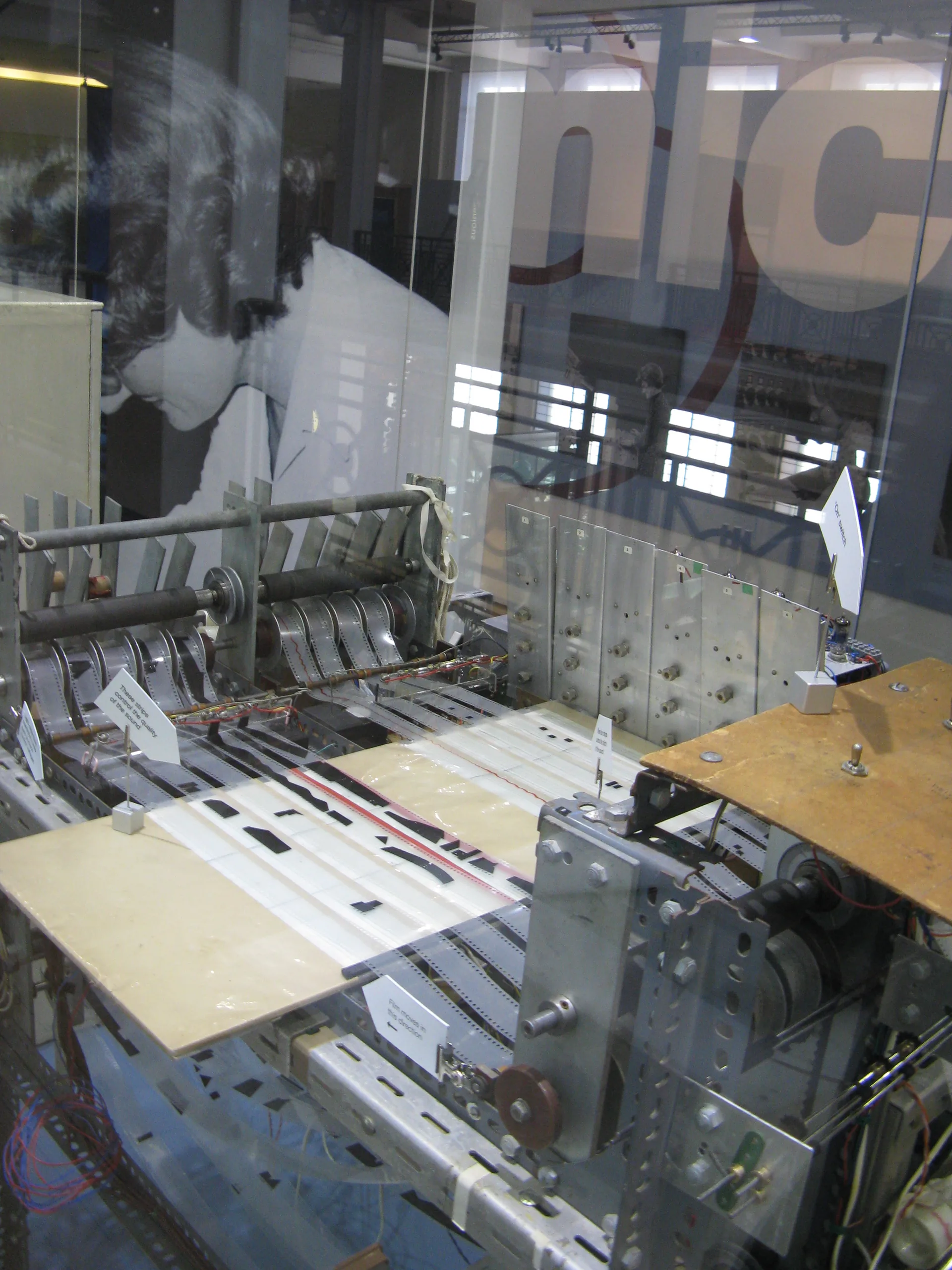
Oramics translated drawn shapes into electronic sound. Daphne Oram developed the experimental instrument with engineers, using film strips to control musical parameters.
Article
An electronic instrument may bring a keyboard or computer screen to mind. British musician Daphne Oram's Oramics had a place for drawing. Lines and shapes on film and glass were read optically to produce sound. The work sought to give a performer hands-on control over waveform, pitch, and volume.
Oram began developing the idea as a BBC studio manager in the mid-1950s. Electronic music then relied heavily on tape techniques. Increasing tape speed raised pitch as well, and looking at a reel did not readily reveal which sound lay in which section. She wanted an instrument whose musical content could be seen, drawn, and adjusted directly.
Research continued after she left the BBC and opened an independent studio in 1959. The Daphne Oram Trust describes Oramics as conceived, co-designed, and commissioned between 1962 and 1969. Her brother John Oram made the film-transport mechanism; electronics engineers Fred Wood and Graham Wrench also contributed. Bringing the musical idea into working form required mechanical and electronic development.
The principle was optical reading of drawn shapes. Hand-drawn waveforms shaped timbre, while separate control information determined changes in pitch and volume. Instead of a performer reading notes on paper, the machine interpreted drawings as sound and control signals. The sound itself and its behavior over time were represented visually, and the markings remained available to be read or revised.
The Science Museum Group's sound generator dates from 1966. Its record credits Oram's design involvement and Graham Wrench's construction. The description refers to waveforms drawn on 35 mm film and ten film strips running simultaneously. Multiple parallel tracks enabled more complex control than a single line followed in sequence. Film transport and optical electronics worked within one machine.
Oramics was never mass-produced. Oram continued changing how the machine read and interpreted drawings during its working life. She developed one evolving prototype rather than selling a standardized range of instruments. The surviving machine is now in the Science Museum's collection. Its hand-drawn marks and film strips were working inputs used to make sound.
Sources and editorial notes
Daphne Oram Trust — The Oramics Machine
Science Museum Group — Sound Generator for Oramics Machine
Photo source
Photo usage conditions: https://creativecommons.org/licenses/by/2.0
Machine-translated from Korean. Read the original.