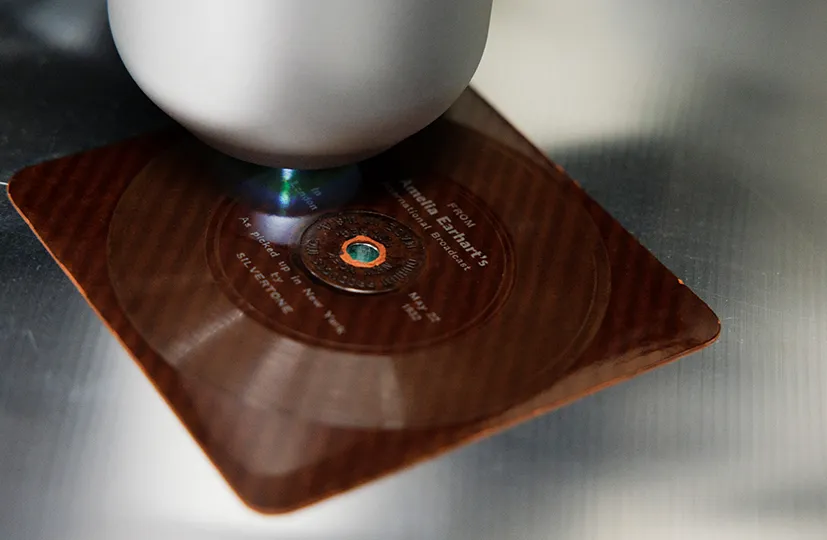
IRENE reads the grooves of fragile recordings with optical equipment and turns those measurements into sound.
Article
An old record can survive without being safe to play. Cracks or fragile materials can make even setting a stylus down risky. IRENE, developed at Berkeley Lab, recovers sound by imaging the surface of a recording. Cameras and optical instruments read the shape that remains.
A record’s tiny grooves vary with the sound they carry. As a stylus follows a groove, its motion is converted into audio. IRENE first records the surface in high resolution, then calculates how the groove changes along its length to reconstruct the signal over time.
Contactless measurement is particularly valuable with damaged materials. It can document surfaces a stylus might damage further and allow researchers to study grooves on surviving fragments digitally. Once the measurements are stored, researchers can continue their analysis without repeatedly playing and wearing down the original.
Early demonstrations from Berkeley Lab compare a song played with a stylus with its optical reconstruction. During restoration, researchers can identify damage such as scratches and reduce the noise it produces. A photograph cannot recover sound from a part of the surface that has disappeared entirely. The type of recording and the amount of surviving material determine what can be read.
Berkeley Lab and the Library of Congress have worked together to preserve early recordings with IRENE. Researchers have explored two- and three-dimensional measurement to handle several kinds of early media. A disc can look familiar and still require a different instrument or method. The first step is to understand how the sound was recorded on its surface.
A listener hears a voice again when they press play. Before that moment, someone located the grooves amid the dust and scratches and assembled many individual images. The original disc is still where it was. This time, the groove was followed by software reading an image.
Sources and editorial notes
Berkeley Lab · Voices From the Past Get an AI Assist
Berkeley Lab · From Quarks to the Blues
Library of Congress · Amelia Earhart: A Voice Brought Back From the Past (including image)
Editorial note: MUADAILY checked the facts against the sources above. The interpretation is MUADAILY’s.