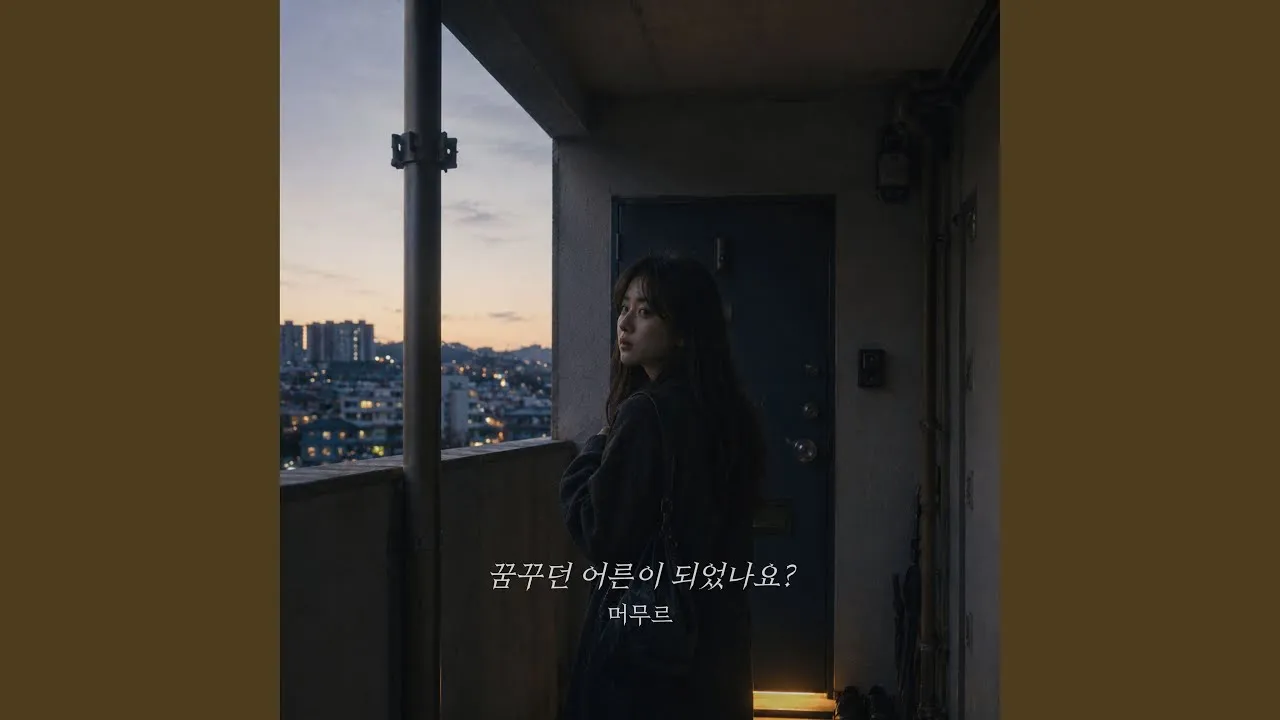
How closely does the person we have become resemble the adult we once imagined? Meomureu’s song explores worries that persist into adulthood, pairing a human-written story with an AI-generated voice.
Article
As children, we may have imagined that growing up would mean fewer worries. Yet a passing remark can still unsettle us, and some days simply getting through feels hard. Meomureu’s “Have you become the adult you dreamed of?” explores the gap between that imagined adult and the person we are today. Its concerns are familiar; what is less familiar is that the voice singing the lyrics was generated by AI.
Grown up, but still unsettled
The album description evokes standing before a mirror, pretending to be fine through the day, and letting out a long sigh. We expected to become more resilient with age, yet days that refuse to go as planned can still shake us. That is the self the song looks back on.
Read alongside those scenes, the title asks more than whether we found the job we wanted or carried out our plans. Things we once expected to manage easily remain difficult. Even as adults, we need time to gather ourselves.
Not everyone will connect with the song for the same reason. Still, pretending to be fine or sighing alone can bring our own days to mind. Sometimes a story resembling our experience reaches us before a vague encouragement to keep going does.
The voice singing that story
“Have you become the adult you dreamed of?” was released on June 23, 2026. According to the album description on Melon, Meomureu handled the concept, lyrics, and overall production direction, while the vocals were created using the generative music service Suno. A person chose the worries the song would address; AI supplied the voice singing those words.
Knowing how it was made invites us to consider the relationship between lyrics and voice. The words contain the story Meomureu wanted to tell, but the voice does not belong to a singer who lived through those days. Listeners can nevertheless recognize their own experiences in the scenes. How a voice was produced and what its words bring to mind are different parts of listening to the same song.
Meomureu explained the use of AI and the artist’s own role in the album description. Listeners need not guess how the recording was made. Whether to keep listening after learning that its vocals are AI-generated, or to seek out a human performance, remains a personal choice.
A song people sought out
Yonhap News reported that the song had peaked at No. 18 on Melon’s TOP100 as of 8 a.m. on October 2, 2026. It had moved beyond a demonstration that AI can generate vocals and become a song on a music chart.
A chart position cannot tell us why listeners connect with a song. But the production tool alone cannot explain this one either. Its question about adulthood and the days depicted in its lyrics are also part of what there is to hear.
The song may bring to mind our lives today rather than a grand future: a day when we said we were fine but were not, or a difficulty we thought time would resolve. Its AI-generated voice conveys scenes a person put into lyrics. Recognizing a day of our own in them can be reason enough to listen again.
Sources and editorial notes
Melon Album Introduction: https://www.melon.com/album/detail.htm?albumId=13744621
Yonhap News, 2026-10-02 Report on chart performance and production methods: https://www.yna.co.kr/amp/view/AKR20261002142400005
Bugs song information: https://music.bugs.co.kr/track/33972776
Machine-translated from Korean. Read the original.