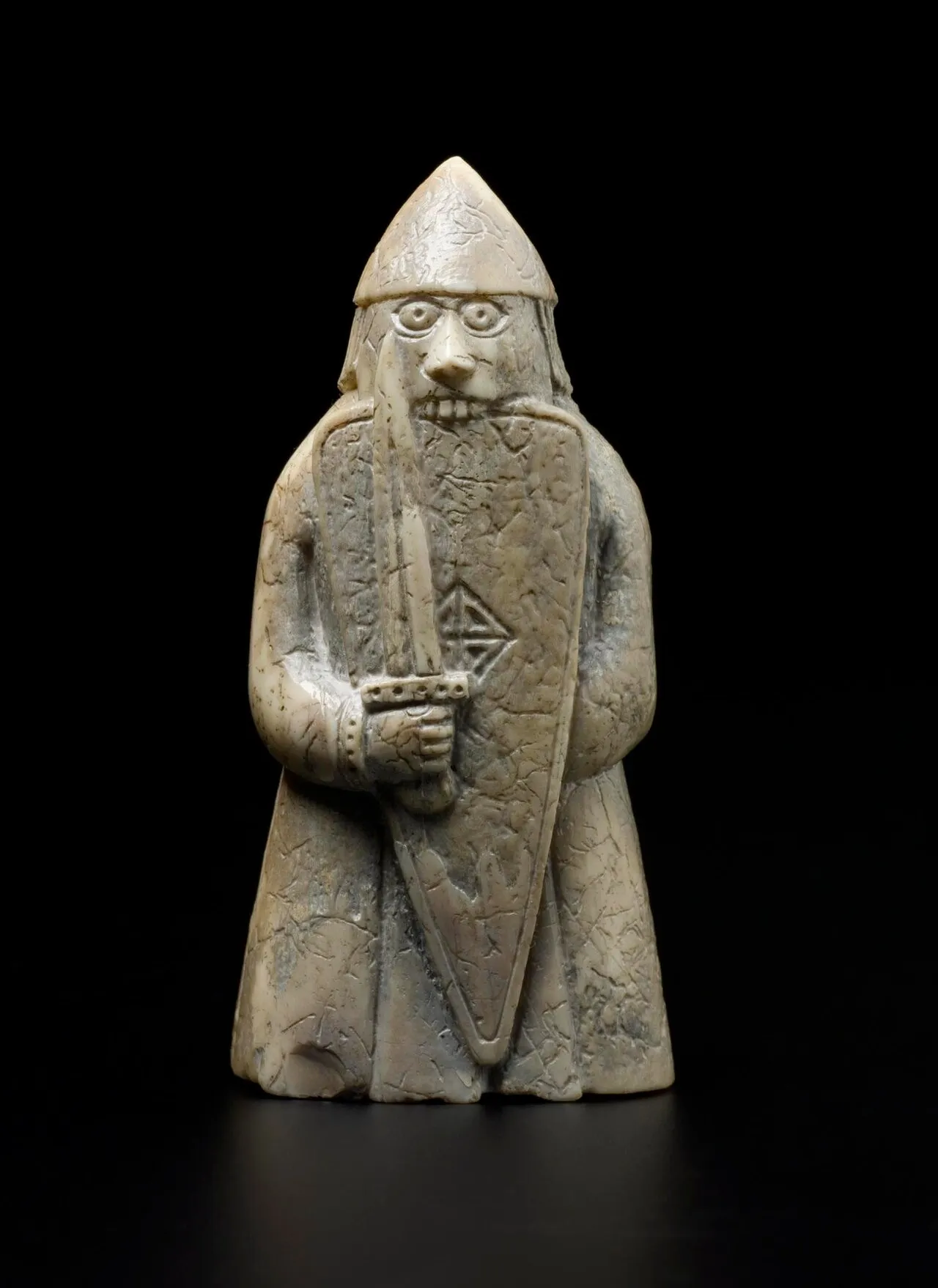
The Lewis chessmen give individual faces to pieces with the same role. Their mouths, eyes and gestures reward a closer look.
Article
A chess piece bites its shield. Its face looks strained even before any attack. Among the warriors serving as rooks in the Lewis chessmen, a fixed role on a board still allows an individual character.
Found on Scotland’s Isle of Lewis in 1831, these medieval pieces depict northern European figures. Mostly carved from walrus ivory, they include kings, queens, bishops and warriors. Trondheim in Norway is a proposed place of manufacture, but their origins and arrival on the island are not completely settled.
The Metropolitan Museum examined four shield-biting warriors associated with the berserker’s furious fighting state. Their faces, headgear and arrangements of hands and shields differ. They do not resemble repeated copies of one component.
A queen holds a hand to her face; bishops carry signs of ecclesiastical authority. Their faces and gestures invite imagined personalities even without knowledge of chess. The warrior’s tense, shield-biting jaw makes a striking contrast with the queen’s hand against her cheek.
At a museum, start with one face rather than the whole imagined board. A carver left expressive mouths and eyes in these little tools of a warlike game. The shield-biting jaw may linger longer than any possible next move.
Sources and editorial notes
The Metropolitan Museum of Art · Lewis chessmen
Image source · National Museums Scotland
Image use terms · CC BY-SA 4.0
Editorial note: Facts were checked against the linked material. Interpretations are MUADAILY’s editorial perspective. Image: National Museums Scotland · CC BY-SA 4.0 · Lewis chessmen at the National Museum of Scotland.
Machine-translated from Korean. Read the original.