Gears with different tooth counts represented solar and lunar motion and eclipse cycles. Fragments recovered from the sea preserve traces of ancient Greek astronomical calculation.
Article
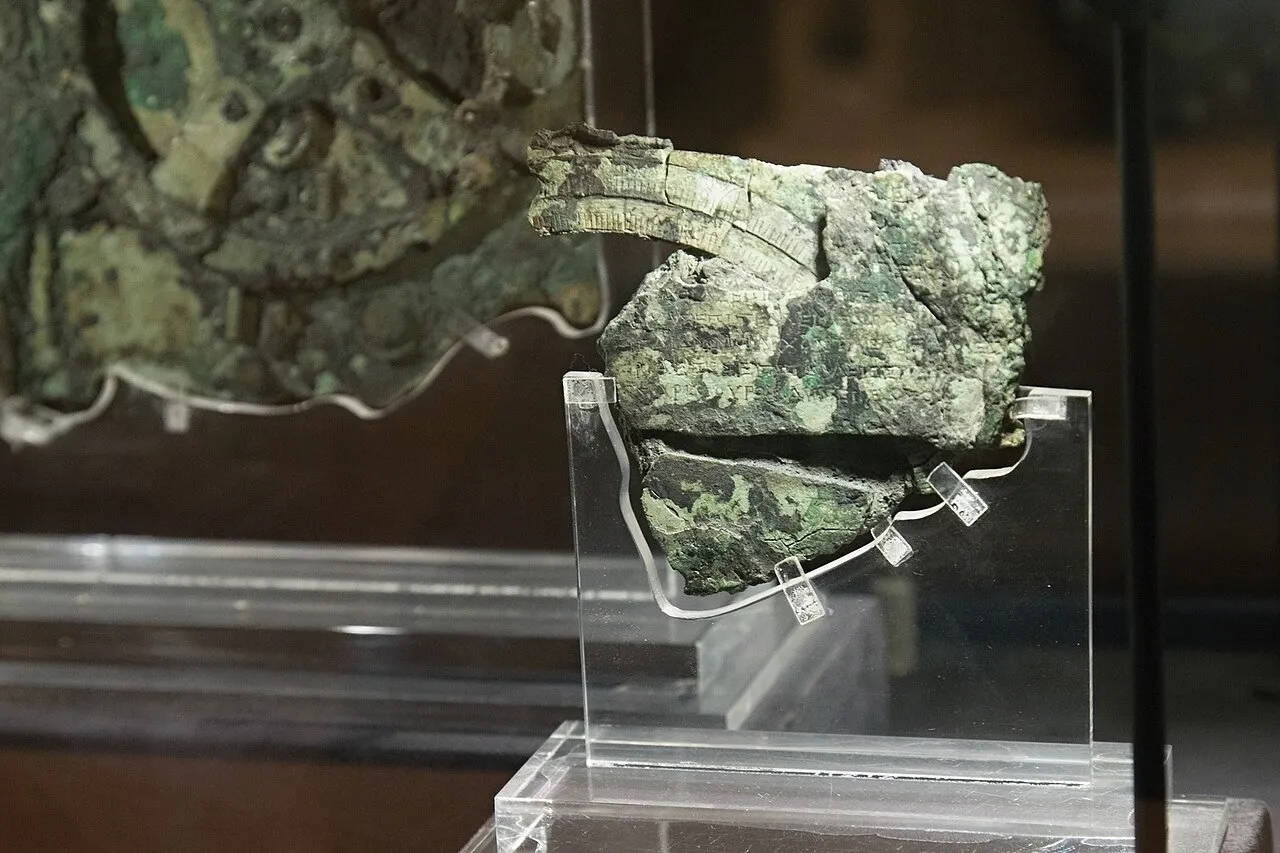
Small gears are visible inside a corroded mass recovered from the sea near the Greek island of Antikythera. The object was an astronomical calculator, with hand-driven gearing designed to represent the cycles of the Sun and Moon.
Recovered from a shipwreck in 1901, the mechanism survives in several fragments. It is generally dated to the later second century BCE. Without electricity, its meshing gears calculated recurring astronomical cycles.
A hand-operated input turned wheels with different tooth counts at fixed ratios. Those relationships supported displays of calendars, solar and lunar motion, and eclipse cycles. Several slow and fast cycles could be represented inside a small box.
Researchers study images and inscriptions on the surviving fragments to investigate the mechanism. Some missing parts remain uncertain, so reconstructions propose arrangements based on the available evidence. The photograph shows original fragments held by the National Archaeological Museum in Athens.
A working reconstruction shows gears and displays moving together when its handle turns. Teeth surviving in the original fragments offer evidence of that motion. The device represented long celestial cycles through the rotation of wheels inside a small box.
Sources and editorial notes
Hellenic Ministry of Culture · Antikythera Mechanism
Image use terms · CC BY-SA 4.0
Editorial note: Facts were checked against the linked material. Interpretations are MUADAILY’s editorial perspective. Image: Zde · CC BY-SA 4.0 · Original Antikythera Mechanism fragments at Athens’ National Archaeological Museum.
Machine-translated from Korean. Read the original.