The Voyager Golden Record carries Bach, Chuck Berry, and greetings in many languages. Its grooves hold sound and images for an unknown listener who may never find it.
Article
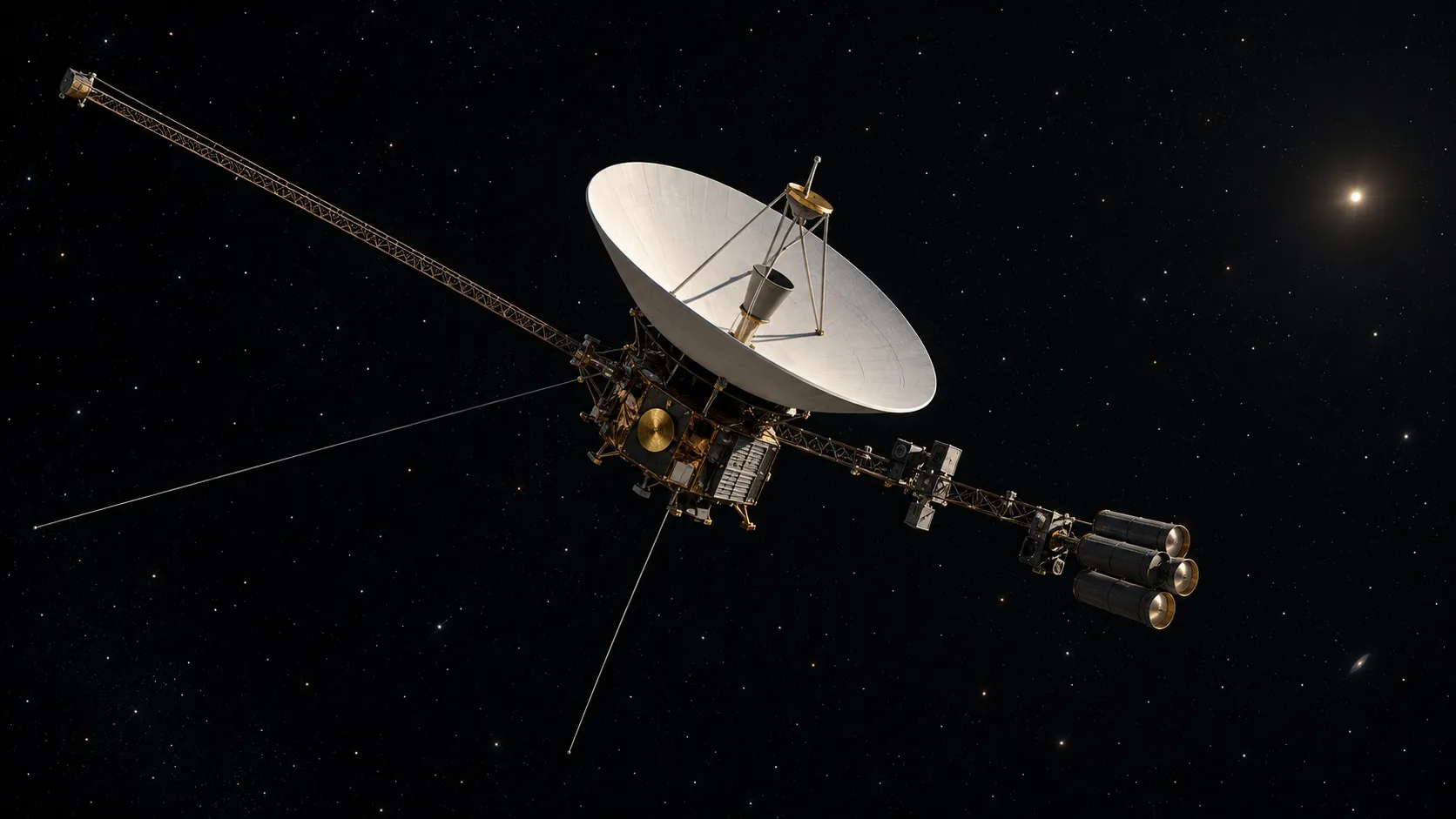
Choosing music for someone usually involves a little thought about their taste. The Golden Record was made without knowing who might listen, or even whether the listener would have ears. Carried by the Voyager spacecraft, it contains Earth's sounds and music, greetings in many languages, and images. Its makers had to choose what to share and explain how to play a record to a being that might never have seen one.
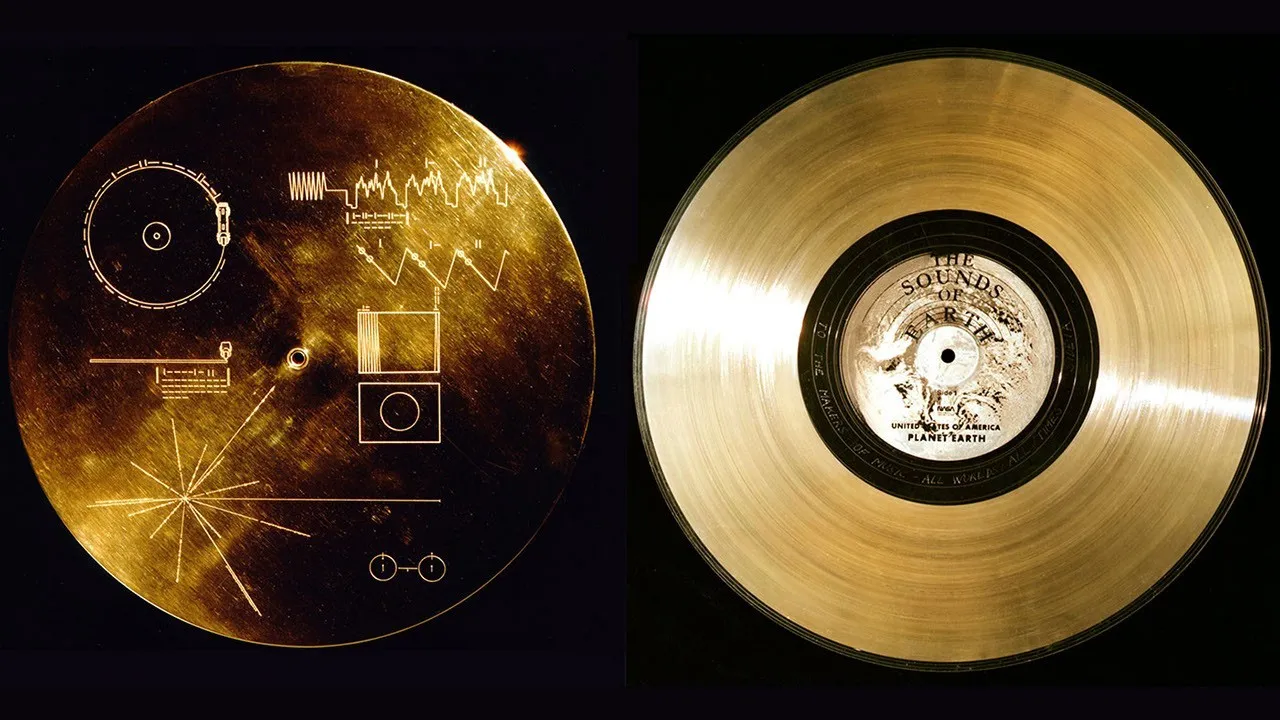
Voyager 1 and 2, launched in 1977, each carried a 12-inch gold-plated copper record. It is an analog medium with information encoded in grooves, not a solid-gold ornament. A stylus and cartridge were included inside the protective aluminum cover, but not a complete audio system. Whoever found it would still need a way to rotate the disc and read the signal.
A committee led by Carl Sagan selected about 90 minutes of music. Chuck Berry's “Johnny B. Goode” sits alongside the first movements of Bach's Brandenburg Concerto No. 2 and Beethoven's Fifth Symphony. “Melancholy Blues,” performed by Louis Armstrong and His Hot Seven, is also included. This is not a compilation of classical favorites alone.
The selection includes Javanese gamelan, Senegalese percussion, Peruvian panpipes, and the Chinese guqin piece “Flowing Streams,” performed by Guan Pinghu. The instruments differ in materials and ways of producing sound. The team placed multiple musical traditions side by side rather than choosing one to represent humanity. No selection within a limited playing time could encompass all Earth's music.
The record also presents waves, wind, thunder, birds, and whales. A separate set of greetings in 55 languages includes Korean. The English greeting identifies its speaker with the children of Earth. Whether an unknown listener could understand human language remains uncertain, but the arrangement presents a planet with many voices.
It includes 115 images showing bodies and cells, families and children, plants and animals, and landscapes. Photographic prints were not tucked inside the record. Images were converted into analog signals readable from its grooves, placing visual information on a medium also used for music.
Recovering sound begins as it does with an ordinary record. As the disc turns, a stylus follows the groove's tiny variations and vibrates. The cartridge converts that motion into an electrical signal; an amplifier and speaker can then turn it into moving air. Changes in a recording are preserved as physical shapes and read back as vibrations, rather than decoded as numerical data as on a CD or digital file.
Playback speed matters. The Golden Record turns at 16⅔ revolutions per minute, or one revolution every 3.6 seconds. At the 33⅓-rpm speed of an LP, it would play twice as fast, changing both pitch and duration. Instructions must therefore explain not only where to place the stylus but how fast to turn the disc.
The upper left of the cover depicts the record and stylus, including the direction of playback from the outside inward. Its time reference is about 0.7 nanoseconds, associated with the transition between two states of a hydrogen atom. A reader unfamiliar with Earth's seconds could identify the same natural phenomenon and use it to interpret the rotation period written in binary.
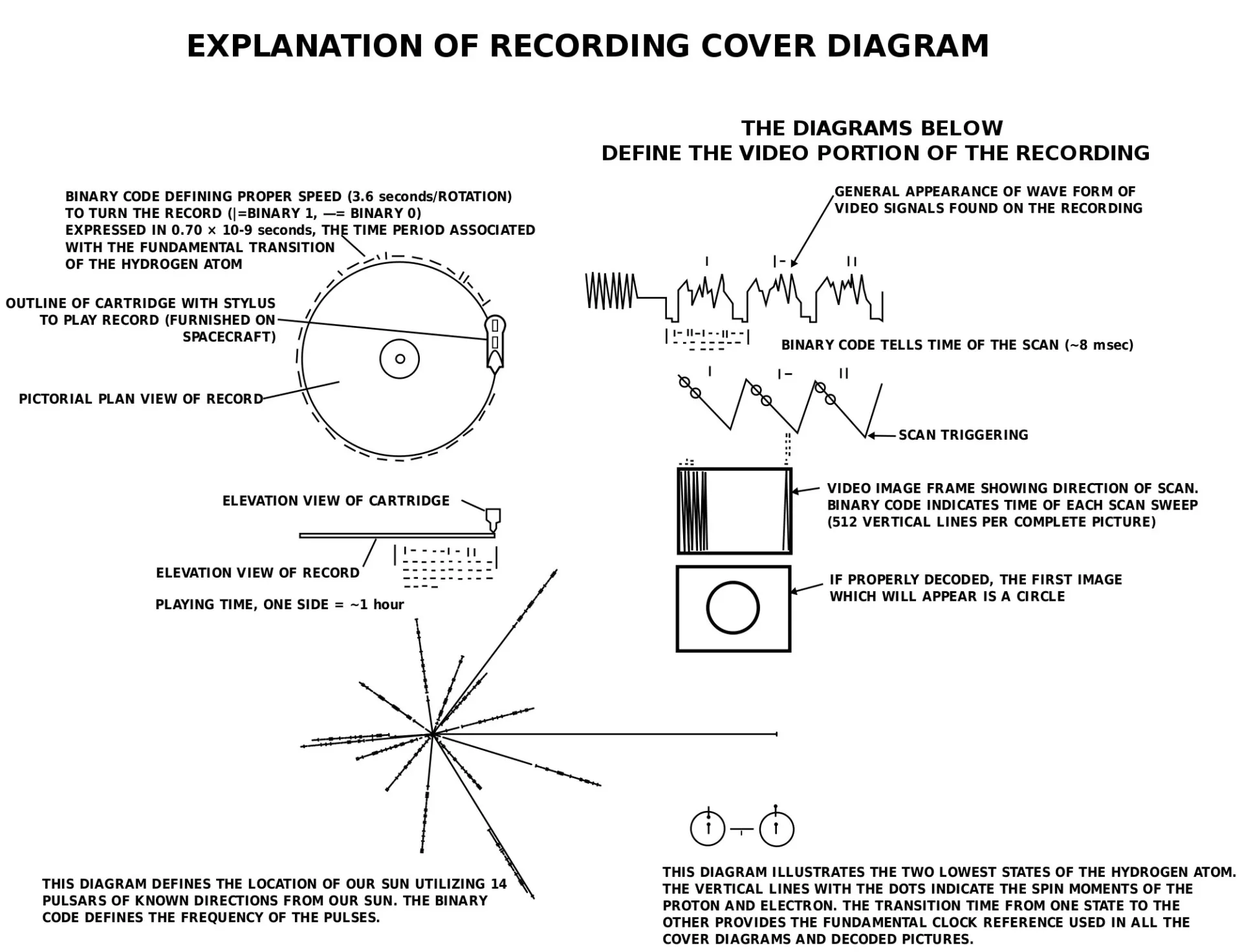
Listening to the image signal does not make a picture visible. Its variations must be translated into brightness and arranged as 512 vertical lines. Diagrams on the cover's right explain the sequence and signal timing: how to turn a one-dimensional stream into a two-dimensional image.
The first picture is a circle for a reason. If it appears oval after reconstruction, the image proportions are wrong. A being unfamiliar with human faces or landscapes would have little basis for knowing whether those pictures looked right. A circle offers a simpler test.
The cover also maps the place of origin. Lines at the lower left show the Sun's position relative to 14 pulsars that emit regular signals. Each pulsar's period is an identifying clue. Without a universal address system, the designers used distant observable objects and their rhythms to describe our location.
Who might find the record, and when, is another question. NASA's Voyager information describes Voyager 1 passing near Gliese 445 and Voyager 2 near Ross 248 in about 40,000 years. Even then, each encounter leaves more than a light-year between spacecraft and star. These are neither arrivals at stars nor planetary landings, and they imply nothing about civilizations there. The number does not promise discovery in 40,000 years.
The record's planners considered much longer spans. A Sagan letter presented by the Library of Congress gives an anticipated record lifetime of about a billion years. NASA has also discussed the spacecraft surviving for billions of years and potentially becoming distant traces of human civilization. These are objects intended to outlast their makers, rather than messages sent in expectation of a prompt reply.
It is possible to imagine a civilization finding one hundreds of millions of years from now. Yet the existence of any finder remains unconfirmed. Without knowing the number, locations, reach, or detection capabilities of other civilizations, there is no basis for assigning a high probability to discovery at that time. Potential longevity and likely discovery are different claims. The records may never be found.
A spacecraft losing power does not itself erase the recording. The Golden Record requires no continuous electrical supply to retain information. If its grooves remain readable and a finder has suitable playback equipment, the signals could be recovered. This does not amount to experimental proof of playback quality a billion years from now. That timespan is an estimate of preservation.
Even for someone holding the disc in a distant future, small diagrams would come before music. The stylus must be placed, speed set, and image proportions adjusted until the circle is round. Through those steps, Earth's voices and instruments could emerge. Long after the makers are gone, the grooves they left could produce sound again.
By then, our civilization may itself belong to a remote past. Even if a finder never replies to Earth or meets a human, the record might reveal that people once lived on this planet in one part of the galaxy. They greeted one another, made music with different instruments, and recorded the places around them. Sounds and images could convey that life without a list of grand achievements.
No date of discovery can be promised. For the possibility alone, people sent a record beyond the waiting span of their own lives. Someone might learn that such beings once lived on a distant Earth. The greetings and music suggest that this, too, was a story worth leaving behind.
Sources and editorial notes
NASA · Golden Record Overview · Material
NASA · Contents · 115 images · 55 languages · Playback speed
NASA · Greeting and recording process by language
NASA · List of included images
Library of Congress · Record Groove · Needle · Sound Restoration Principle
NASA · Cover reproduction, photo reconstruction, hydrogen standard, pulsar map
NASA · Voyager Future Route FAQ
Library of Congress · Sagan's Golden Record Life Expectancy Letter
NASA · Explanation of long-term viability of 40th anniversary data in 2017
AI Illustration: MUADAILY / OpenAI ImageGen · Image Source
Editorial note: Facts were checked against the sources above; interpretations reflect MUADAILY’s editorial perspective. Image: AI Illustration: MUADAILY / OpenAI ImageGen · AI generated concept image.
Machine-translated from Korean. Read the original.