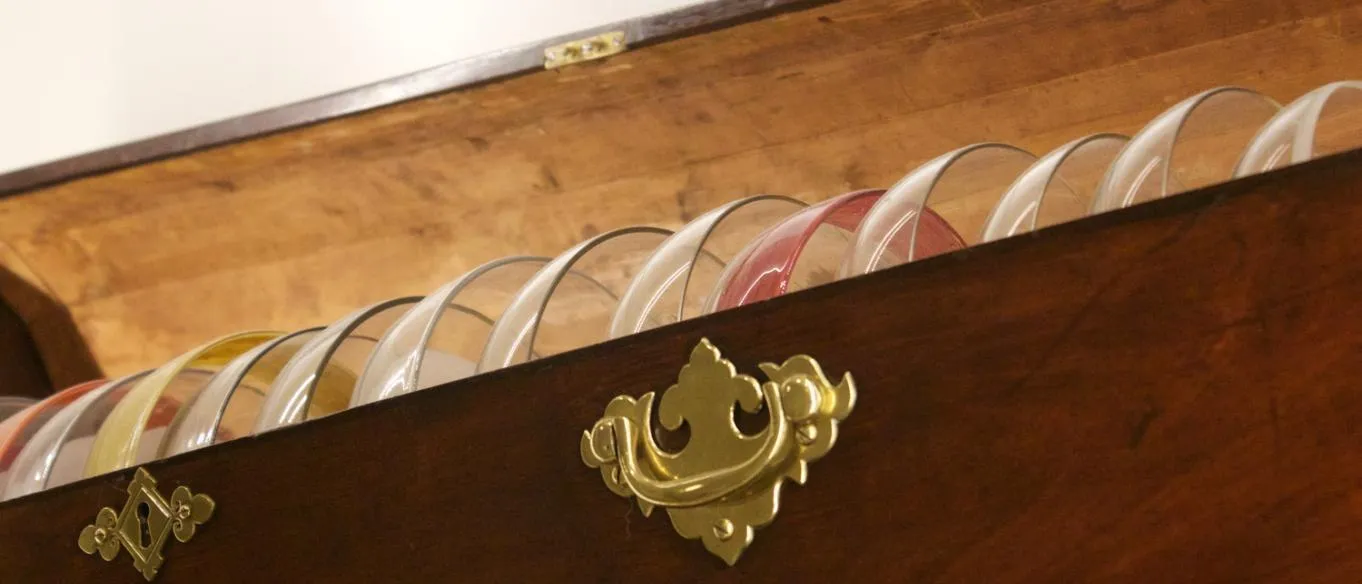
The glass armonica is played by touching rotating glass bowls with wet fingers. Franklin’s 1761 invention turned the sound of a glass into an instrument for melodies and chords.
Article
Rub the rim of a glass with a wet finger and a thin, sustained tone emerges. Benjamin Franklin used that principle to make an instrument without a keyboard. Completed in 1761, his glass armonica is played on bowls of different sizes rotating on a single shaft.
Franklin did not discover musical glasses. He devised the instrument after hearing them played. Where earlier players tuned glasses by varying the water inside, his bowls were made to particular sizes and thicknesses to produce their pitches. They no longer needed water inside for tuning.
The bowls nest together on an iron shaft. A foot pedal turns a wheel to rotate them, while wet fingers touch their rims. Contact with the moving glass sustains the vibration. Instead of circling a finger around each rim, the performer lets the glass move.
This also changes how notes connect. Hands can move sideways between bowls or play several notes together. Franklin color-coded the bowls to identify pitches. Sensitive touch still matters, but the sounding surfaces are gathered in a row.
The Franklin Institute notes that Mozart and Beethoven wrote for the instrument. Its sound became part of compositions, rather than merely an unusual effect. Whether its tone suggests a human voice or an electronic sound is something to explore by listening.
The feet turn the shaft and the hands touch the glass. Water, once used to fill and tune glasses, now helps the fingers make contact. A sound familiar from the dining table became an instrument whose melodies could follow the hands from side to side.
Sources and editorial notes
The Franklin Institute · The 1761 armonica, glass bowls, shaft, pedal, and composers
The Franklin Institute · Franklin's invention and the armonica
Editorial note: Factual statements are based on the sources above; interpretations reflect MUADAILY's editorial perspective. Image: Collection of musical instruments Photo credit: The Franklin Institute.
Machine-translated from Korean. Read the original.