Cooper Hewitt used The Pen from 2015 to 2020 to let visitors collect exhibit information. We revisit a tool that carried an exhibition beyond the museum visit.
Article
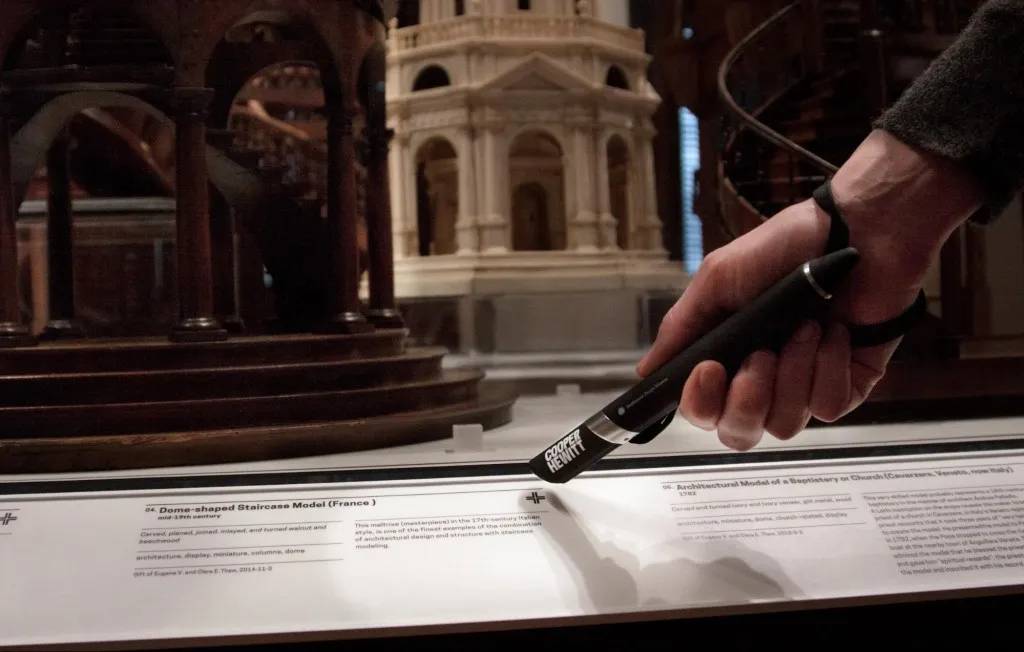
An interesting object in a gallery can prompt a series of phone photographs of the object and its label. The photographs accumulate, while the reason for stopping can grow hazy. The Pen, once offered by New York’s Cooper Hewitt, Smithsonian Design Museum, addressed that moment. Touching it to an exhibit label saved information to revisit later, turning the act of recording a visit into a simple gesture.
The museum identifies its period of use as 2015–2020. It should therefore be understood as a past approach to visiting, not equipment guaranteed to be available today. Its interest remains in the decision to build a separate handheld tool rather than put the entire digital experience into a phone app.
One end read NFC tags embedded in labels. Bringing the pen close stored information identifying the object. Visitors did not mark or directly touch the exhibits themselves: interest in an object led to a gesture towards its label. The aim was to keep visitors physically engaged with the gallery even while using technology.
Large touch tables let visitors transfer and explore what they had collected. The Pen could also draw on the screens, with collecting and drawing handled by opposite ends. Selecting existing designs and making forms of one’s own were linked through the same tool. It invited an active encounter with design as well as a record of what had been seen.
A unique web address linked to the admission ticket extended the experience after the visit. Even after returning the pen, visitors could use that address to find their collection again. The device went back to the museum, while access to the day’s interests remained. The museum also described anonymous use. Identification and privacy were part of designing a service around a visit’s record.
Seen as a past experiment, The Pen raises a clear question: how busy should the recording hand be, and where should a day’s interests remain? Instead of dozens of photographs, visitors could collect small references and open them later. A museum tool can do more than explain objects; it can help people hold on to their own curiosity.
Sources and editorial notes
Cooper Hewitt · Designing The Pen, Used from 2015 to 2020
Project participants Sebastian Chan and Aaron Cope · MW2015 design account
Editorial note: Facts were checked against the sources above; interpretations reflect MUADAILY’s editorial perspective. Image: Katie Shelly / MW2015 and Cooper Hewitt development documentation / March 2015.
Machine-translated from Korean. Read the original.