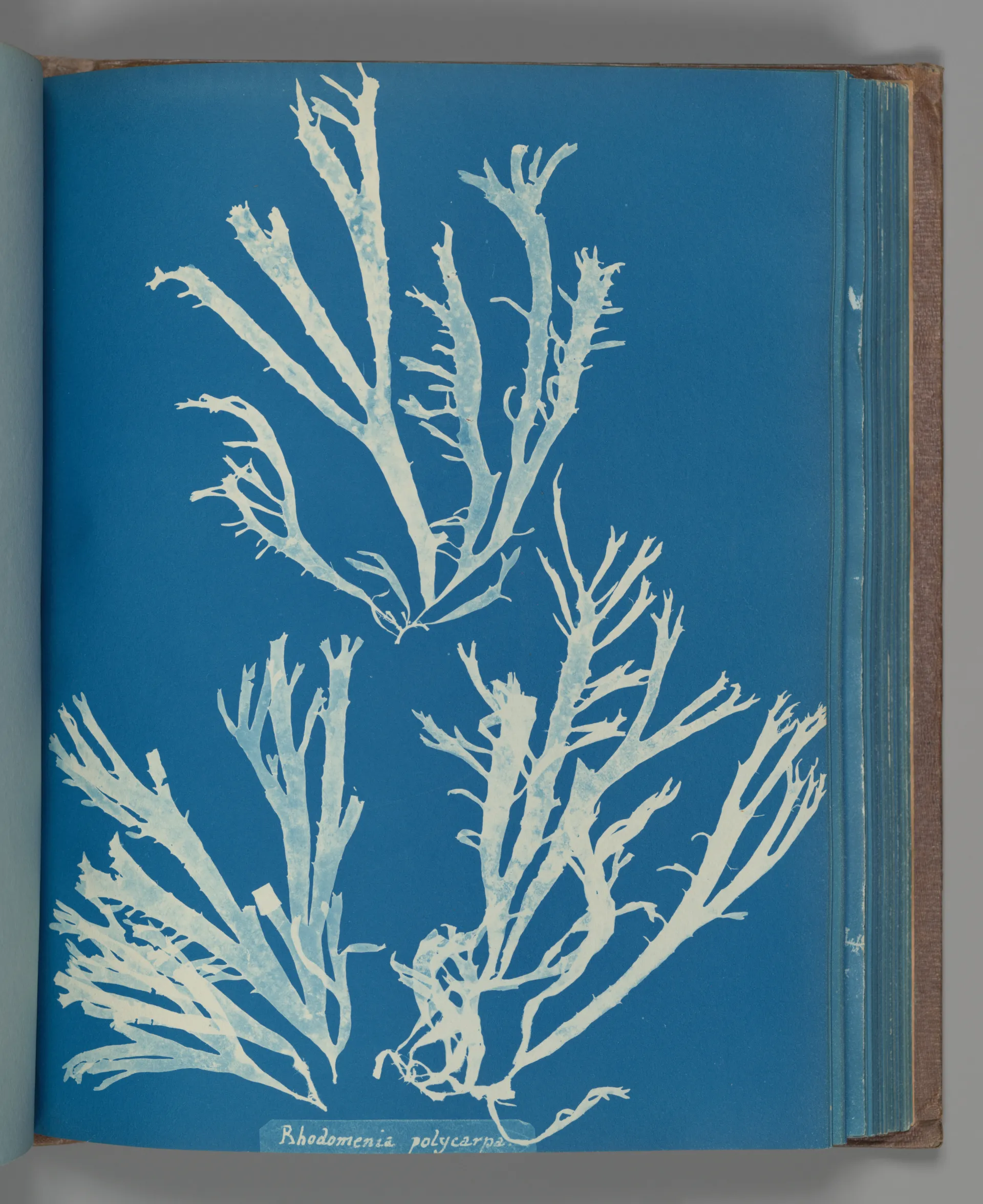
Anna Atkins placed algae specimens on light-sensitive paper and used sunlight to record their shapes.
Article
Open the book and delicate white branches spread across blue pages. They look like drawings, but Anna Atkins worked with real algae specimens. In the nineteenth century she used cyanotypes to document British algae, spreading the outlines of organisms from the water across paper.
A cyanotype does not require a camera lens. When a specimen is placed on light-sensitive paper and exposed, the uncovered areas react differently from those shaded by the specimen. Rinsing leaves pale shapes against a blue background. How the specimen is arranged determines whether its stems and fine branches overlap or separate.
According to the Metropolitan Museum of Art, Atkins began issuing the book in installments in 1843. Its cyanotypes preserve both the specimens’ impressions and names written by hand. Branches spread from the center of a page, while long stems can lead the eye from one edge to the other. Arranging the specimens also meant deciding what a reader would notice first.
For the names, Atkins consulted William Harvey’s guide to British algae, which had no illustrations. Adding a pale outline to a name let readers see a trace of an actual specimen rather than imagine its form from words alone. Differences in tone also reveal variations in thickness and overlapping fine branches.
The pages do not show organisms moving in water. They record specimens laid out to block the light during exposure. Yet they preserve information different from a drawing made from memory. Later readers can see the arrangement as it was on the paper, down to the points touched by its finest tips.
In this book, the algae’s impressions and names do different jobs. The name identifies the species; the shape left by the specimen shows where a fine branch divides. On one blue page, readers can examine both the name and the form.
Sources and editorial notes
www.metmuseum.org · Official source
ocean.si.edu · Official source
Editorial note: Factual statements are based on the sources above; interpretations reflect MUADAILY’s editorial perspective. Image: Anna Atkins / The Metropolitan Museum of Art · Public Domain.
Machine-translated from Korean. Read the original.