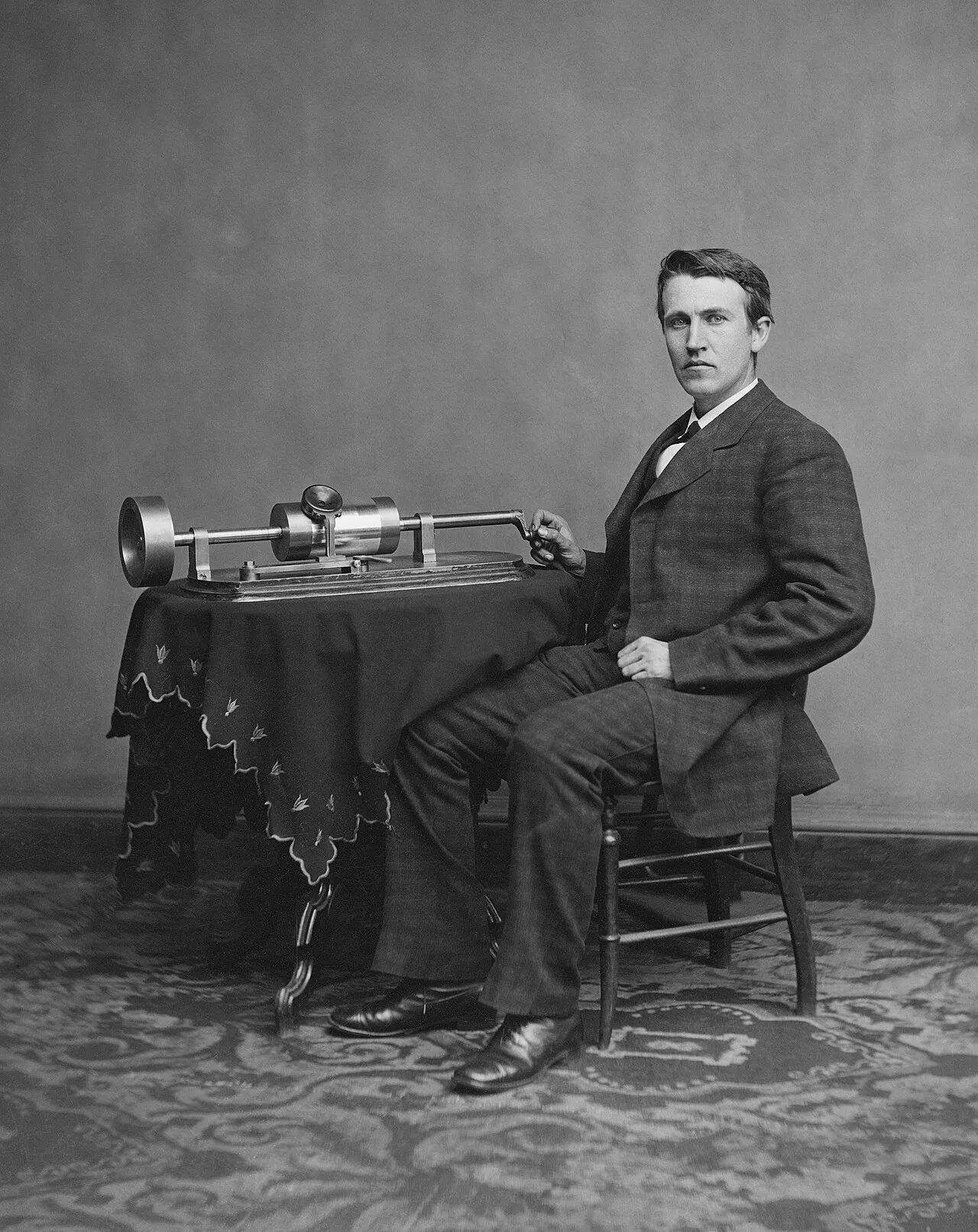
Edison’s 1877 phonograph indented tinfoil and traced it again, linking the recording of sound to its playback.
Article
Someone speaks toward a metal cylinder. A handle turns, the needle returns, and the words are heard again. Recording buttons now make this seem ordinary, but retrieving a sound after it had passed was once unfamiliar. Edison’s 1877 phonograph preserved that moment in thin tinfoil.
Sound vibrated a diaphragm, and an attached stylus pressed a trace into foil wrapped around a rotating cylinder. During playback, the stylus followed that trace and made the diaphragm vibrate again. Recording and retrieval ran through the mechanism in opposite directions.
Edison’s machinist John Kruesi built the early device, turning Edison’s design into a working arrangement of cylinder, stylus and handle. In the early phonograph described by the National Park Service, the exposed parts make it possible to follow what moves when the handle turns.
Experiments had already recorded sound as a physical trace. Edison’s device could follow that trace with a stylus and play the sound back. The early tinfoil was difficult to handle, however. Later media, including wax cylinders, brought changes in the phonograph’s mechanism and use.
There is no electronic storage circuit in this phonograph. During playback, the stylus retraces the indentations it made in the foil while recording. Turning the cylinder with the handle and bringing the stylus to the foil makes the recorded words sound again.
Sources and editorial notes
National Park Service · Origins of sound recording
National Park Service · Phonograph demonstration
Image source · Levin C. Handy (per http://hdl.loc.gov/loc.pnp/cwpbh.04326)
Editorial note: Facts were checked against the linked material. Interpretations are MUADAILY’s editorial perspective. Image: Levin C. Handy (per http://hdl.loc.gov/loc.pnp/cwpbh.04326) · Public domain · Historical photograph of Edison with a phonograph.
Machine-translated from Korean. Read the original.