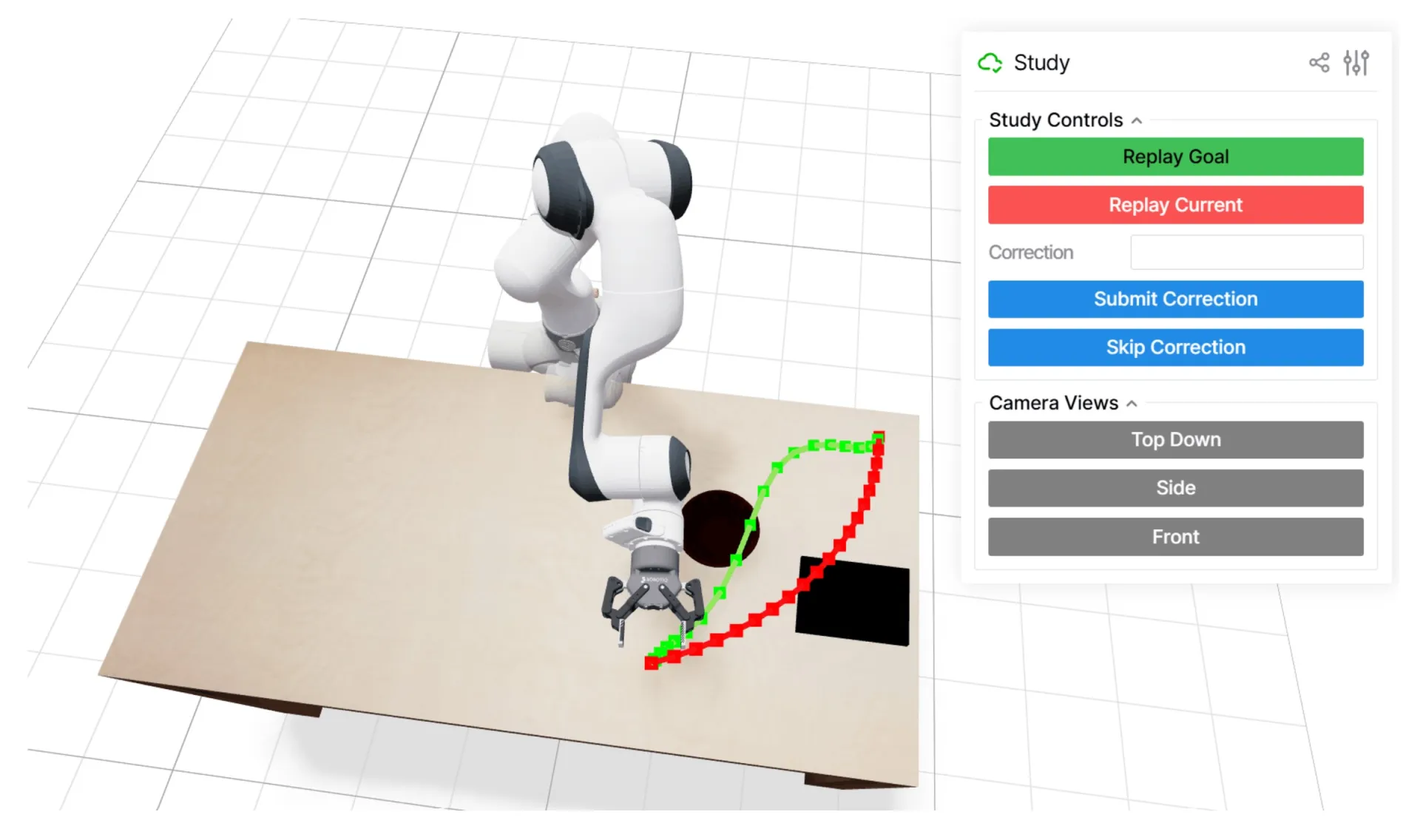
MIT’s FLEX uses the intent behind instructions in motion planning. Its coffee-serving example is simulated; the broader study also uses demonstrations from a physical robot.
Article
Tell a coffee-carrying robot not to spill on a laptop. A phone is on the table too: is avoiding only the laptop enough? MIT and NYU’s FLEX explores incorporating objects that were not explicitly named into motion planning. [1]
The coffee-carrying example presented by MIT on November 9, 2026 is a computer simulation. A person types instructions and a virtual robot arm changes its path. The route avoiding both the laptop and the phone was also demonstrated in this virtual setting. [1]
FLEX uses a language model to infer the reason behind a command. If liquids can damage electronics, avoidance can extend from one laptop to nearby devices, including the phone. [1]
The inferred reason must become a condition used to calculate the robot’s path. A decision to avoid electronics has to guide which objects receive clearance. The task is to reduce the need to name every object while keeping the restrictions relevant to the instruction.
The study also used demonstrations collected on a physical robot. In an evaluation with 12 participants, people watched simulated robot movements for safety and typed corrections. The researchers then trained offline using those corrections and expert demonstrations collected on a physical Franka arm. [2][3]
Sources and editorial notes
[2] FLEX 원논문, arXiv 2610.28893, 5.3절
[3] MIT CLEAR Lab FLEX 공식 프로젝트: RQ3
Editorial note: Facts were checked against the linked sources. Interpretations are MUADAILY’s editorial perspective. Image: Audrey Lee, Nathaniel Dennler, Ilia Sucholutsky and Andreea Bobu / MIT CLEAR Lab, FLEX project · The participant interface published by the FLEX research team: users view a simulated robot arm’s path and enter corrections in the panel at right.
Machine-translated from Korean. Read the original.