The Maeslant Barrier floats its stored gates into the channel, then sinks them. Keeping the waterway open is part of its design.
Article
Normally, large ships have an open route through the estuary. When a storm surge is forecast, giant gates move out from either bank. The Maeslant Barrier on the waterway toward Rotterdam closes the shipping channel when needed.
Completed in 1997, it has two gates, each 210 metres long. They are stored beside the channel rather than permanently standing in it. For closure, they float toward the centre and then fill with water to sink into position. Rotation and lowering happen in sequence.
The Dutch water authority describes automatic closure procedures triggered by predicted levels of three metres above NAP at Rotterdam or 2.9 metres at Dordrecht. NAP is the Netherlands’ elevation reference. Forecasts and defined thresholds guide the process rather than an impression that the water looks high.
Automation does not remove people from the system. The barrier needs monitoring, testing and the ability to intervene. Closing a shipping route involves navigation management as well as mechanical movement.
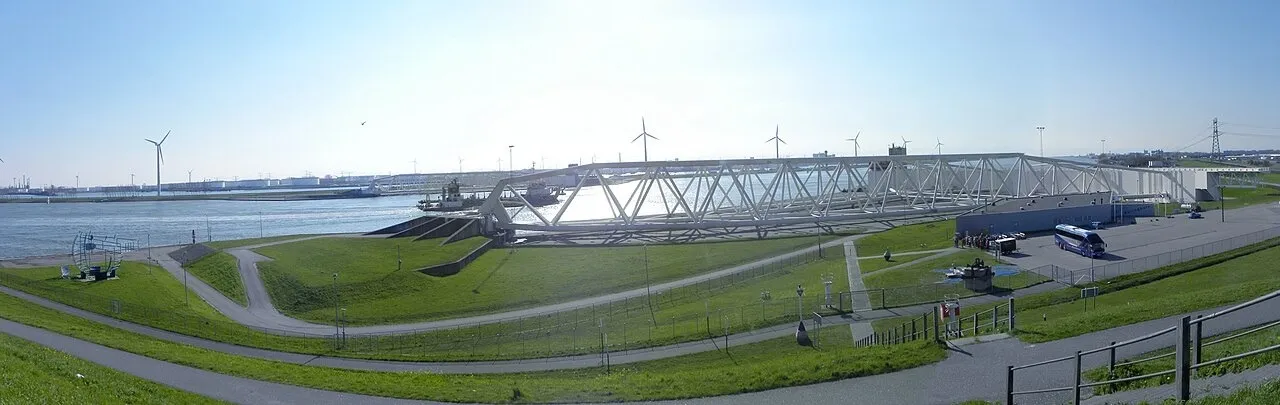
When the gates are stored ashore, the photograph shows a broad, empty channel. That is the space ships need in ordinary conditions. The gates move onto the water and close when storm-surge protection is required. The open channel explains why two 210-metre gates are kept beside it.
Sources and editorial notes
Rijkswaterstaat · Maeslant Barrier
Rijkswaterstaat · Maeslantkering
Image use terms · CC BY-SA 3.0
Editorial note: Facts were checked against the linked material. Interpretations are MUADAILY’s editorial perspective. Image: JHvW · CC BY-SA 3.0 · Maeslant Barrier beside its open shipping channel.
Machine-translated from Korean. Read the original.