The Hovenring’s circular cycle bridge sits above a lowered junction, a design decision that made its approach slopes gentler.
Article
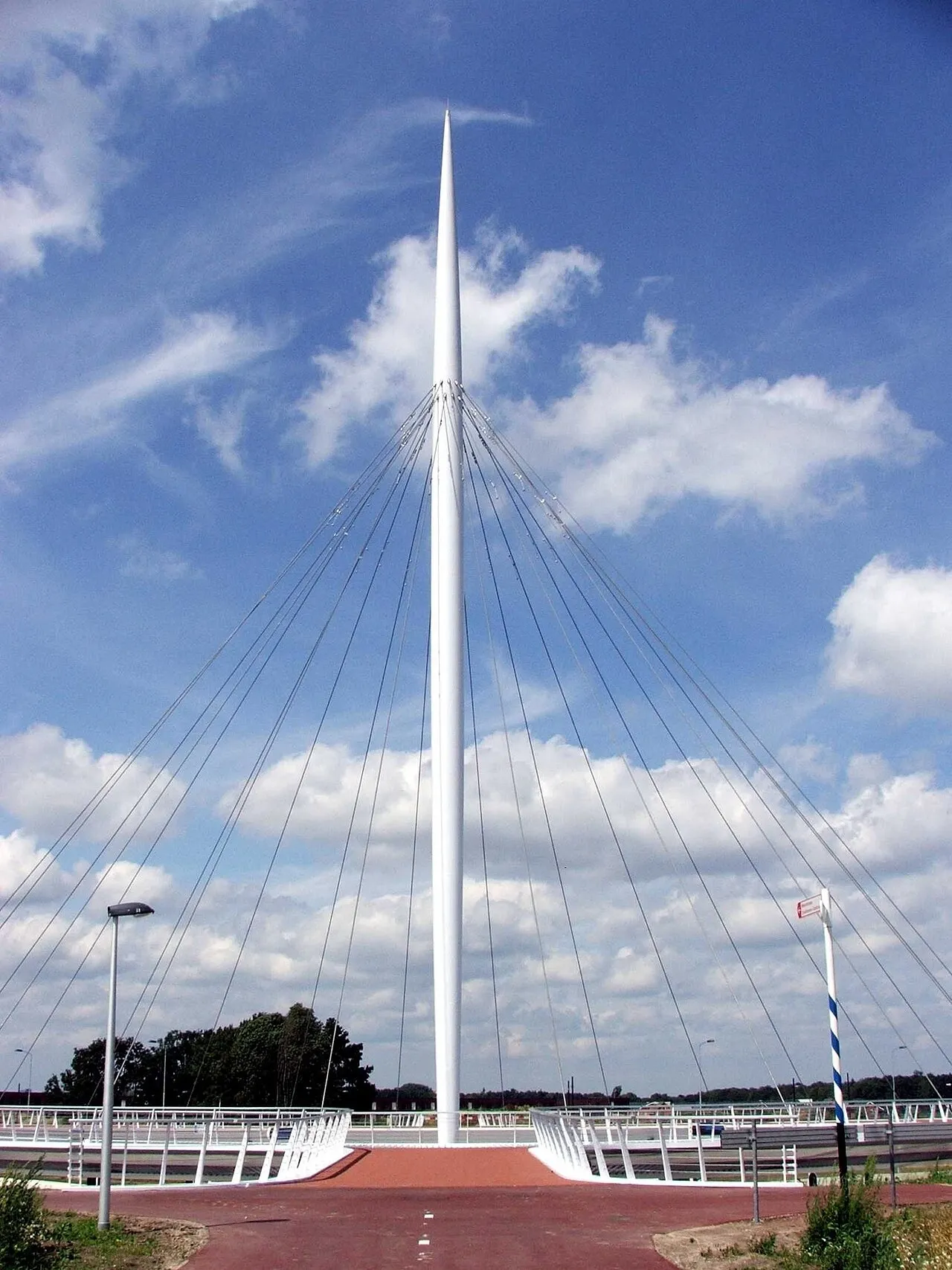
Cars cross a junction while cyclists circle above them. Between Eindhoven and Veldhoven in the Netherlands, the Hovenring resembles a great suspended ring, held by cables radiating from a central pylon.
Opened in 2012 and designed by ipv Delft, it has a 70-metre pylon and a 72-metre-diameter deck. Its monumental scale began with a traffic problem: nearby housing development meant growing demand, and bicycles and cars needed routes at different levels.
Simply raising the bridge was not enough. Cyclists required ramps, while existing roads and buildings limited the available space. The designers lowered the junction beneath by about 1.5 metres. Bringing cars down reduced the height cyclists had to climb, making gentler approaches possible.
Cyclists can follow the ring toward their chosen exit, with four approaches connecting nearby routes. Cars use the junction below and bicycles the circular bridge above. Gentler approaches spread the climb over the route rather than confronting riders with a steep ascent.
Photographs often emphasize the illuminated floating circle. Looking at the road below reveals the other half of the design: the bicycle route was not asked to do all the climbing. The road shared the change in level.
Sources and editorial notes
ipv Delft · Bridge Design Manual
Image use terms · CC BY-SA 3.0
Editorial note: Facts were checked against the linked material. Interpretations are MUADAILY’s editorial perspective. Image: HHahn · CC BY-SA 3.0 · Hovenring supported by its pylon and cables.
Machine-translated from Korean. Read the original.