A boat stays afloat while its tank moves to another level. Balance is central to the Falkirk Wheel’s enormous rotation.
Article
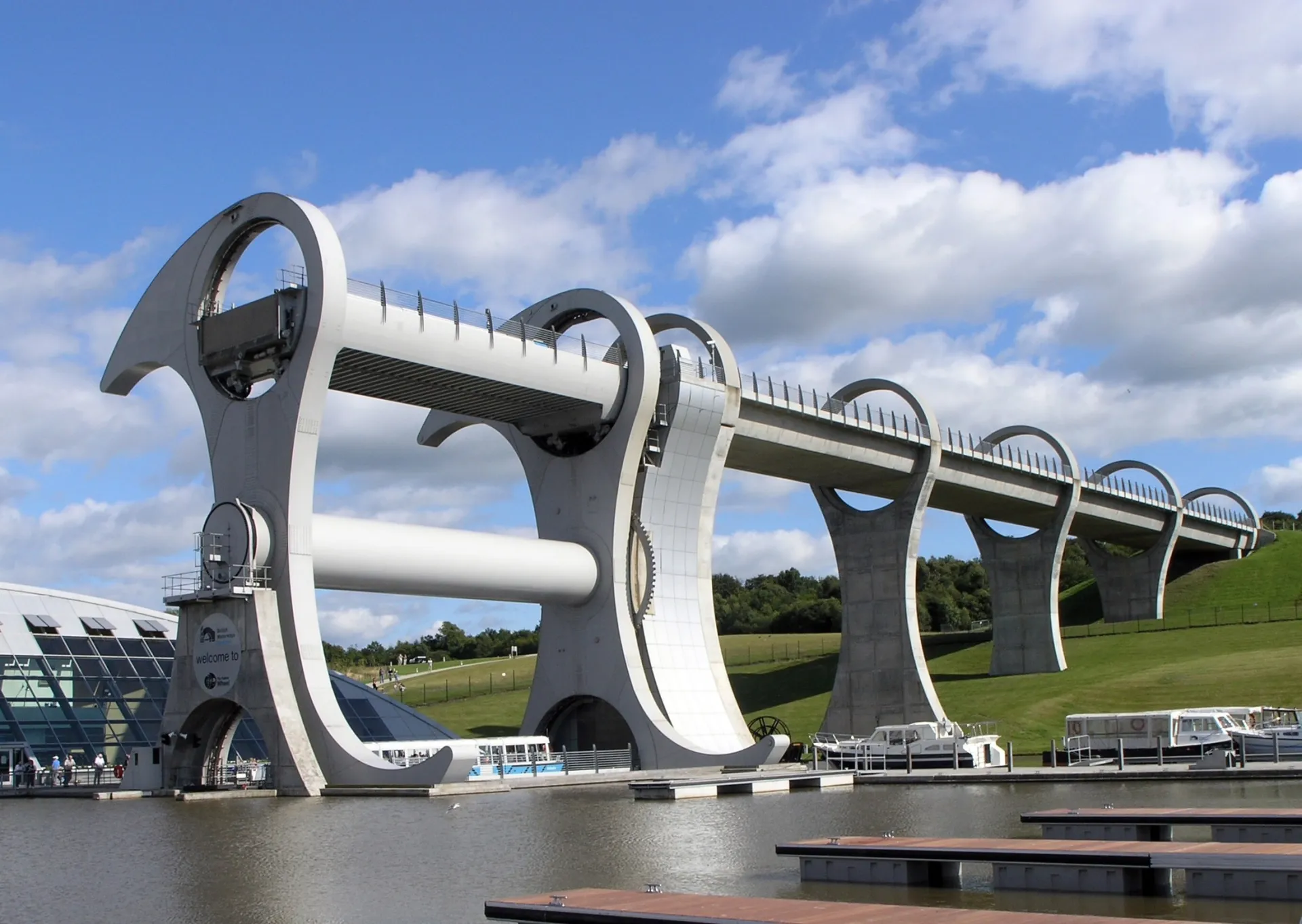
A boat reaches a steep change in level. On a conventional canal, locks would raise or lower it in stages. At Falkirk in Scotland, it enters a long tank of water. A giant wheel turns, carrying the tank upward. The boat reaches another level of waterway without ever leaving the water.
Opened in 2002, the Falkirk Wheel reconnects the Forth & Clyde and Union canals. A water-filled tank hangs on each side of the wheel. As one rises, the other descends. The tanks remain level independently of the rotating wheel, so the boats stay upright and afloat.
Would a heavy boat on one side upset the balance? A floating boat displaces its own weight in water. With the water level controlled, water leaves as the boat enters. What matters is the combined weight of boat and water, rather than whether a tank contains a boat. That balance helps the enormous structure move.
The wheel does not overcome the canals’ entire difference in elevation by itself. An upper waterway, a tunnel and additional locks complete the journey. Beyond the spectacular rotating structure, there is still a route for the boat to follow.
Following the ends of the tanks makes the two movements easier to distinguish. The wheel’s arms trace a large circle, but the water surfaces stay level. At the top, a boat leaves its tank and continues along the waterway. Throughout the rotation, it has remained afloat.
Sources and editorial notes
Scottish Canals · The Falkirk Wheel
ICE / Scottish Canals · Falkirk Tunnel & Wheel
Editorial note: Facts were checked against the linked material. Interpretations are MUADAILY’s editorial perspective. Image: Sean Mack · CC BY 2.5 · Falkirk Wheel and its water-filled gondolas.
Machine-translated from Korean. Read the original.