Chandra’s new sonifications map brightness and kinds of light to volume and timbre.
Article
As a scan crosses a bright source, the sound grows louder. Chandra’s new sonifications translate telescope observations into audible patterns; they are not recordings made by microphones in space. [1]
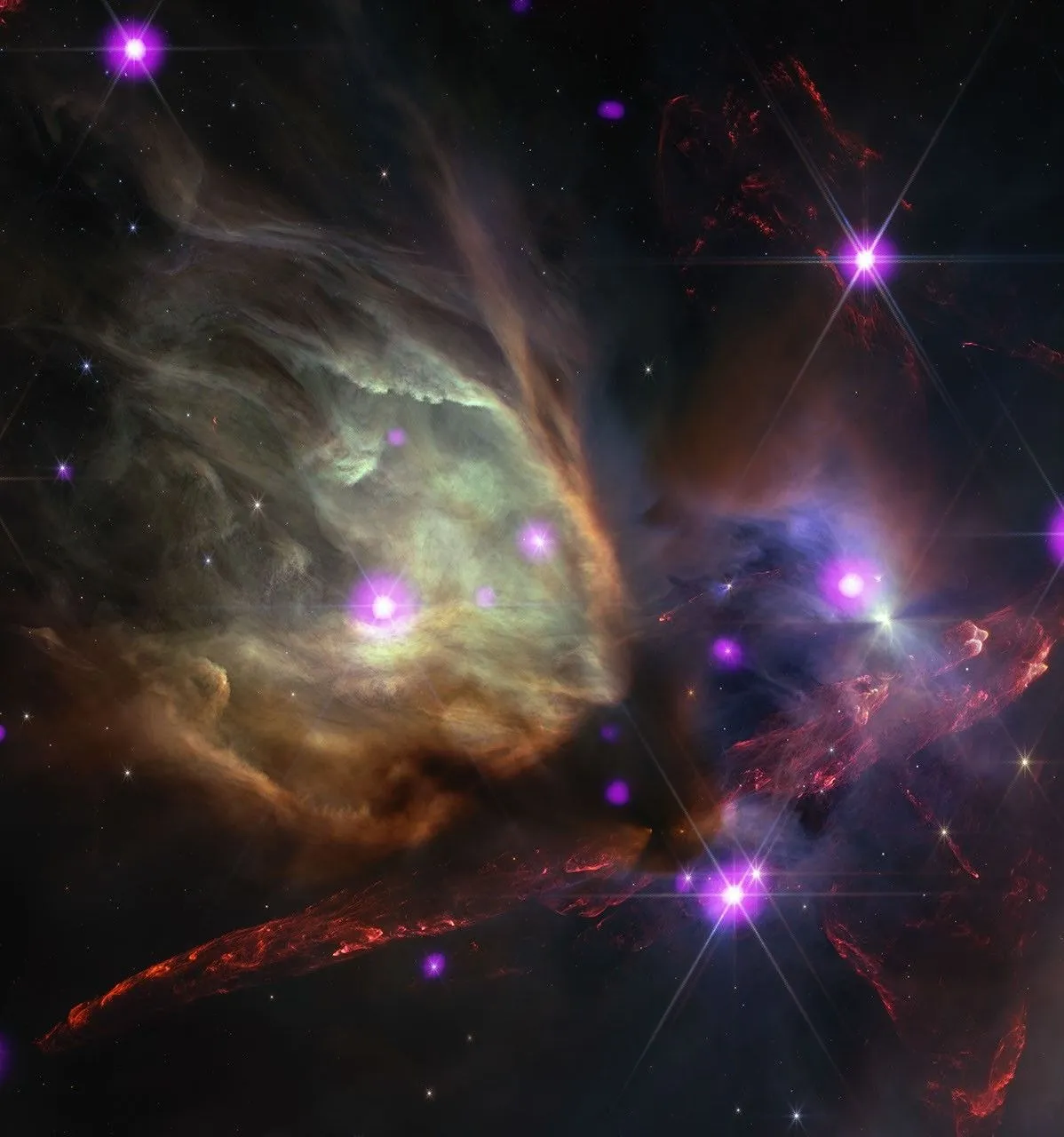
The November 17, 2026 account presents four works: M82, the Orion and Carina nebulae, and Rho Ophiuchi. They combine Chandra with observations from telescopes including Hubble and Webb, whose different wavelengths reveal different structures. [1]
M82 uses a rotating scan, with brighter sources producing greater volume. X-rays occupy higher frequencies; infrared becomes low sustained and plucked sounds, while optical data receives a range of pitches and textures. [1]
The creators choose how positions, brightness and wavelengths on the screen correspond to sound. Those rules allow differences represented visually to be distinguished by ear as well. Knowing the mapping helps connect a bright point on screen to a sound.
As playback proceeds, an image visible all at once becomes a sequence. Bright areas stand out and wavelengths overlap in different timbres. Keeping the image alongside the sound lets the eye find a place the ear noticed first.
Sources and editorial notes
[2] Image licence · NASA informational use
Editorial note: Facts were checked against the linked sources. Interpretations are MUADAILY’s editorial perspective. Image: X-ray: NASA/CXC/MIT/C. Canizares; IR: NASA/ESA/CSA/STScI/K. Pontoppidan; processing: NASA/ESA/STScI/Alyssa Pagan, NASA/CXC/SAO/L. Frattare and J. Major · Rho Ophiuchi in a composite of Chandra X-ray and Webb infrared data, one of the regions used in the sonification project.
Machine-translated from Korean. Read the original.