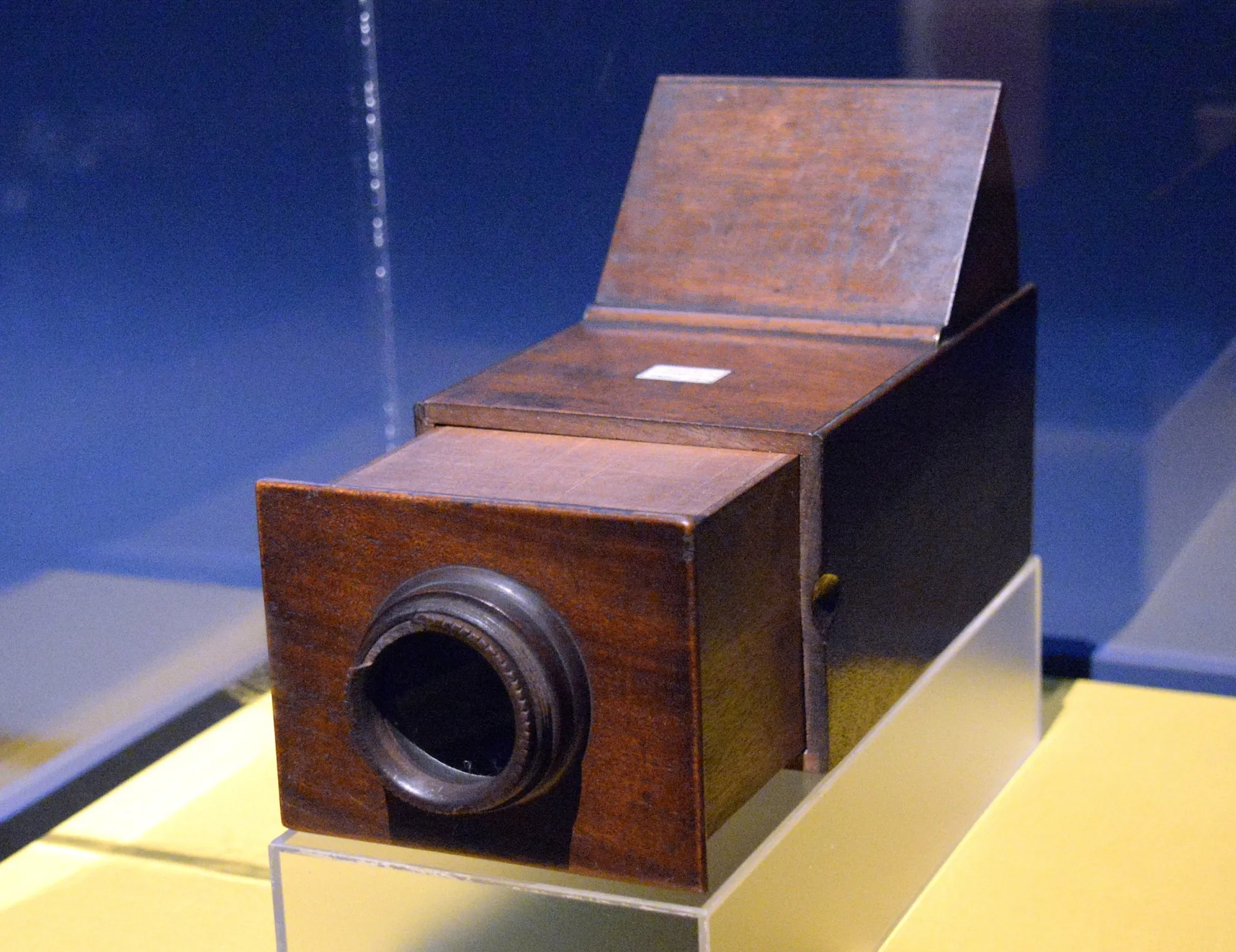
A camera obscura projects light through a small opening onto an interior surface. It brought the outside scene indoors before photography could preserve it.
Article
An upside-down street appears on the wall of a dark room. When a person walks outside, the figure on the wall moves too. No screen is playing a recording: incoming light is producing the scene at that moment. Camera obscura literally means “dark room.”
A small opening between the bright exterior and dark interior allows light to reach the opposite surface. Light from above reaches the lower part, while light from below reaches the upper part. The paths cross at the opening, inverting the image.
A lens in place of a small hole can admit more light and create a brighter image, but requires focusing. Alongside room-sized devices, portable boxes used a lens and mirror to direct an image onto an upper surface. Paper could be placed there to trace its outlines.
The device does not automatically preserve what it shows. Without film or a sensor at the receiving surface, a person must draw the image or simply watch it. The camera’s name and optical principle existed before photographic recording.
When a cloud covers the Sun outside, the projected image darkens too. Without a play button or brightness control, the street on the wall changes with the weather beyond it.
Sources and editorial notes
blog.scienceandmediamuseum.org.uk · 카메라 옵스쿠라 자료 1
www.nationalgallery.org.uk · 카메라 옵스쿠라 자료 2
Image source · Osama Shukir Muhammed Amin FRCP(Glasg)
Editorial note: Facts were checked against the linked sources. Interpretations are MUADAILY’s editorial perspective. Image: Osama Shukir Muhammed Amin FRCP(Glasg) · CC BY-SA 4.0 · A portable W&S Jones camera obscura, 1800–1820, National Museum of Scotland.
Machine-translated from Korean. Read the original.