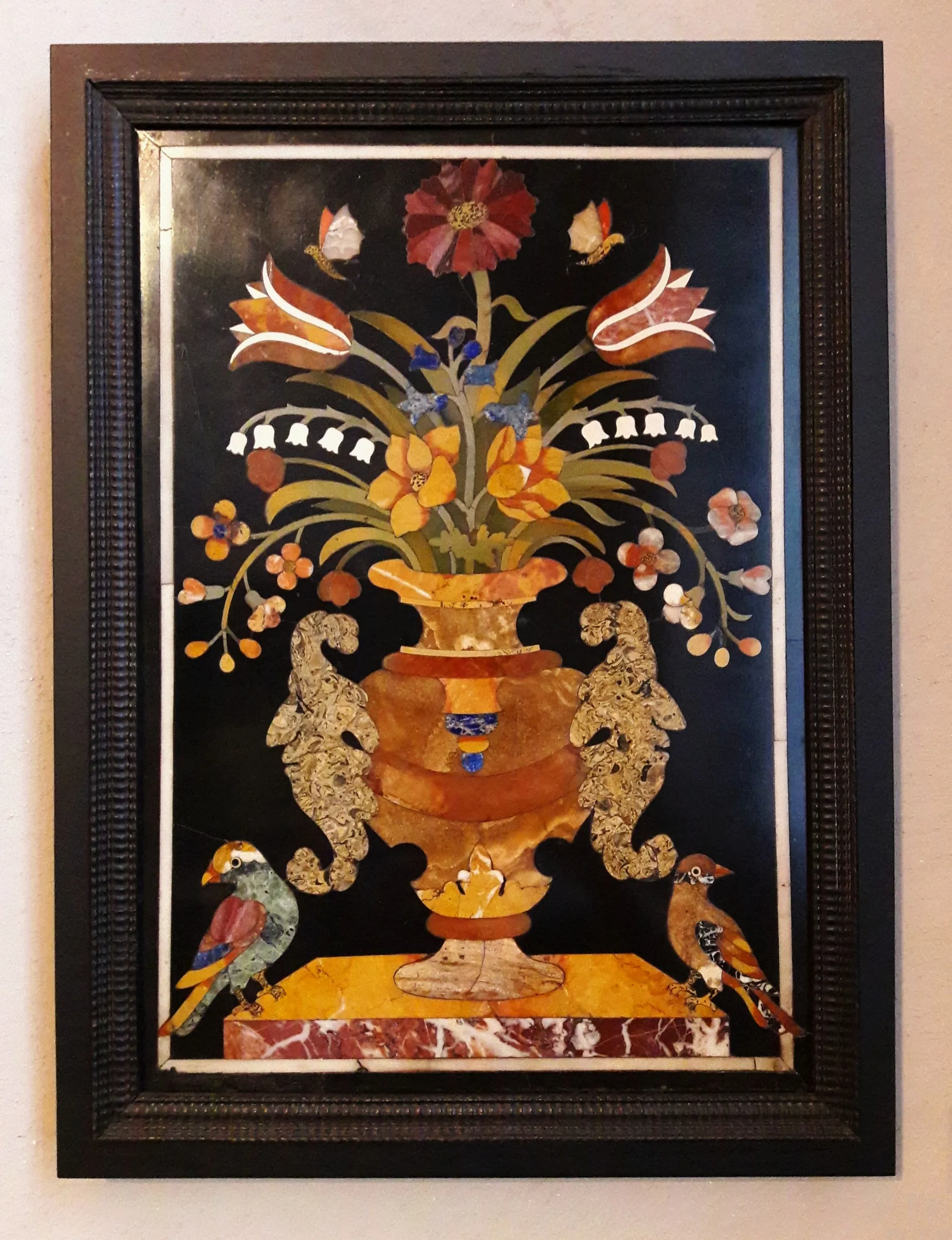
Pietre dure assembles precisely cut coloured stones. Natural veins and colour variations become parts of a picture instead of painted marks.
Article
From a distance, it looks like a picture of trees and mountains. Closer up, the boundaries between colours reveal joints between pieces of stone rather than brushstrokes. Pietre dure is a decorative technique that fits cut hardstones together to create a pattern or image.
The process begins by choosing which parts of the stone to use. Colour and veining vary even within one piece. A darker patch can become a shadow; a long streak can supply a line in a landscape. Rather than mixing a desired paint colour, the maker looks for useful shapes and colours already present in the material.
The chosen stones are cut precisely to fit their neighbours. The assembled picture is set into a panel, often of marble. Wide gaps would interrupt its outlines, so the shape of each adjoining edge matters as much as the colour visible on the surface.
The surface is then ground and polished. The separately cut pieces become one smooth panel while retaining their own colours and veins. The edge of a leaf or the ridge of a mountain is formed by the fitted stone, rather than a painted line.
In two Tuscan landscapes held by Florence’s Opificio delle Pietre Dure, yellow and green Sicilian jasper supplies the colours of the ground. Streaks in Persian lapis lazuli suggest distant clouds and mountains. For these works, made around 1608, painters and artisans reportedly spent months examining stone at the quarries. Finding the colours for a picture meant going to where the stone came from.
Sources and editorial notes
www.vam.ac.uk · 돌 조각으로 그리는 피에트레 두레 자료 1
opificiodellepietredure.cultura.gov.it · 돌 조각으로 그리는 피에트레 두레 자료 2
Image source · Artinpl / Wikimedia Commons
Editorial note: Facts were checked against the linked sources. Interpretations are MUADAILY’s editorial perspective. Image: Artinpl / Wikimedia Commons · CC0 1.0 · A hardstone panel depicting flowers in a vase, Bavarian National Museum.
Machine-translated from Korean. Read the original.