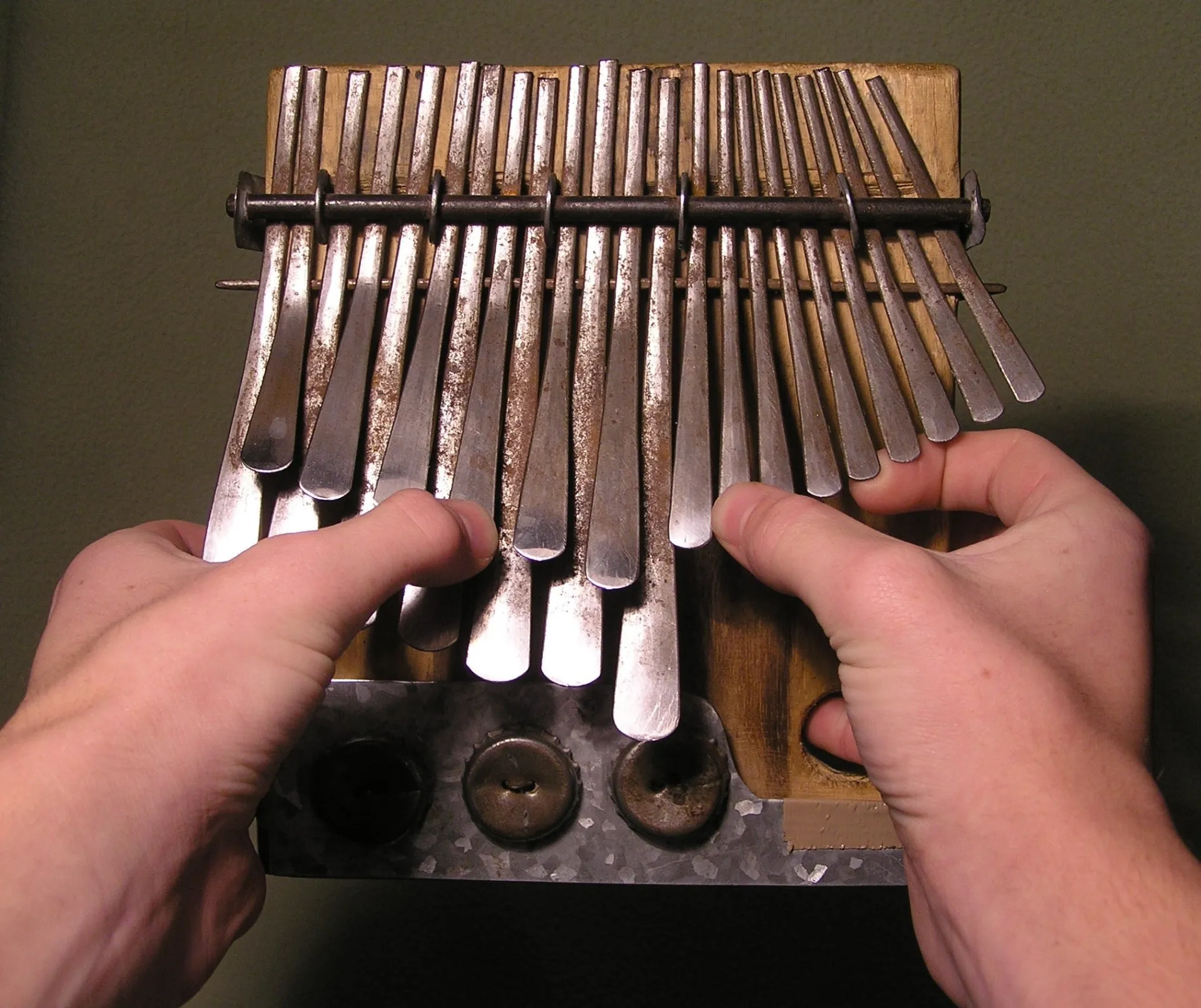
Metal tongues of different lengths sit on a wooden board. Small finger movements set the instrument and its resonator vibrating.
Article
Metal tongues of different lengths lie across a small wooden board. Press and release an end with a thumb, and it vibrates to produce a note. The mbira is played in this way by communities including the Shona of Zimbabwe. Players may use other fingers as well as their thumbs.
Each sounding tongue is fixed at one end and free to vibrate at the other. Changing the length projecting beyond its support changes how quickly it vibrates. Sliding a tongue slightly inward or outward is one way to tune it.
The metal is not the only part that vibrates. A wooden board or box transmits the sound, and a hollow gourd can provide additional resonance. Some instruments carry small pieces of metal or shell that add a buzzing or rattling quality alongside the pitched notes.
Instruments of this kind are found under different names and in different forms across Africa. The Metropolitan Museum of Art’s nyonganyonga from Mozambique is one example. The museum notes the tendency to call them all mbira or sanza without recognizing differences in construction.
Mbira/Sansi music in Malawi and Zimbabwe features recurring phrases that vary slightly with each repetition. As several melodies interweave, the fingertips alternate between metal tongues. The next notes join sounds still resonating through the board and gourd.
Sources and editorial notes
www.metmuseum.org · 엄지로 튕기는 음비라 자료 1
ich.unesco.org · 엄지로 튕기는 음비라 자료 2
ich.unesco.org · 엄지로 튕기는 음비라 자료 3
Editorial note: Facts were checked against the linked sources. Interpretations are MUADAILY’s editorial perspective. Image: Alex Weeks · CC BY-SA 3.0 · Fingertips playing the metal tongues of an mbira.
Machine-translated from Korean. Read the original.