FREITAG cuts used truck tarps into bags. The material explains why colors and lettering differ even between bags of the same model.
Article
Choose between bags of the same model and one may carry a fragment of lettering while another has a broad patch of color. FREITAG's truck-tarp bags share a shape but not an identical surface. Their patterns come from covers once used on trucks, rather than graphics newly printed for the bags.
When the brand began in 1993, the idea was to make durable messenger bags from used truck tarpaulins. FREITAG now works with various reused and recycled materials, but old tarps remain a defining one. The starting question is whether the end of one use must also mean the end of a material's life.
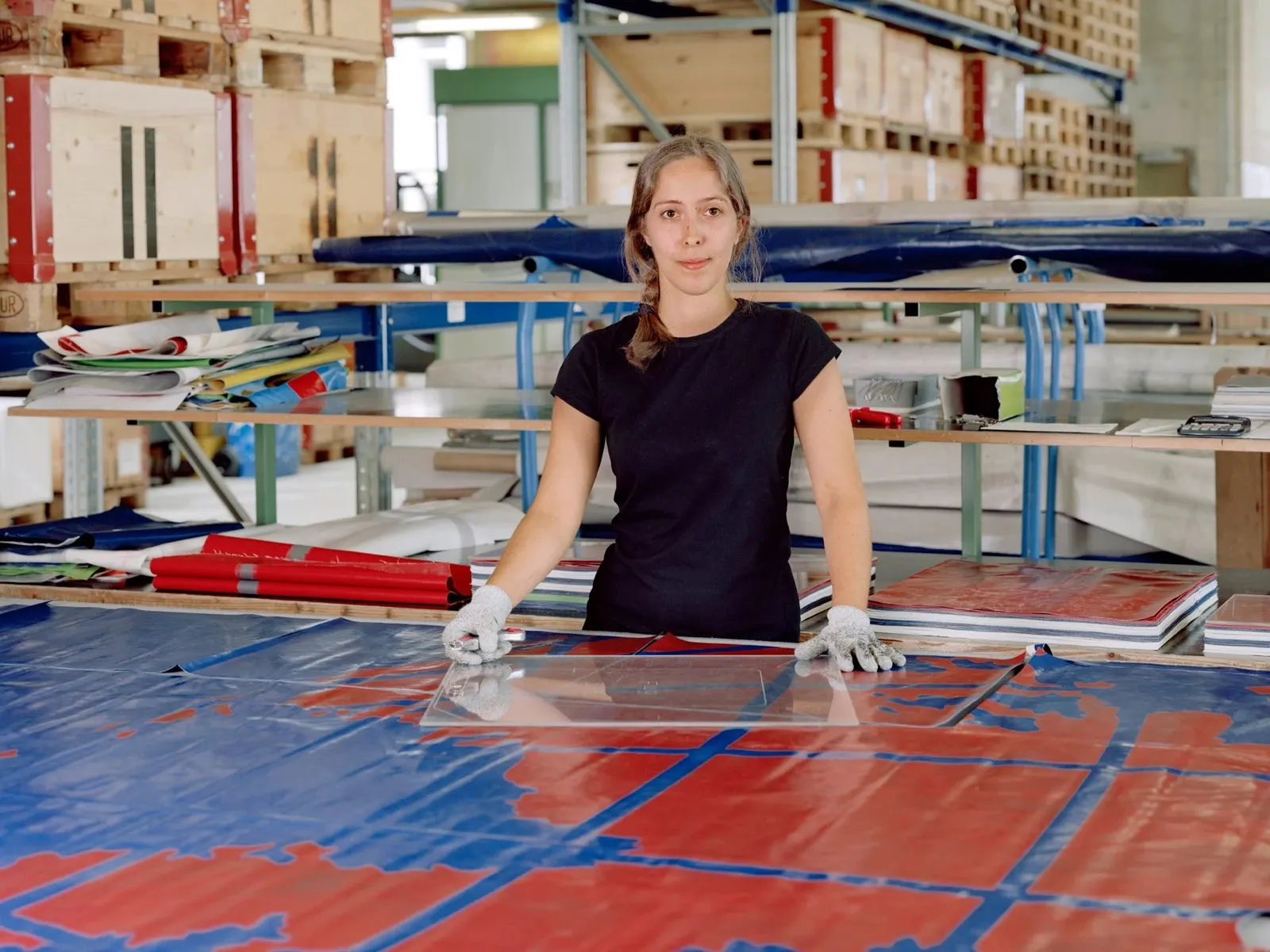
The official production guide begins with sourcing the tarps. Materials are tested for harmful substances, stripped of unnecessary fittings, and washed. A used cover is not simply folded and slung over a shoulder. Preparation turns something made for another purpose into an object worn close to the body.
Choosing where to cut is part of the design. A bag pattern placed over large letters and colored panels produces different results depending on its position. A stroke of lettering may land at the center of one bag and along the edge of another. The finished shape can be repeated while the surface remains individual.
Workers in several regions contribute to production. Processes handled in Zurich and sewing by external manufacturing partners do not all take place in one factory. Reused material still involves a sequence of collection, testing, cleaning, cutting, and stitching.
Using old material does not remove every environmental burden. What can be seen directly is a piece of a large tarp retained as the surface of a new object. Lettering once read from a distance on a truck becomes color and line carried on a shoulder.
Sources and editorial notes
FREITAG · Official five-stage production guide
FREITAG · 2023 Impact Report Production Partner Record
Editorial note: Facts were checked against the sources above; interpretations reflect MUADAILY’s editorial perspective. Image: FREITAG.
Machine-translated from Korean. Read the original.