Atsushi Futatsuya shares sashiko through the people and culture behind the patterns. We look at the rhythm of stitching and the process of making together.
Article
Small stitches across dark cloth gradually form a pattern. From a distance the lines may look even; up close, their length and spacing retain traces of the hand. Sashiko practitioner Atsushi Futatsuya does not describe the practice only as attractive geometry or a way to mend clothes. He also asks who passed it on, within what daily lives, and what people share when they stitch together.
His writing for Upcycle Stitches presents sashiko as a practice inherited through ordinary life. Needle and thread place stitches in cloth, but a single simple definition cannot capture every region and person. Calling any visible repair sashiko, or insisting on a perfectly copied pattern, can both miss the people behind it.
The Sashiko Challenge Jacket project introduced in 2019 makes that perspective tangible. Futatsuya and his collaborators planned to send materials to participants living apart, collect their stitched pieces and join them into a jacket. Cloth and thread could sustain a collective project without everyone meeting continuously in one place. Online communication and posted materials gave the established handwork a new way to connect people.
The account particularly values each participant’s pace and stitch size. Even with a shared direction for the pattern and thread colours, the rhythm of the needle remained individual. Working towards one object did not require erasing the differences between hands. A finished pattern could contain time spent in many places—a form of order different from uniform production.
Introducing his book in 2026, Futatsuya again explained why he wanted to share sashiko’s background and stories alongside technique. This can be read as an invitation to look beyond the pattern to the people, without rejecting the enjoyment of trying it. Nor does historical hardship need to be romanticised. Needing to make cloth last and choosing stitching as a hobby today can be different circumstances.
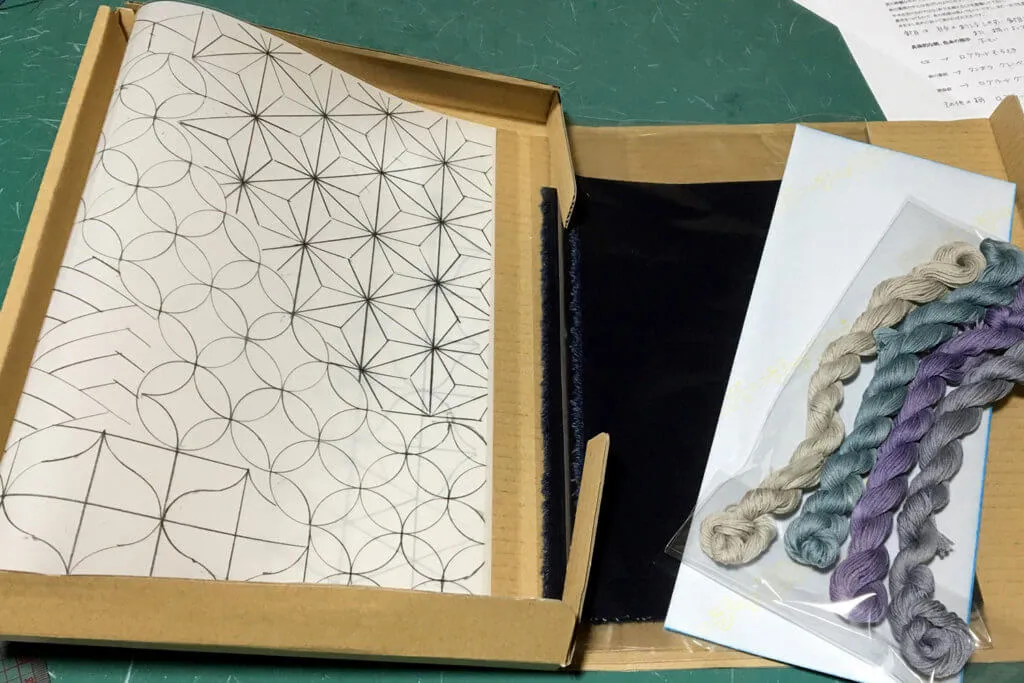
Looking at sashiko can therefore mean more than searching for perfectly straight lines. Which materials were chosen? Who taught the maker? Was the work individual or shared? Hand-stitching takes time, at different rhythms for different people. The prepared cloth and thread in the photograph invite attention not only to the pattern to come, but to the people who will make its stitches.
Sources and editorial notes
Upcycle Stitches / Atsushi Futatsuya · Author’s introduction to Sashiko: The Untold Story
Upcycle Stitches / Atsushi Futatsuya · Sashiko Challenge Jacket project
Editorial note: Facts were checked against the sources above; interpretations reflect MUADAILY’s editorial perspective. Image: Upcycle Stitches / Atsushi Futatsuya.
Machine-translated from Korean. Read the original.