October’s Orionid meteor shower begins with fragments left by a comet. This year, moonlight is part of planning when to watch.
Article
When a line of light passes by in the night sky, you see again the spot you were looking at just a moment ago. The star is still there, but the line has already disappeared. The meteor lasts only a fraction of the time spent waiting for it.
October's Orionid meteor shower comes from small pieces of debris left behind by Halley's Comet. The comet itself does not need to be nearby for this display. As Earth passes through the debris stream, the particles produce brief streaks of light in the sky.
The stars are not falling
A meteor is not a phenomenon where a single star falls to Earth. This is a phenomenon in which small matter in outer space emits light when it meets the atmosphere. The name ‘Orionids’ does not mean that all meteors are visible only within that constellation. It is named so because when the lines are connected backwards, they appear to be spreading out from that direction.
NASA's October observation guide introduces the period between the night of the 21st and the early morning of the 22nd as the peak period. However, the exact peak time and observation conditions in Korea must be confirmed separately by regional data. Reading the same date does not mean it is best viewed at the same time.
Moonlight matters this year
This time, the bright moon may obscure the faint meteor. NASA advises to look at the time after the moon sets and before dawn. Give your eyes time to adjust in a dark location and watch a broad area of sky rather than fixing on one point.
It is difficult to promise that you will be able to see a certain number. The same meteor shower looks different depending on the clouds, ambient lighting, and moonlight. When deciding when to go out in Korea, you should check the moonset, sunrise, and weather at the location you are visiting.
Although we have to wait a long time to see Halley's Comet in person, the material left behind by the comet meets us in a different way. Even a single line that appears briefly and then disappears contains traces of a much longer orbit.
Watch the official video
https://www.youtube.com/watch?v=0w5hBQcFYaw
official channel
https://www.youtube.com/@NASAJPL
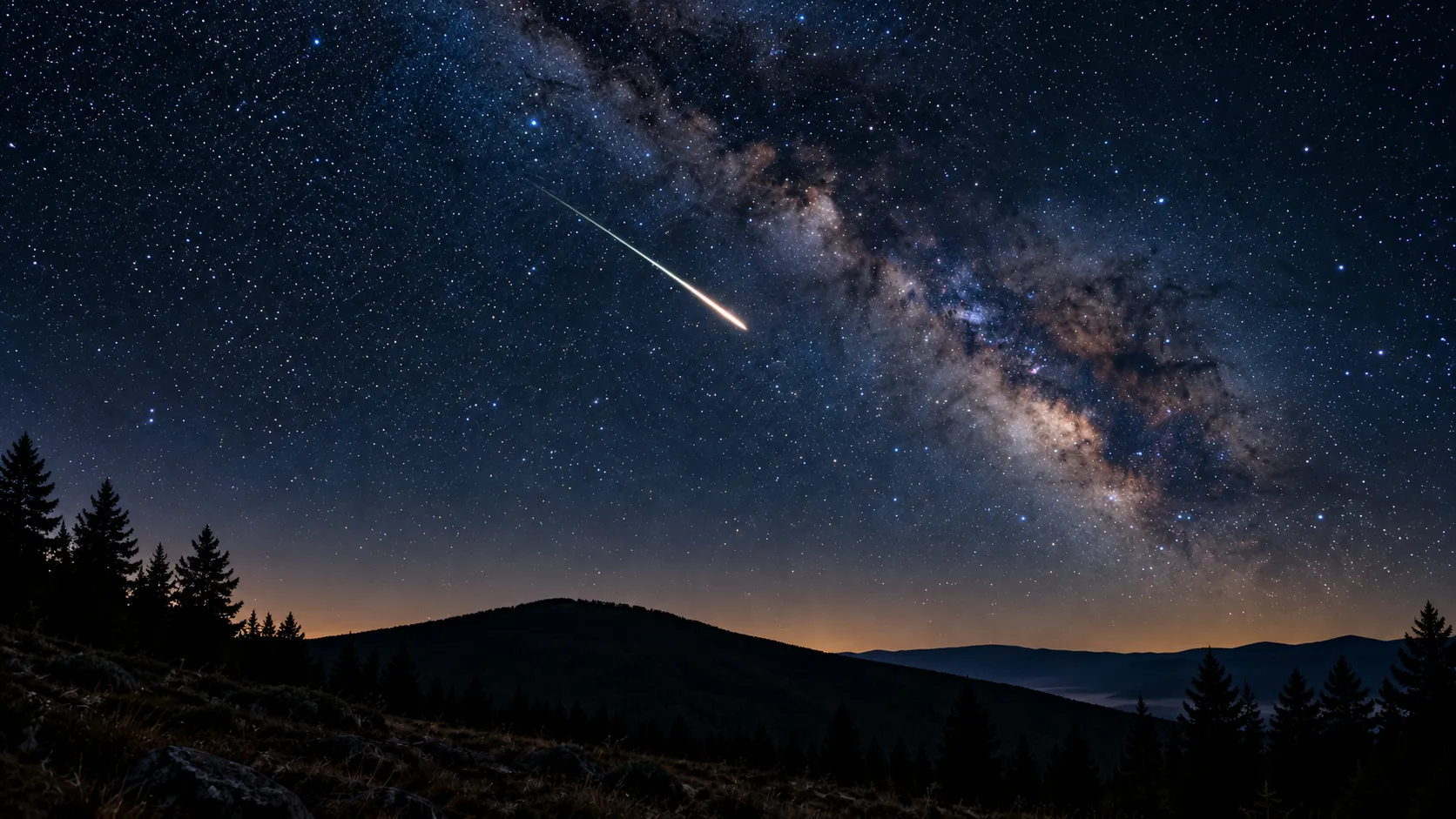
Image Guide: This is an AI-generated concept image depicting the night sky with a shooting star passing by. This is not an actual meteor shower observation photo.
Sources and editorial notes
NASA · October observation information
NASA · Meteor shower information
Editorial note: Facts were checked against the sources above; interpretations are MUADAILY’s editorial views. Image: MUADAILY · AI-generated concept image.
Machine-translated from Korean. Read the original.