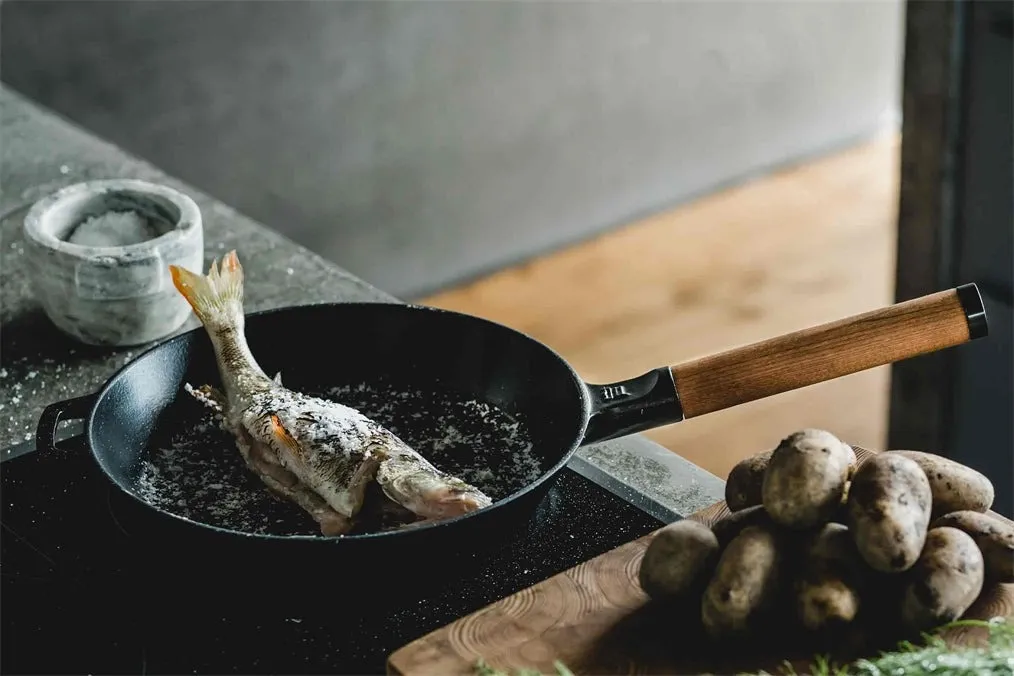
The Fiskars Norden cast-iron frying pan leaves its birch handle behind when it moves from the hob to the oven.
Article
Moving a pan from the hob into the oven means checking its handle as well as its metal body. The Norden cast-iron frying pan with a detachable handle allows its wooden part to be removed first. [1][2]
Finnish birch makes a visible boundary against the dark iron. Norden includes many utensils; this structure belongs specifically to its cast-iron frying pans with removable wooden handles. [1]
Fiskars’ US instructions for the 9.4-inch model explicitly require removing the wood before oven use. Instead of making every part withstand the same environment, the design separates what enters the heat. [2]
Cast iron retains heat after warming up. Using one vessel to sear food and then cook it through in an oven can be useful. Temperature limits still depend on the model, and removing the wood does not make hot metal safe to touch.
The wood is more than decoration. It stays attached when needed for handling and remains outside when the pan enters the oven. A change of cooking space brings a small change in the pan’s shape.
Sources and editorial notes
[2] Fiskars · Norden Cast Iron Frying Pan 9.4, 1026568
Editorial note: Facts were checked against the linked sources. Interpretations are MUADAILY’s editorial perspective. Image: Fiskars · A Fiskars Norden cast-iron frying pan used to cook fish, with its long birch handle.
Machine-translated from Korean. Read the original.