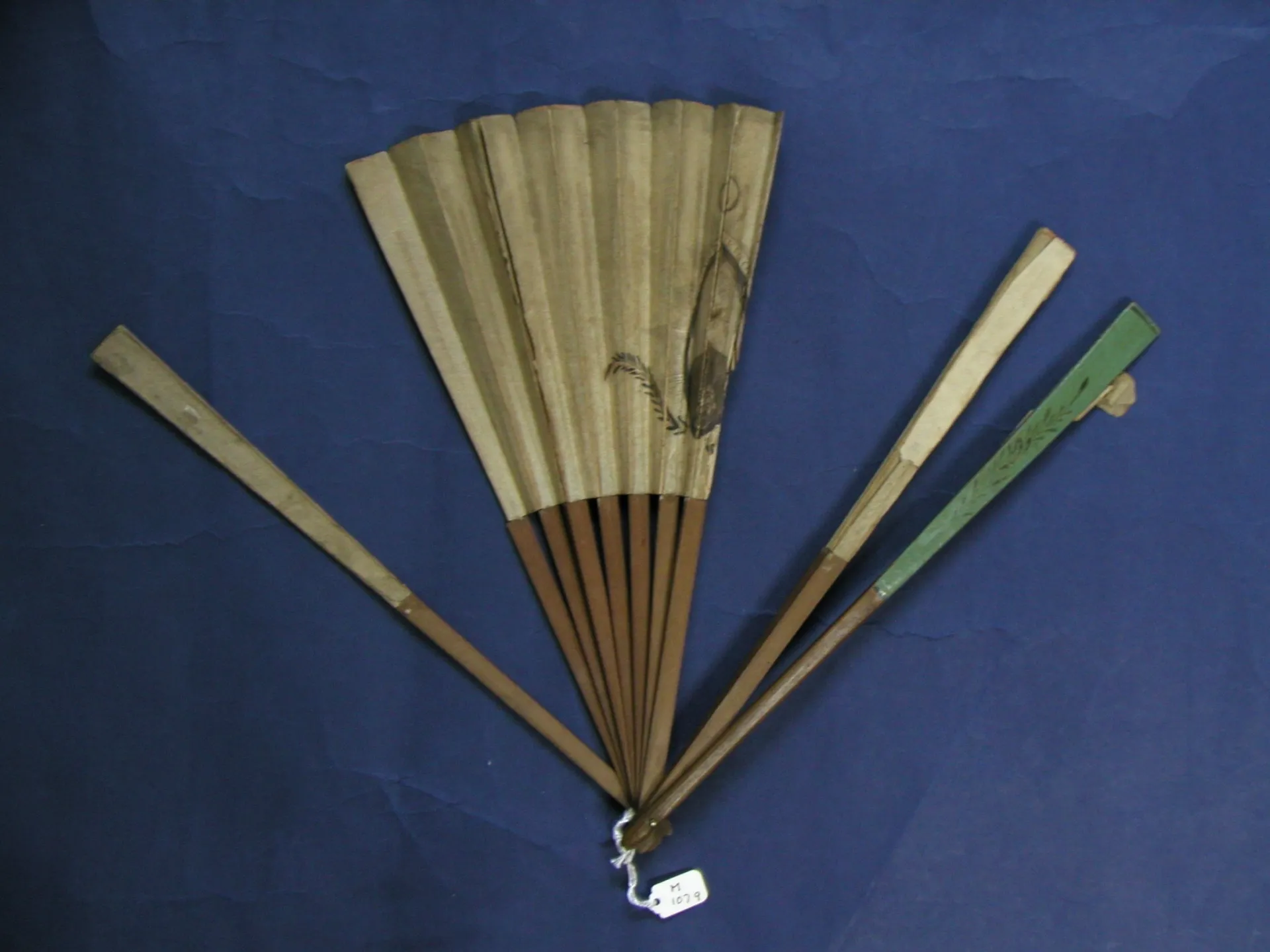
Ribs rotate around a shared pivot while the leaf folds between them. A wide picture becomes a narrow object in the hand.
Article
Push a bundle of slender sticks sideways and an almost semicircular surface opens. A folding fan combines the area needed to move air with a size small enough to carry. As the ribs move, the material between them unfolds along prepared creases.
The lower ends of the ribs share a pivot. Each rotates a little around it as the fan opens. Stronger outer guards enclose the finer ribs and folded leaf when shut. The pleats in the open surface provide places for that material to fold away.
Leaves have been made from paper, fabric and other materials, while ribs carry varied materials and decoration of their own. The same opening mechanism can take different forms. A fan with writing or a painting must be opened to reveal the complete scene; closed, its image is divided among narrow folds.
An eighteenth-century Chinese fan in the V&A joins thin sheets of mica rather than using a paper leaf. The sheets are painted and decorated with mother-of-pearl and bird feathers. Paper links the rigid mica sections, allowing them to fold as the fan opens and closes.
Close the fan again and the broad leaf disappears between the ribs. The object that moved air becomes narrow in the hand. A small pivot below and the folds above make the two shapes possible.
Sources and editorial notes
www.vam.ac.uk · 접는 부채의 살과 종이 자료 1
artsandculture.google.com · 접는 부채의 살과 종이 자료 2
Image source · Auckland Museum
Editorial note: Facts were checked against the linked sources. Interpretations are MUADAILY’s editorial perspective. Image: Auckland Museum · CC BY 4.0 · A folding fan with part of its paper leaf missing, exposing the ribs and pivot; Auckland Museum.
Machine-translated from Korean. Read the original.