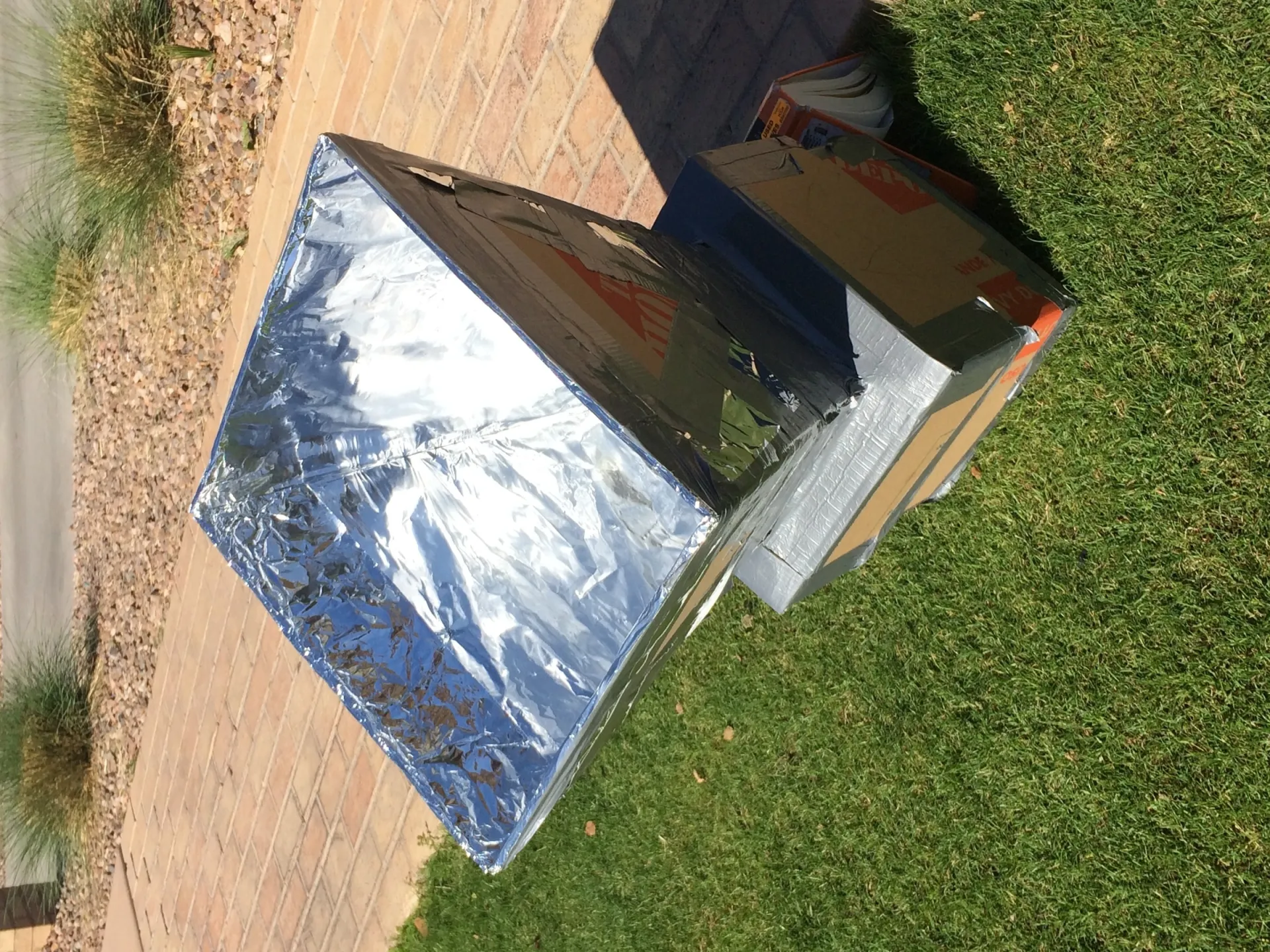
A black base, foil reflector and transparent cover turn a box into an experiment in admitting sunlight and retaining heat.
Article
Line a pizza-box lid with foil and make the base black. Tilt the lid toward the Sun and more light can be directed into the box. This is a simple solar-oven experiment: sunlight warms the interior in place of an electric heating element.
The black base absorbs incoming light and heats up. Foil does not generate heat by itself; it changes the direction of light. Its angle is adjusted to send rays into the box that would otherwise miss it. Even under the same sunlight, the lid’s position changes how much reaches the interior.
A transparent cover admits light while reducing the escape of warm air into the breeze. Closing gaps and adding insulation can also help. The oven needs both incoming energy and ways to retain the heat it has collected.
Imperial College London presents this pizza-box oven as an educational experiment. A material such as chocolate can reveal warming through melting without an electrical connection. Performance depends on weather, ambient temperature and construction, so the box cannot be assumed to match a household oven’s temperatures or cooking times.
As the Sun moves, the reflector needs adjustment. Tilting the lid shifts the bright patch across the base. Its angle is adjusted again to direct the light into the box.
Sources and editorial notes
www.jpl.nasa.gov · 피자 상자 태양열 오븐 자료 1
www.imperial.ac.uk · 피자 상자 태양열 오븐 자료 2
Editorial note: Facts were checked against the linked sources. Interpretations are MUADAILY’s editorial perspective. Image: Hunter McNenny · CC BY-SA 4.0 · An example of a solar oven made from cardboard and reflective foil.
Machine-translated from Korean. Read the original.