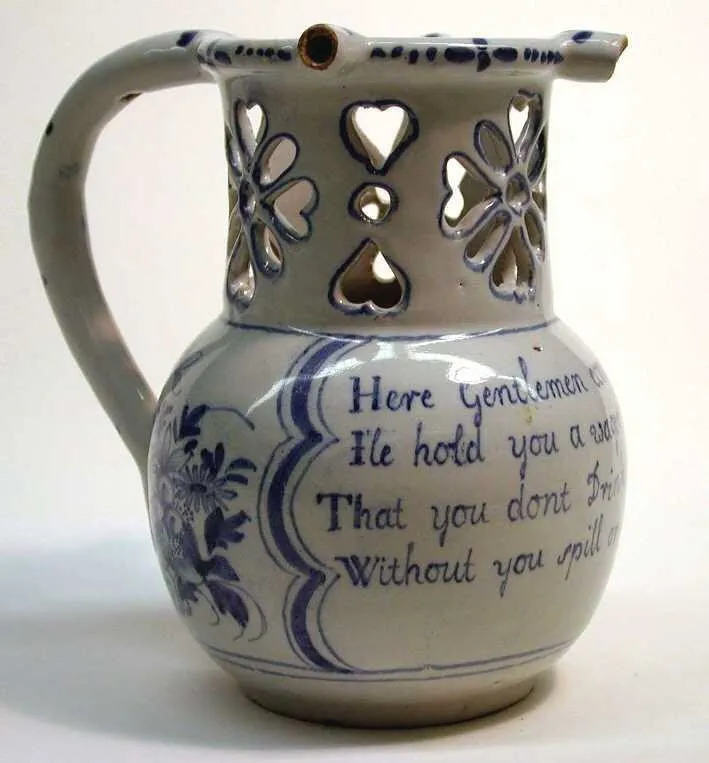
A puzzle jug leaks if you tip it. Its secret lies in a hollow handle and small drinking spouts around the rim.
Article
Holes pierce the neck of the jug. The decoration is attractive, but liquid would escape through the sides if it were tilted to pour. That is intentional. A puzzle jug was a drinking-game vessel whose user had to discover how to drink without spilling.
London’s V&A describes an example made in Bristol around 1770–75. Its material showing ceramicist Michelle Erickson recreating the jug follows the throwing of the body and the cutting of details into wet clay. While shaping the exterior, the maker also prepares a concealed route inside.
The secret in this form is the hollow handle. A passage leads from near the bottom of the jug through the handle to its rim, where a small nozzle acts like a straw. Instead of tilting the vessel to pour, the drinker draws liquid up through this passage.
Fingers must cover the unused nozzles and a hidden hole beneath the handle. Air entering through those openings makes it difficult to lower the pressure in the drinking passage and draw liquid upward. Finding which holes connect to that passage is part of the puzzle.
The large holes around the neck remain open while the person drinks. Only the small openings connected to the concealed drinking passage need to be covered. Once the answer is known, the vessel is held more like an instrument whose holes are covered with the fingers.
Sources and editorial notes
www.vam.ac.uk · 구멍 난 퍼즐 주전자 자료 1
emuseum.colonialwilliamsburg.org · 구멍 난 퍼즐 주전자 자료 2
Image source · Metropolitan Museum of Art
Editorial note: Facts were checked against the linked sources. Interpretations are MUADAILY’s editorial perspective. Image: Metropolitan Museum of Art · CC0 · A Liverpool puzzle jug in the Metropolitan Museum of Art.
Machine-translated from Korean. Read the original.