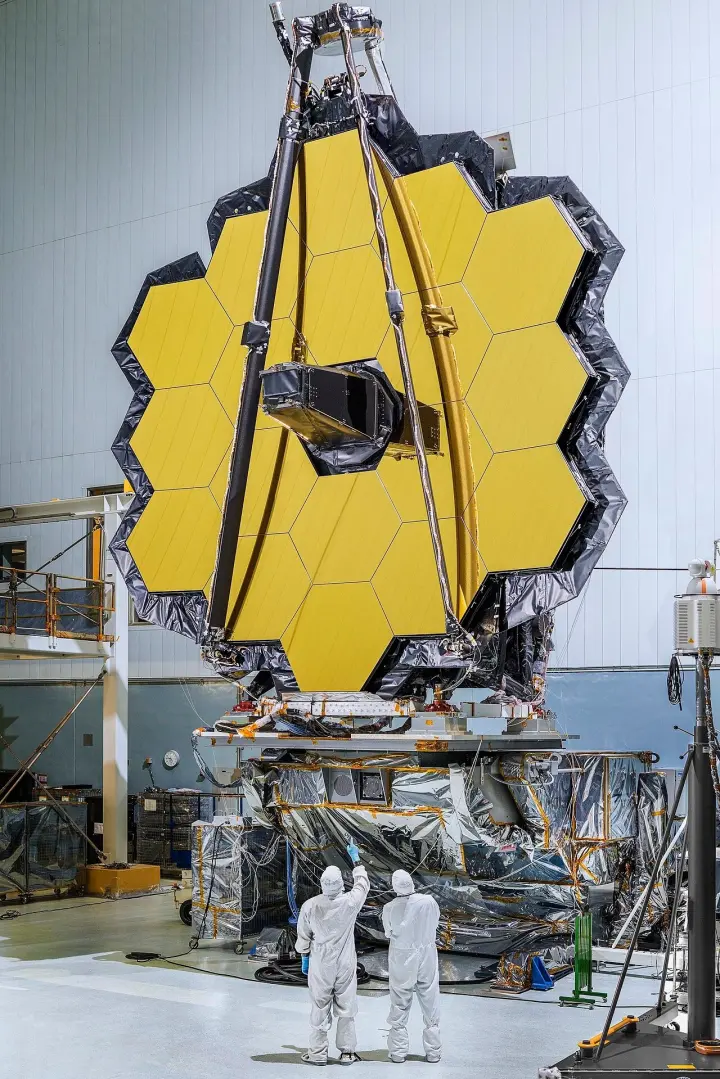
The James Webb Space Telescope observed light from a cold brown dwarf for 11 hours. Researchers traced changes in the thickness of its clouds.
Article
As the clouds pass by, the light in the room changes. Even without looking up at the sky, you can guess the weather by looking at changes in sunlight. The way astronomers looked at WISE 0855, a cold brown dwarf about 7.5 light years from Earth, started by reading changes in light. However, you cannot see the clouds there.
In a study introduced by the University of Arizona on October 8, Brittany Miles' research team observed this celestial body for 11 hours with the James Webb Space Telescope. The spectrum of light divided by wavelength was collected every 15 minutes. Instead of taking a single photo, a record of light that changes depending on time was created.
Clouds inferred from light, not photographed
WISE 0855 is a cool brown dwarf. It lacks the mass needed to sustain stable fusion in its core as a star does. Although it is a celestial body whose classification is discussed between planets and stars, this does not mean that an Earth-like surface or life has been confirmed.
What is important in observation is not the outline of the cloud, but the trace left in the light. Light passing through the atmosphere leaves different information at specific wavelengths depending on the materials in it. The researchers explain that by comparing spectra over time, they distinguished signals corresponding to changes in thickening and thinning water clouds and changes in gases deep in the atmosphere.
Beyond a change in brightness
If only the overall brightness of the celestial body has changed, there may be several causes. Regions at different temperatures may have rotated into view, or clouds or atmospheric composition may have changed. By dividing the light by wavelength and placing the changes in time order, we can compare these explanations more closely.
This is why understanding the distant atmosphere is not simply a competition to take clearer pictures. Even if the light is blurry, if you record what changed and when, you can find movement in an object that seemed like a stationary dot.
The scene presented in this presentation is unfamiliar yet familiar. Even beyond the small light captured by a telescope, the thickness of clouds changes over time. Observation records captured the changes at 15-minute intervals.
Sources and editorial notes
University of Arizona · October 8, 2026 Research Introduction
Editorial note: Facts were checked against the sources above; interpretations are MUADAILY’s editorial views. Image: Courtesy NASA/JPL-Caltech · Artist’s impression of a brown dwarf.
Machine-translated from Korean. Read the original.