Webb’s mirror folded for launch and was precisely aligned afterward. Beneath its thin gold coating lies lightweight, stable beryllium.
Article
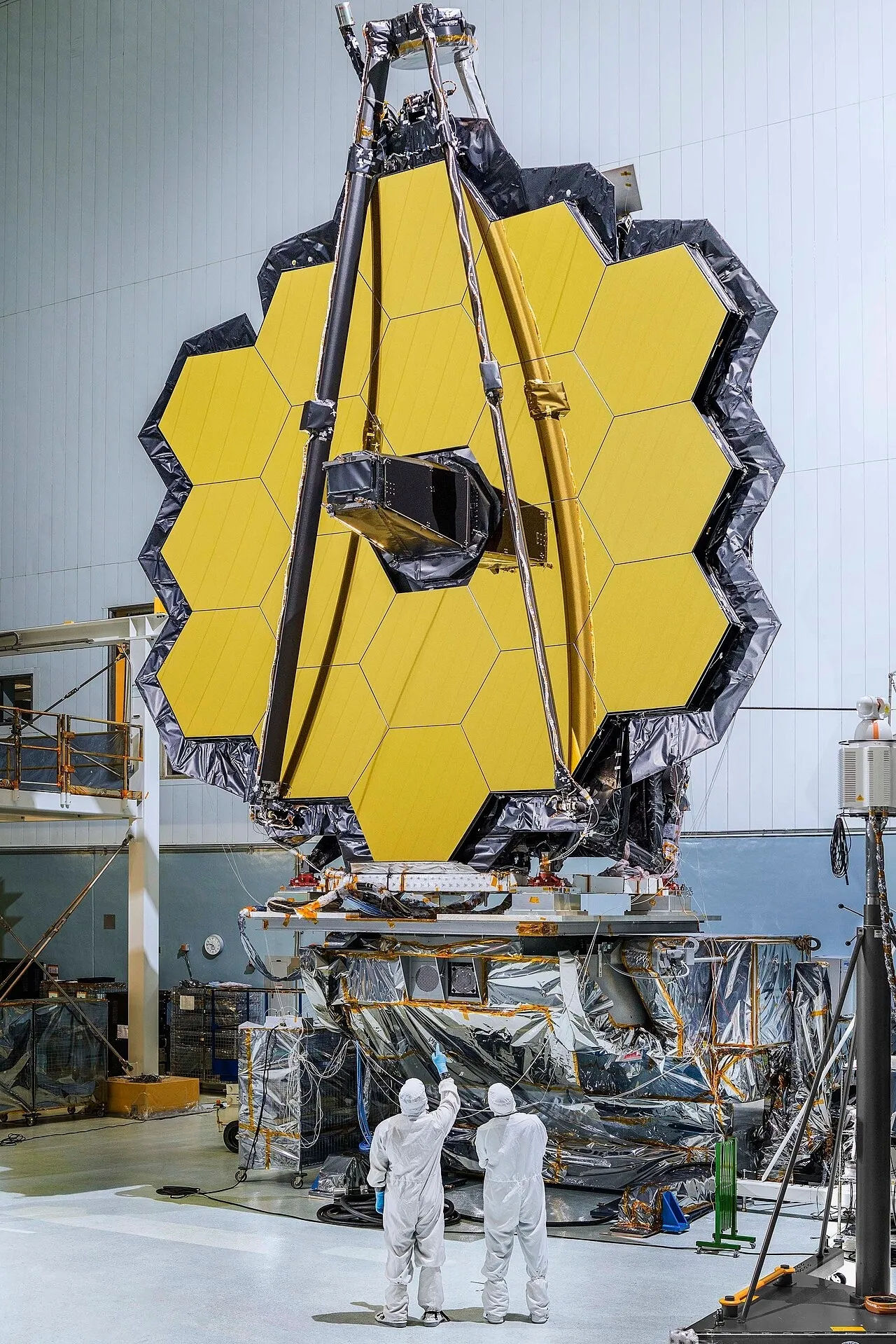
The James Webb Space Telescope’s face consists of 18 golden hexagons. Collecting faint, distant light requires a large mirror, yet that mirror must fit inside a rocket for launch. Dividing it into segments and folding its side wings meets both needs.
The primary mirror spans about 6.5 metres. Its side wings folded for launch and unfolded in space. Hexagons minimize gaps while approximating a circular overall shape. Segmentation addresses transport and assembly as well as geometry.
Beneath the gold, the mirror material is beryllium, chosen for its low weight and stability at very low temperatures. A thin gold coating reflects the infrared light Webb observes. The mirror is not cast from solid gold.
Unfolding alone does not make the segments act as one mirror. Actuators behind them precisely adjust position and shape. Their separate images must be brought together for sharp observations. Collecting area and accurate alignment are both essential.
A person standing beside the mirror in a ground-assembly photograph makes its 6.5-metre span tangible. The side wings folded to fit it into a rocket, then opened in space so the segments could be aligned individually. The hexagonal boundaries mark both the divisions that made transport possible and the pieces that had to be precisely adjusted for observation.
Sources and editorial notes
Editorial note: Facts were checked against the linked material. Interpretations are MUADAILY’s editorial perspective. Image: Chris Gunn · CC BY 2.0 · Webb’s segmented mirror during ground assembly.
Machine-translated from Korean. Read the original.