PigeonBot folds feathered wings through wrist- and finger-like movements. It studies wing shape and control rather than flapping propulsion.
Article
A pigeon’s feathers overlap as its wing folds and fan outward as it opens. Does reproducing that movement require a motor for every feather? Stanford researchers’ PigeonBot used real feathers on a flying machine to investigate the connections.
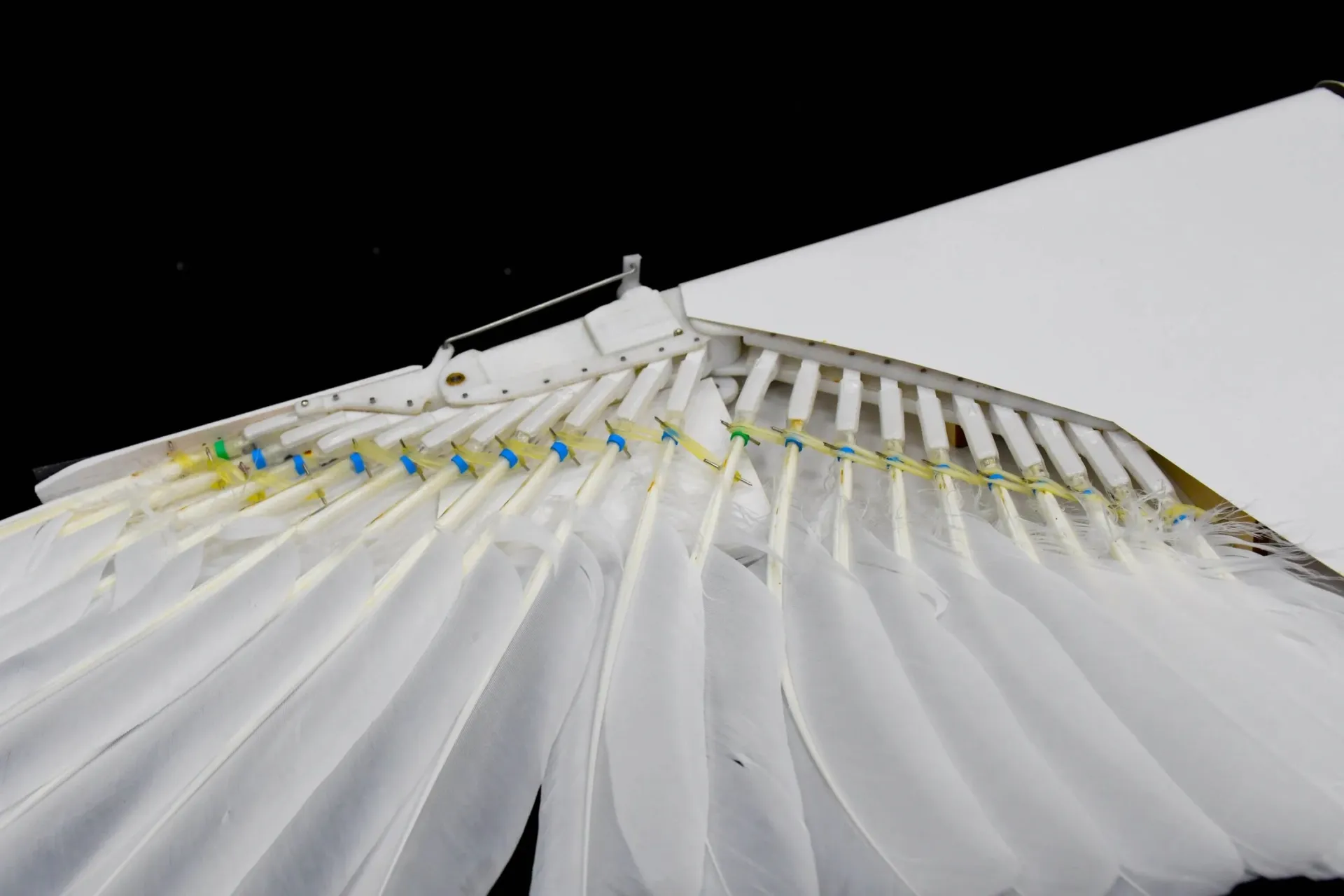
Presented in 2020, PigeonBot carried 40 pigeon feathers, 20 on each wing. Moving structures corresponding to a bird’s wrist and fingers changed the wing’s shape. Linked components opened and folded together instead of assigning an independent actuator to each feather.
Relations between neighbouring feathers also matter. Microscopic connections help prevent excessive gaps when they spread, while allowing feathers to slide over one another during folding. Researchers examined behaviour that would be missed by replacing feathers with simple plates.
PigeonBot gets its thrust from a propeller. Its wings, made with real pigeon feathers, fold and spread to control flight. The research focuses on how changing wing shape affects control, rather than on producing thrust by flapping.
PigeonBot’s wing surface is made from individual feathers. Folding overlaps them and reduces the area; spreading brings the connections between neighbouring feathers into play, helping prevent gaps. This allows movements at the wrist- and finger-like structures to change the arrangement of all 40 feathers.
Sources and editorial notes
Stanford research paper · Biohybrid robotics and PigeonBot
Editorial note: Facts were checked against the linked material. Interpretations are MUADAILY’s editorial perspective. Image: Lentink Lab / Eric Chang · Detail of PigeonBot’s wing with real feathers.
Machine-translated from Korean. Read the original.