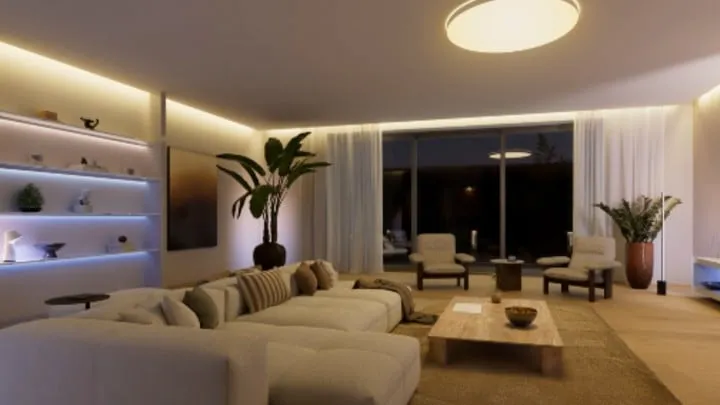
SpatialAware uses a camera-assisted map of lights to arrange colors across the room.
Article
Several color-changing lights can look attractive individually yet awkward together. Assigning colors without knowing where the sofa lamp and ceiling lights sit may produce an uneven arrangement. Philips Hue SpatialAware addresses this by mapping the lights' positions and adjusting how colors are distributed around the room.
During setup, a phone or tablet camera identifies the lights in turn. The app records their positions and uses that layout to distribute colors from prepared lighting scenes. Instead of choosing each bulb's color independently, the system considers how light connects across the room.
A sunset scene, for example, must work with different numbers and heights of bulbs in different homes. That requires choosing which light receives which color. SpatialAware uses an algorithm to adapt human-created scenes to a room. The manufacturer distinguishes it from generative AI that creates the lighting effect itself.
The requirements matter: a Hue Bridge Pro is needed, not the standard Hue Bridge. The app and Bridge Pro must be updated, and the feature works with supported scenes rather than every scene automatically. Unscanned rooms continue to use the existing behavior. Lights that are moved or added require their positions to be checked again.
Adding location to smart lighting changes setup from selecting a palette to surveying a room. Knowing where the lights sit makes it possible to arrange how the same sunset colors connect across the space.
Sources and editorial notes
Philips Hue · SpatialAware features, settings, and support conditions
Signify · Feature release introduction in Q1 2026 announcement
Editorial note: Facts were checked against the sources above; interpretations reflect MUADAILY’s editorial perspective. Image: Signify · Philips Hue SpatialAware official press release.
Machine-translated from Korean. Read the original.