To study the universe, researchers buried 5,160 sensors in ice. Francis Halzen, the 2026 Nobel laureate in physics, and the IceCube team use neutrinos to find information that starlight alone cannot easily provide.
Article
To see the stars, we find a dark place and look up. Telescopes, too, point toward incoming starlight. Yet the IceCube Observatory in Antarctica searches for neutrinos from space with sensors buried in ice. The arresting idea is to wait for the universe at a depth starlight cannot reach.
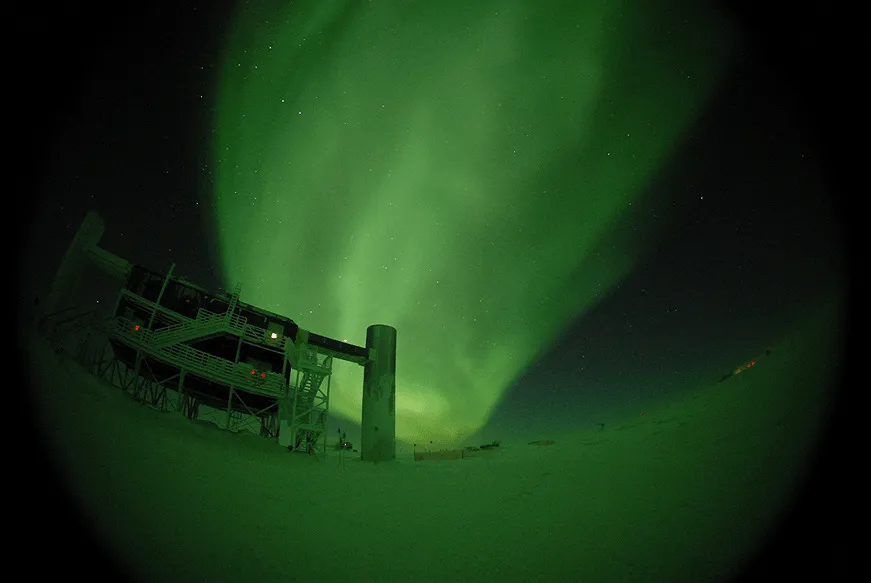
The light that matters most to the researchers is not the aurora overhead but a signal about 1.5–2.5km below the surface: a trace of the rare interactions between incoming neutrinos and the ice. The ice does more than house the equipment. Its enormous volume forms part of the detector itself.
On October 6, 2026, the Nobel Prize in Physics was awarded to IceCube principal investigator Francis Halzen for his decisive contributions to the observatory and the discovery of high-energy neutrinos from space. The award recognizes work that made these elusive particles a way to study the universe.
Hard to catch, able to travel far
Neutrinos have no electric charge and rarely interact with matter. Most pass through the entire Earth without leaving a trace. For an observer, that is frustrating: if an arriving particle does not interact inside the detector, it cannot be detected.
But those same properties help on the journey from distant space. Matter seldom blocks neutrinos, and magnetic fields do not bend their paths because they carry no charge. A signal from space is useful only if it reaches us without being lost or deflected along the way. What makes neutrinos hard to catch also makes them useful for looking far away.
The high-energy neutrinos IceCube seeks offer clues to violent activity in the universe. Alongside images made from light, they provide a way to investigate what is happening to particles in those distant places. They let researchers study the same sky through a different signal.
How does light appear in the ice?
The sensors do not photograph neutrinos themselves. When a neutrino interacts with the ice, it can produce other, electrically charged particles. As these travel rapidly through the ice, they emit Cherenkov light that the sensors can detect.
Here, “rapidly” means faster than light travels through ice. Light travels more slowly through matter than through a vacuum; this is not the discovery of a particle moving faster than light in a vacuum. It is a way to read an indirect signal left by a neutrino.
A flash reaching one sensor is only the beginning. Researchers combine the arrival times and distribution of light across many sensors to estimate a particle’s direction and energy. They work backward from the light’s path through the ice to reconstruct the information carried by the incoming particle. A tiny flash becomes an event that can be analyzed when its time and position are recorded together.
A vast volume of ice for tiny particles
Rare interactions call for a large volume in which they can occur. The original IceCube detector distributed 5,160 optical sensors through about one cubic kilometer of ice—the volume of a cube one kilometer on each side. The sensors sit roughly 1,450–2,450m below the surface.
To install them, the team melted deep holes with hot water and lowered strings of sensors into them. The water refroze around the equipment. This observatory depended on people drilling in the field, building sensors and cables, and analyzing countless signals working together.
The completed observatory began operating in 2011. In 2013, it announced the detection of high-energy neutrinos from space. An idea for embedding instruments in ice had become a way to read actual signals from the universe.
Another view of the Milky Way
In 2023, researchers released an image of the Milky Way made with neutrinos. It was not a starlight photograph recolored for effect, but a map assembled from neutrino signals originating in our galaxy. The Milky Way could now be studied through another form of observation.
Producing that image required finding signals in the data and testing the analysis with simulations. Computation that separates meaningful traces from the data is part of observing, just as the equipment that receives the signals is.
What holds our attention is more than the depth of the holes. To study something invisible, the researchers worked out what to record, then gathered those rare records into a map of the sky. The sensors in Antarctica do not look up at the stars. Even so, light recorded below the surface adds to what starlight tells us about the universe.
Sources and editorial notes
IceCube · October 6, 2026, Announcement of Francis Halzen winning the Nobel Prize in Physics
IceCube · Structure of existing detectors and principles of neutrino observation
IceCube · Representative photo original gallery and image usage guide
https://icecube.wisc.edu/press-guide/
Editorial note: Award winners, announcement dates, and research achievements are based on official announcements from IceCube and NSF. The number of sensors and depth are the configuration figures of the existing IceCube detector and are not the sum of subsequent expansion equipment. The part that explains the meaning of the observation is MUADAILY's editorial interpretation. Photo: Sven Lidstrom, IceCube/NSF. Photographers and institutions are indicated in accordance with the terms of use for informational purposes in the official gallery. The aurora in the photo is not a neutrino detection signal.
Machine-translated from Korean. Read the original.