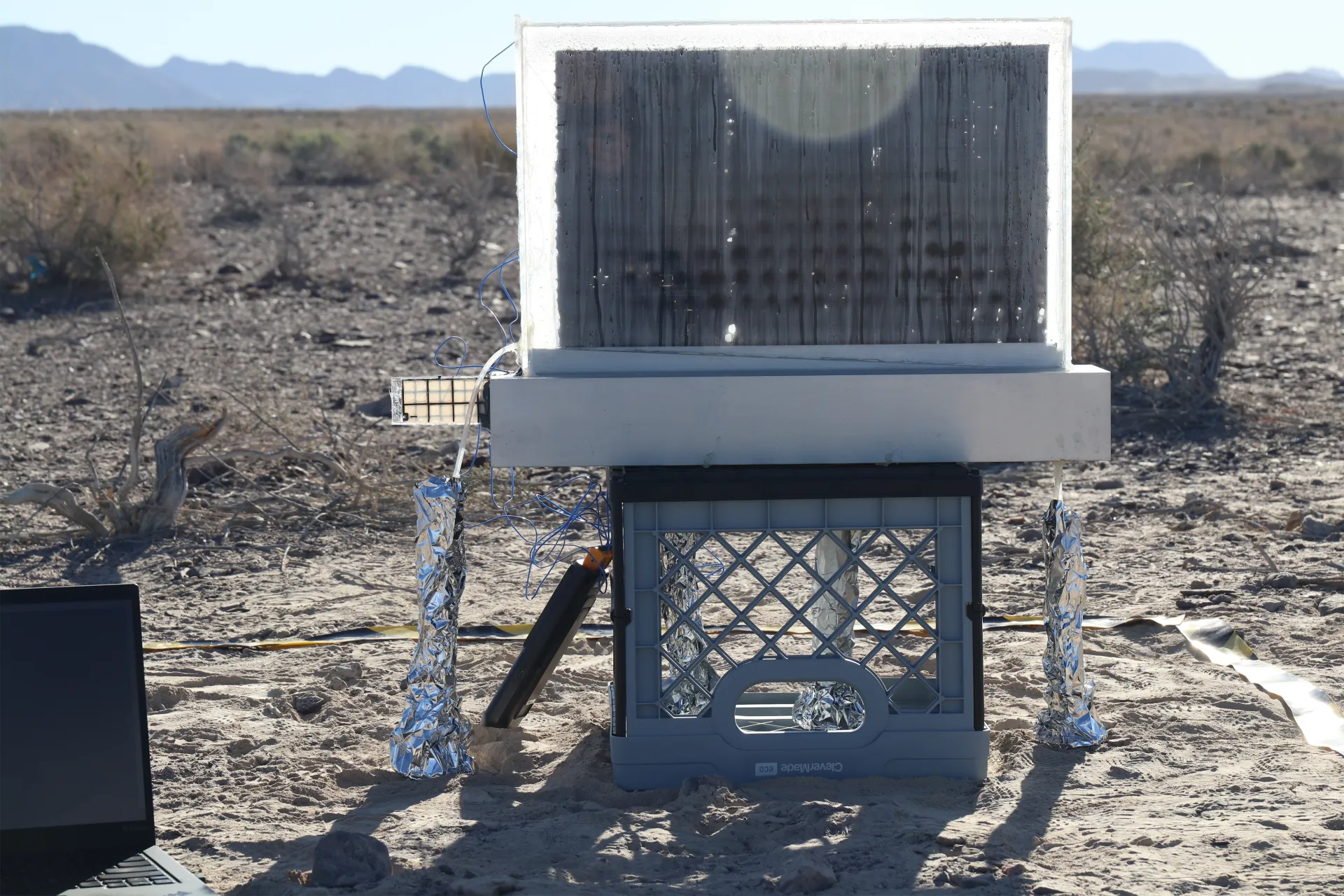
MIT’s window-shaped panel captures airborne moisture at night and releases it with sunlight during the day. Water held in a gel then condenses into droplets on glass.
Article
Water droplets on a window are usually wiped away. Collecting them below the glass offers another possibility. In Death Valley, California, an MIT research team built a device that caught water running down the inside of glass and guided it into a tube. No water supply pipe fed it, and no electrically powered chiller ran inside. The experiment collected moisture from the air across a day-and-night cycle.
The research, announced in June 2025, centers on a water-attracting hydrogel. Lithium chloride is held within a polymer network that can retain water. The salt draws moisture in, and the gel holds it. At night, when desert humidity is relatively higher, water vapor enters the material. Fog or rain is not required.
During the day, sunlight helps evaporate the water held in the gel. A cooling film on the surrounding glass helps the vapor condense into droplets on its surface. Water then runs down into a collection tube. Moisture captured overnight is released during the day and collected on the glass. The process uses sunlight and material properties rather than batteries or photovoltaic panels.
The black gel's bubble-wrap-like surface has a purpose. Small domes swell as they absorb water and shrink as they release it. Compared with a flat sheet, this increases the area exposed to air while providing volume to hold water. The team placed roughly half a square meter of gel in a windowlike glass enclosure and stood it upright, designing both the absorbing surface and the route for water to drain.
Salt's ability to attract water brings a challenge: it must not leak into the collected water. The researchers added glycerol to help keep it within the gel and reduce leakage. MIT reported salt concentrations below the applicable drinking-water threshold in the collected water. Capturing moisture and checking what comes out with it are connected parts of the work.
A weeklong field test took place in November 2023. At relative humidities of 21–88 percent, the device collected 57–161.5 milliliters a day. One panel cannot supply a household's drinking water; the researchers describe a proof-of-concept design, with combining multiple panels left for further work. The experiment demonstrated a complete route from water vapor in desert air to gel swollen at night and droplets running down glass during the day.
Sources and editorial notes
NUS Mechanical Engineering · Bibliographic record of the lead researcher’s 2025 Nature Water paper
Featured Photo License · CC BY-NC-ND 3.0
Editorial note: Facts were checked against the sources above; interpretations reflect MUADAILY’s editorial perspective. Image: Courtesy of the researchers / MIT News.
Machine-translated from Korean. Read the original.