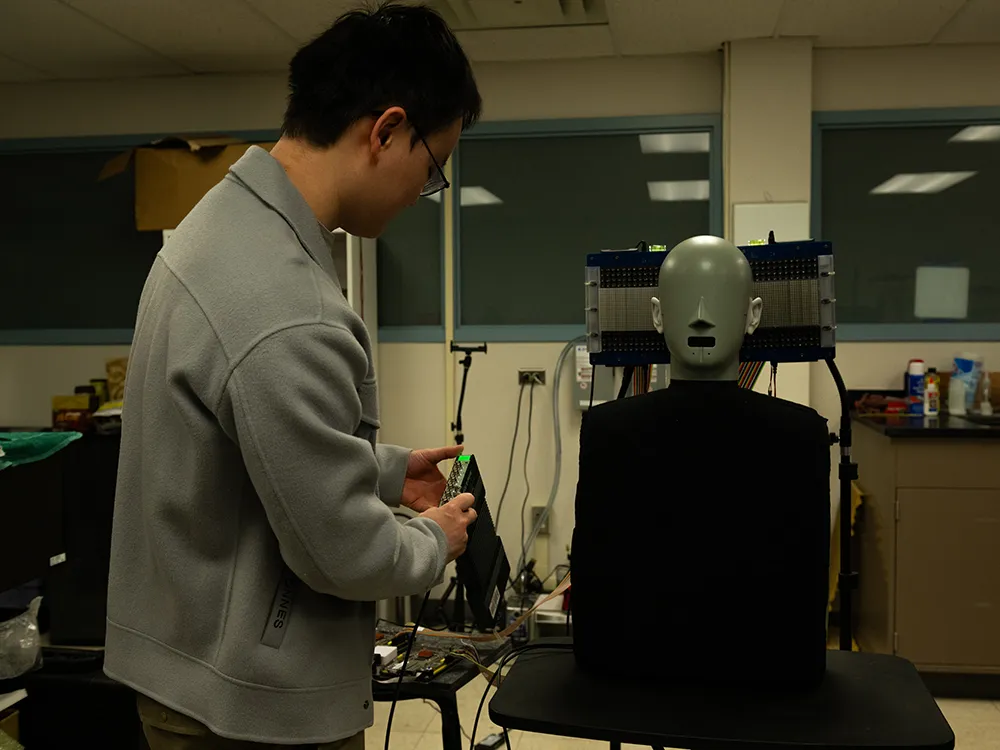
Two curved ultrasonic beams create audible sound where they meet. Researchers used microphones inside a model head’s ears to measure where the sound could be heard.
Article
Usually, headphones are needed for one person to hear music while someone nearby hears almost none of it. Researchers at Penn State and Lawrence Livermore National Laboratory instead created a small region in a room where audible sound forms. Announced in March 2025, the experiment differs from simply turning down a speaker and leaning closer.
The device sends out two ultrasonic beams at slightly different frequencies, both above human hearing. Where they overlap, the nonlinear behavior of air generates audible sound at the difference between those frequencies. In one experiment, beams at 39,500 and 40,000 hertz produced a 500-hertz tone. The audible sound is generated locally rather than carried unchanged from the source.
To bring the beams together, their paths must be shaped precisely. The researchers placed 3D-printed structures containing small air channels in front of the ultrasonic sources. Adjusting the phase of waves passing through the channels bends their paths. Two beams could then curve around opposite sides of an obstacle, such as a head, and overlap in a small region beyond it.
Testing used a model of a human head and upper torso. Microphones were placed in both ears, while another scanned the region where the beams met. This distinguished the paths of the ultrasound from the area where audible sound formed. Tests also took place in an ordinary room with sound reflecting from the walls. The paper reported localized audible regions across frequencies from 125 hertz to 4 kilohertz.
The technique does not remove all room noise. It aims to make sound delivered to a chosen location less audible elsewhere. The university described a range of roughly one meter and a level of about 60 decibels, comparable to conversation. The work did not demonstrate a commercial product or continuous tracking of a moving listener. A collaborator said further research was needed to identify useful applications and address implementation challenges.
In May 2026, the same laboratory presented a separate structure fitted over an ultrasonic speaker. Unlike the earlier crossing-beam approach, this follow-up focused sound at a fixed point like a small lens, approximately ten centimeters in front of the speaker. Playing music and moving a microphone in and out of the focus showed how recorded volume changed over just a few centimeters.
Sources and editorial notes
Penn State · Device · Model measurement · Distance and sound pressure explanation, 2025-03-17
LLNL · Remaining challenges of 3D printed acoustic structures and practical applications, 2025-04-17
Penn State · Passive cover in a separate follow-up study · Fixed focus, 2026-05-21
Editorial note: Facts were checked against the sources above; interpretations reflect MUADAILY’s editorial perspective. Image: Poornima Tomy / Penn State · Acoustic measurement experiment.
Photograph / image source
Poornima Tomy / Penn State · Acoustic measurement experiment
Image description: Researcher Jia-Xin Zhong working with a dummy fitted with microphones to measure sound along an ultrasonic path
Original aspect ratio preserved; resized and reformatted for web display
Machine-translated from Korean. Read the original.