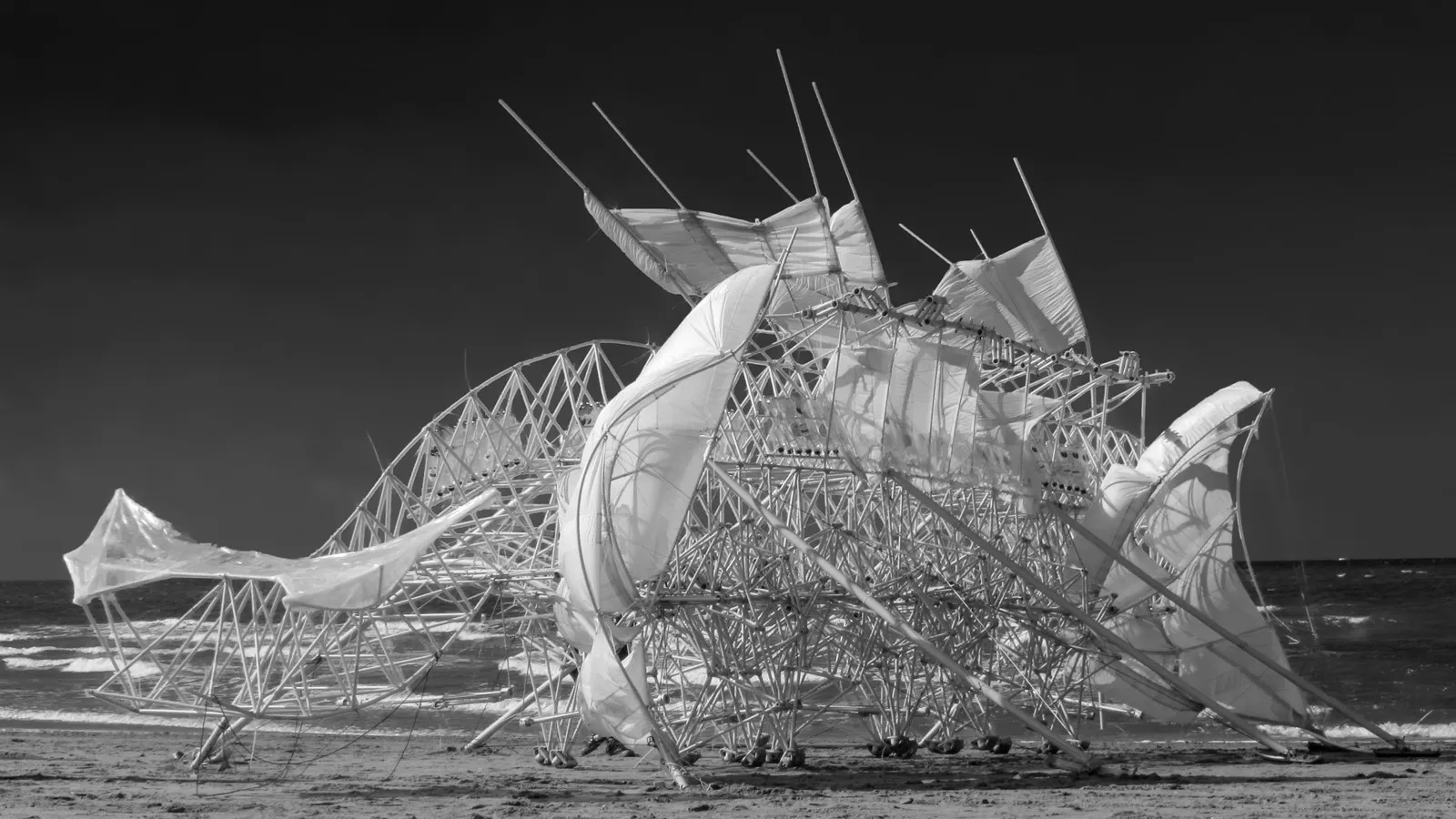
Theo Jansen’s Strandbeest walks through linked plastic tubes and joints. Carefully chosen lengths turn rotation into a movement that resembles a creature’s gait.
Article
On a beach, a yellow framework advances on several alternating legs. From a distance it resembles a large animal; close up, it is an assembly of slender plastic tubes. Theo Jansen's Strandbeest is a wind-powered walking sculpture. Rather than sliding when pushed by the wind, it lifts a foot and places it farther ahead.
Strandbeest is not the name of one finished product. It describes the family of walking structures the Dutch artist has developed over many years. Size, body shape, and ways of harnessing wind differ between generations. Jansen describes the work as creating new forms of life, but that is not a claim that the structures are biological organisms.
The main material is yellow plastic tubing used for electrical conduit in the Netherlands. Connecting tubes turns simple lines into an articulated framework. Linked joints translate rotation into the path of each foot. Designing a whole body's gait requires more than moving one piece of material.
Wind drives mechanisms that produce the legs' repeating motion, a different starting point from a motor-driven walking machine. The generations vary, however, so not every work can be described as moving independently on wind alone at all times and in every location.
Seeing a framework in a gallery differs from watching it on a beach. Outdoor demonstrations depend on weather and scheduling. The artist's website announces beach sessions according to conditions. A location shown in an old video is not a permanent show guaranteed to repeat the same scene.
The moment a foot meets the ground rewards a long look. Wind is invisible, but joints folding and extending reveal its force. A complex framework at rest becomes a recognizable gait in motion, giving the wind along the beach a rhythm of footsteps.
Sources and editorial notes
Theo Jansen · Official project/demonstration notice
The Hague official tourism agency · Description of materials, wind, and movement
Robbert van den Beld / Flickr · Wikimedia Commons · CC BY 2.0 · Image source
Editorial note: Facts were checked against the sources above; interpretations reflect MUADAILY’s editorial perspective. Image: Robbert van den Beld / Flickr · Wikimedia Commons · CC BY 2.0.
Machine-translated from Korean. Read the original.