A starshade would block a bright star to help a telescope observe nearby planets. Paper models and ground tests explore how to fold and deploy it, and how to keep it aligned with the telescope.
Article
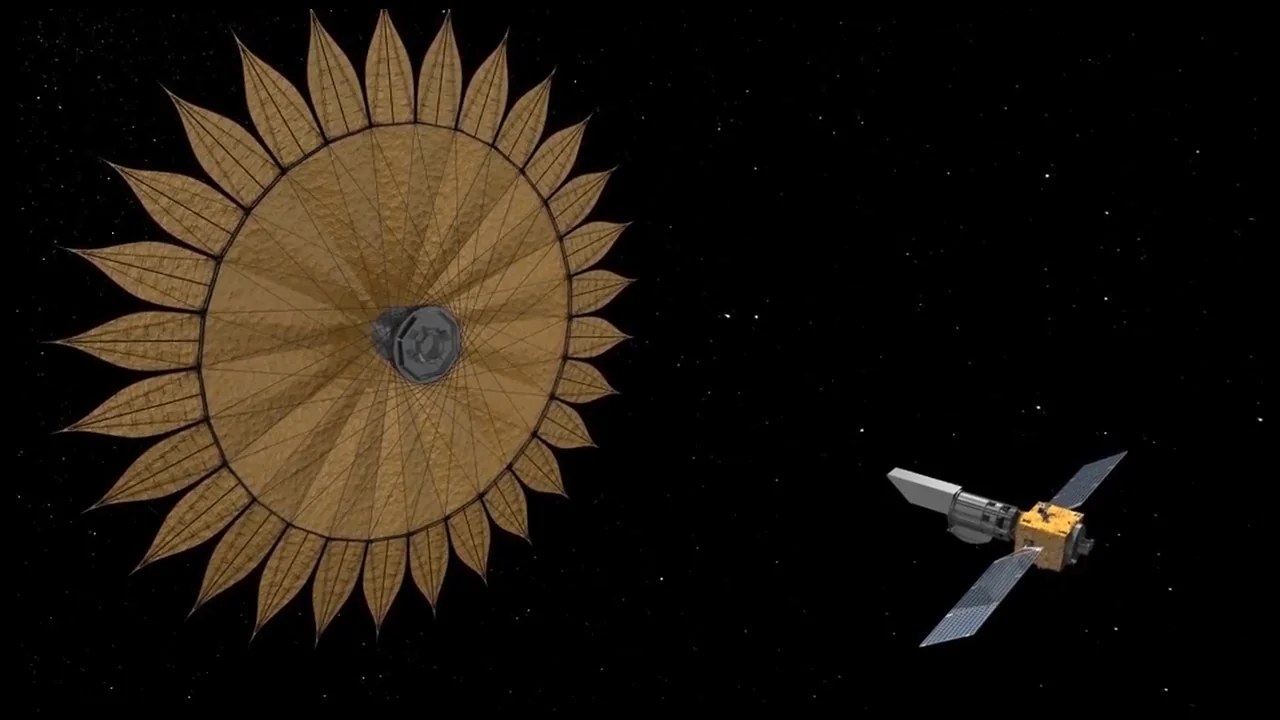
A small planet can be hard to see beside a much brighter star. Increasing the performance of a telescope and blocking starlight are two different problems. Starshade is an idea to block starlight by placing a large screen far in front of the telescope. The flower-like edges are shaped to control how starlight is blocked.
In NASA's explanation, the starshade is distinct from the parts that go into the telescope. It would fly separately from the space telescope, positioned between the telescope and the target star. This method blocks the strong light from the star and allows the telescope to receive the weak light from the surrounding planets. The screen and telescope must be spaced apart and aligned exactly.
The wide-open structure comes with transportation problems. Since it cannot be placed in the rocket in the size required for observation, it must be folded small, loaded, and then unfolded later. Researchers have studied how the outer petals could wrap around the central structure for launch. The design must meet two requirements: a precise shape when deployed and a compact volume when folded.
The paper model released by JPL allows us to examine the principle of folding the inner disk. If you fold the paper along the lines marked on it, the parts surrounding the central hexagon come together in a spiral. The blue line is a mountain fold, and the orange line is a valley fold. The paper model is an educational illustration of the inner light shield, not a working spacecraft. JPL cautioned that this model should not be used to experiment with blocking sunlight.
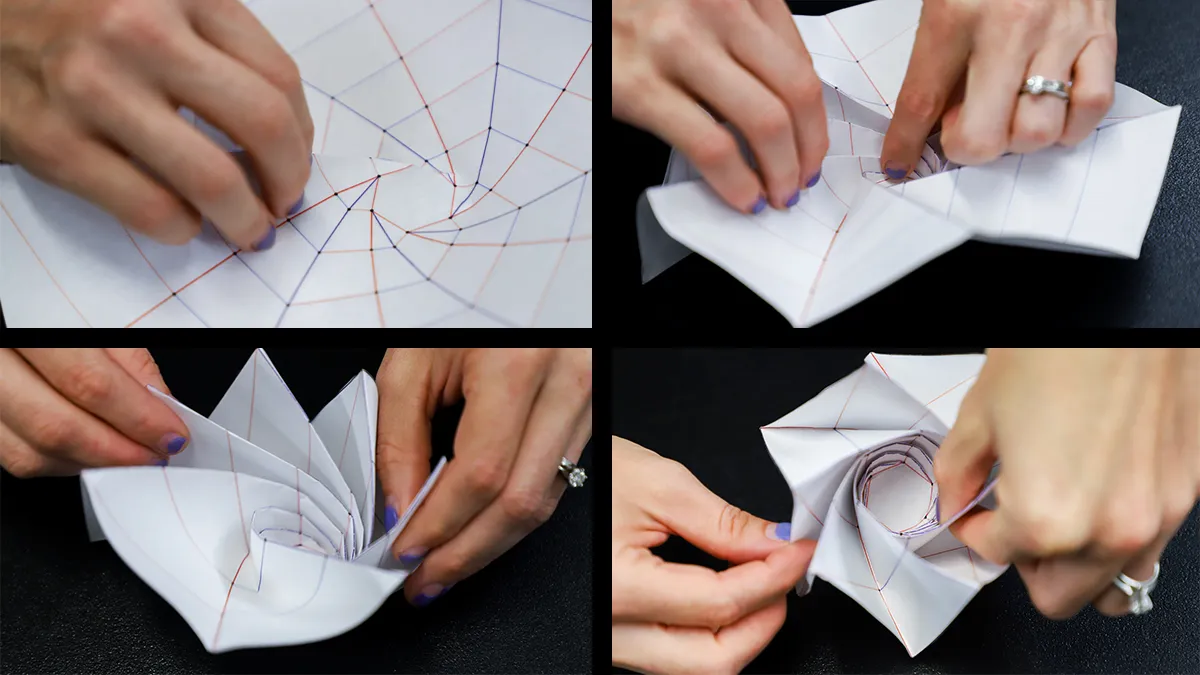
Photo credit: https://www.jpl.nasa.gov/edu/resources/project/space-origami-make-your-own-starshade/
The conditions for unfolding a model and unfolding an actual structure are also different. A 2014 ground test photo released by JPL shows a half-scale structure and four petals. The structure was unable to withstand its own weight on Earth, so the load was relieved with support devices and counterweights. You can see what kind of test scene it is by looking at the lines hanging from the ceiling.
What is needed in space is maintaining the position after unfolding. In a 2019 announcement, JPL introduced research that reads the degree of misalignment through bright and dark patterns coming into the telescope and corrects the position with a thruster. JPL explains that the exact size of the screen and the distance between the two devices will vary depending on the mission and telescope. Not all starshades use the same size and spacing.
Paper models and ground tests are separate from actual space operations. NASA also introduced a separate research initiative in 2026 that would combine orbital starshades and ground-based telescopes. When looking at the folding and unfolding structure, you can also check what kind of model it is and what stage of testing it is at. In the ground test photo, there is still a device under the unfolded petal to support the weight.
Photo Caption: NASA/JPL-Caltech concept diagram showing starshade and space telescope deployment. This is a concept illustration, not a photograph taken in space
Image source/terms of use: NASA/JPL-Caltech; concept illustration
https://www.jpl.nasa.gov/news/starshade-would-take-formation-flying-to-extremes/
https://www.jpl.nasa.gov/jpl-image-use-policy/
Image changes: resized with the aspect ratio preserved and converted to WebP.
Sources and editorial notes
NASA JPL Education · Space Origami: Make Your Own Starshade · Updated 2024-10-11
NASA JPL · Starshade Would Take Formation Flying to Extremes · 2019-06-11
NASA JPL · PIA20909 Starshade Deployed at JPL · 2014 test photo caption, released on 2016-08-09
NASA JPL · NASA Research Proposes Technology to Seek Earth-Like Exoplanet · 2026-03-25
Editorial note: Factual statements are based on the sources above; interpretations reflect MUADAILY's editorial perspective. Image: NASA/JPL-Caltech; concept illustration.
Machine-translated from Korean. Read the original.