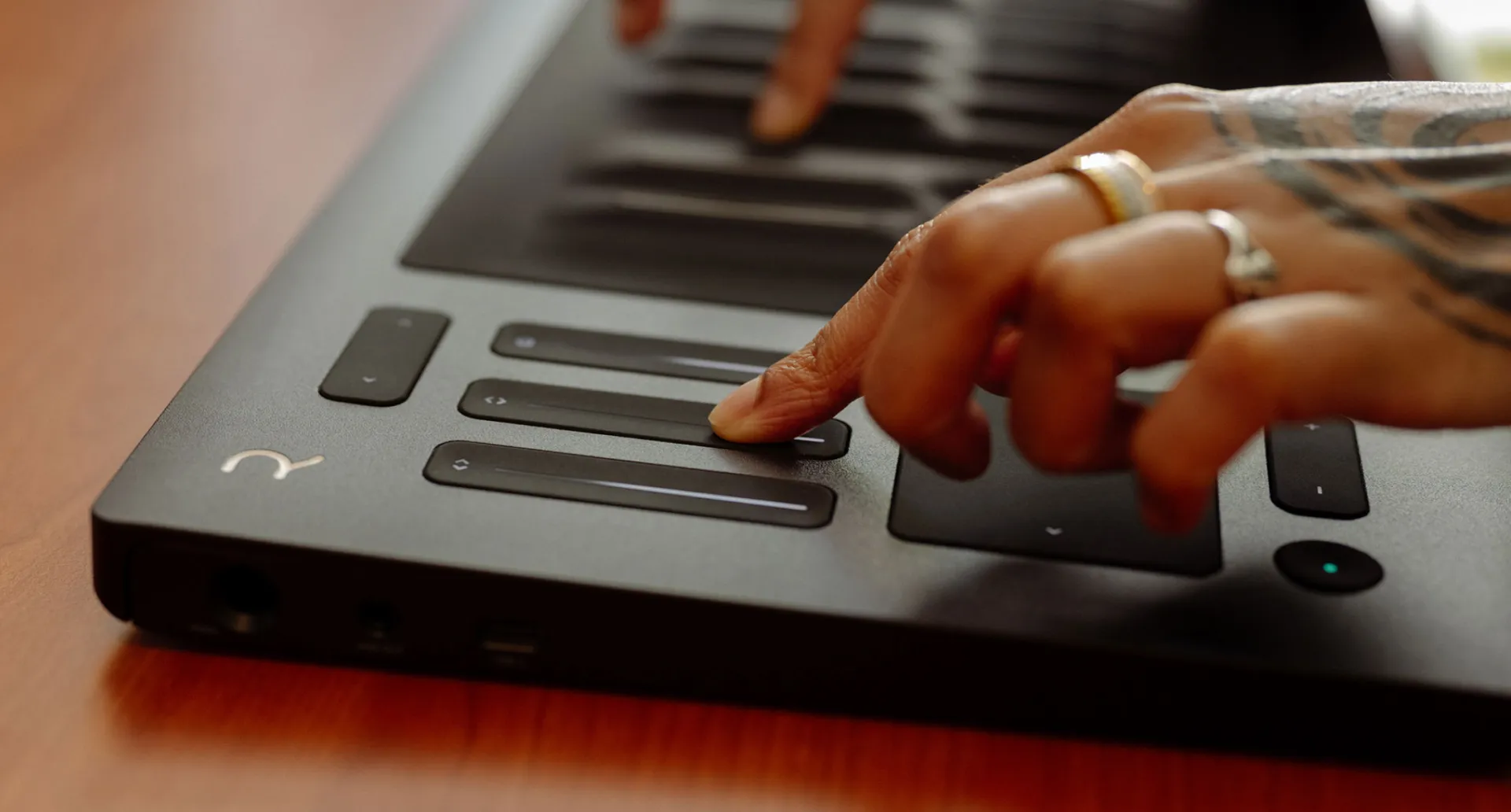
ROLI's Seaboard 2 responds to finger movements after the initial strike. Pressing, wiggling, and sliding let players shape the pitch and timbre of a sustained note.
Article
On a piano, how firmly you strike a key changes the sound. ROLI's Seaboard 2 also responds to what your fingers do after the initial strike. Keeping a finger on the surface and moving it from side to side or forward and back can change a note's pitch and timbre. In place of rigid black and white keys, it has a soft, continuous surface shaped like black waves. You can shape a sustained note much as a string player or singer might add vibrato.
The manufacturer calls this input system “5D Touch.” It senses five gestures: the initial strike, continuous pressure, movement from side to side, movement forward and back, and the speed at which a finger lifts off. How each gesture changes the sound depends on the connected software and sound settings. After starting a note, you can continue to shape it by varying pressure or moving your finger.
Raised ridges help you locate the notes. The layout is based on a familiar keyboard, but the continuous surface lets your fingers slide sideways across it. Holding a note and gently moving your finger from side to side can add vibrato. Finding the note is joined by another task: shaping how it continues.
Seaboard 2 is a controller that transmits your gestures; it has no built-in sound engine. To produce sound, it needs to be connected to a compatible software or hardware instrument. Adjusting the pitch or timbre of individual notes while playing several at once requires an MPE-compatible instrument and appropriate settings. The connected instrument must be able to respond to the gestures Seaboard detects.
Because the surface responds to small movements, getting comfortable with it is likely to take practice. An unconscious wiggle of a finger could produce an unintended change in sound, and pressing the soft surface feels different from pressing a piano key. The nuances heard in the manufacturer's demonstrations are examples of what these controls can produce. How long it takes to make those movements a natural part of a performance may vary from player to player.
What draws attention to Seaboard is what happens after a note begins. While it sounds, you can wiggle a finger to add vibrato or slide it to change the pitch. There is something to do even before moving to the next note in the melody. The keyboard layout is familiar, but the hand resting on it has new movements to learn.
Sources and editorial notes
Editorial note: Factual statements are based on the sources above; interpretations reflect MUADAILY's editorial perspective. Image: ROLI.
Machine-translated from Korean. Read the original.