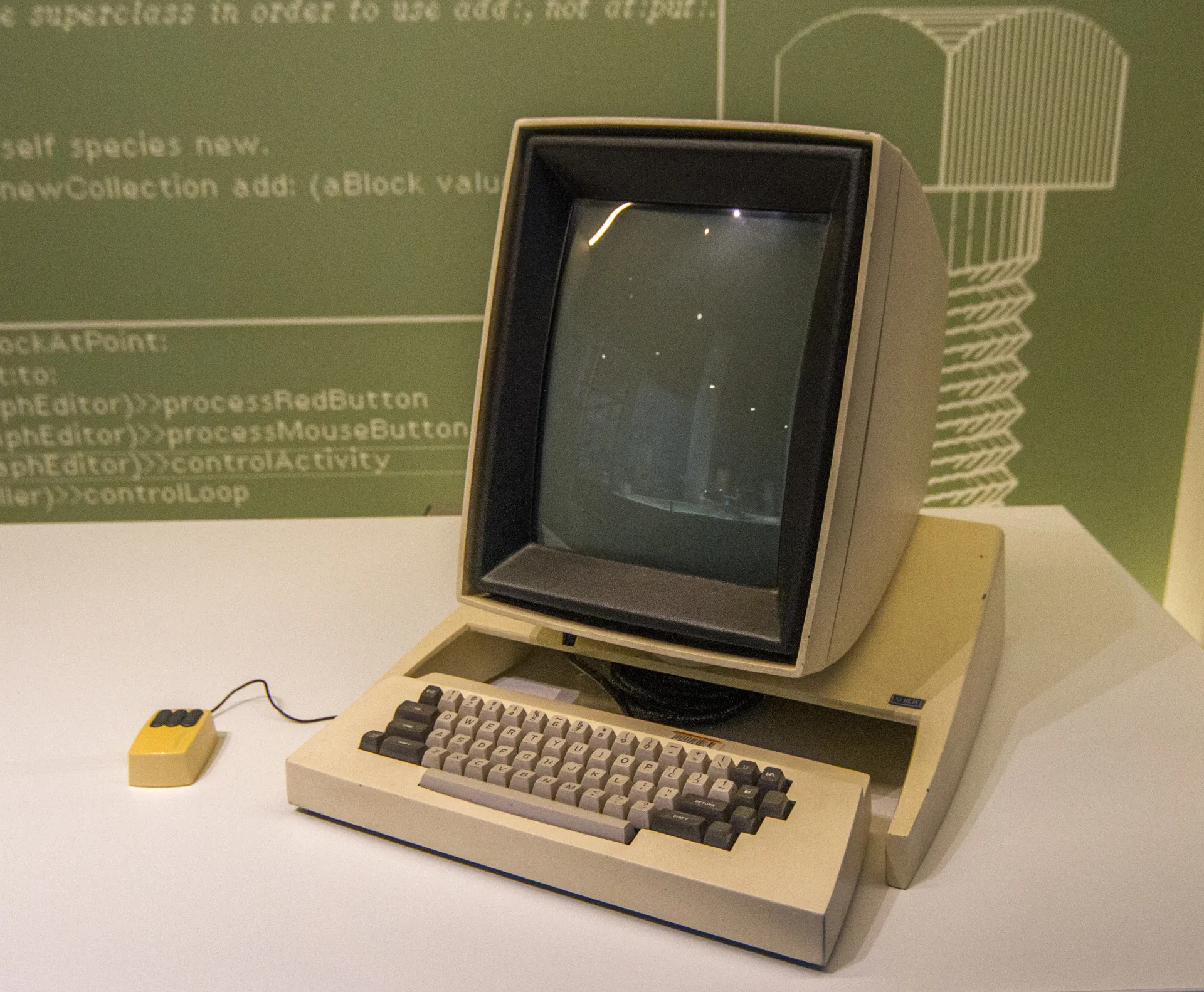
The Xerox Alto of the 1970s demonstrated a way of working with things on a screen by pointing to them.
Article
Opening a document does not always require remembering its exact filename. You can scan the screen for a familiar name or icon and select it with a mouse. The screen and mouse of the Xerox Alto take us back to an early example of that familiar action in the 1970s.
The Computer History Museum describes the Alto’s graphical display and mouse. The rolling-ball mouse in its collection transmitted hand movement through a ball underneath. The desktop where the mouse moves and the screen where the pointer moves are different places, yet users experience the two motions together.
In the museum photograph, the Alto has a tall, portrait-oriented display, unlike the wide monitors common today. A separate mouse sits beside the keyboard. Hands move to the keyboard to enter text and to the side to choose a point on the screen. The arrangement divides typing and pointing between two devices, rather than assigning every operation to the mouse.
Moving the mouse along a surface turns its ball. Detecting that rotation yields movement along two axes, which shifts the pointer accordingly. The small device on the desk lets a user indicate a position without touching the monitor itself.
Comparing the Alto with a modern computer, it is revealing to consider what the screen and mouse made possible together rather than only asking when each device was first invented. Display proportions have changed and the mouse ball has largely disappeared, but the sequence of looking and pointing remains familiar.
Being able to find a target on screen changes what users need to remember. Instead of recalling an exact command, they can look where a document is likely to be. Seen together, the Alto’s screen and mouse show a computer becoming not just a place to display results, but a surface on which to select and work with things.
Sources and editorial notes
www.computerhistory.org · Official source
www.computerhistory.org · Official source
Editorial note: Factual statements are based on the sources above; interpretations reflect MUADAILY’s editorial perspective. Image: Maksym Kozlenko / Wikimedia Commons · CC BY-SA 4.0 · https://creativecommons.org/licenses/by-sa/4.0/ · Converted for web display.
Machine-translated from Korean. Read the original.