NASA’s shape-memory-alloy tire accommodates deformation through metal rather than pressurized air. It remains ground-tested technology for exploration.
Article
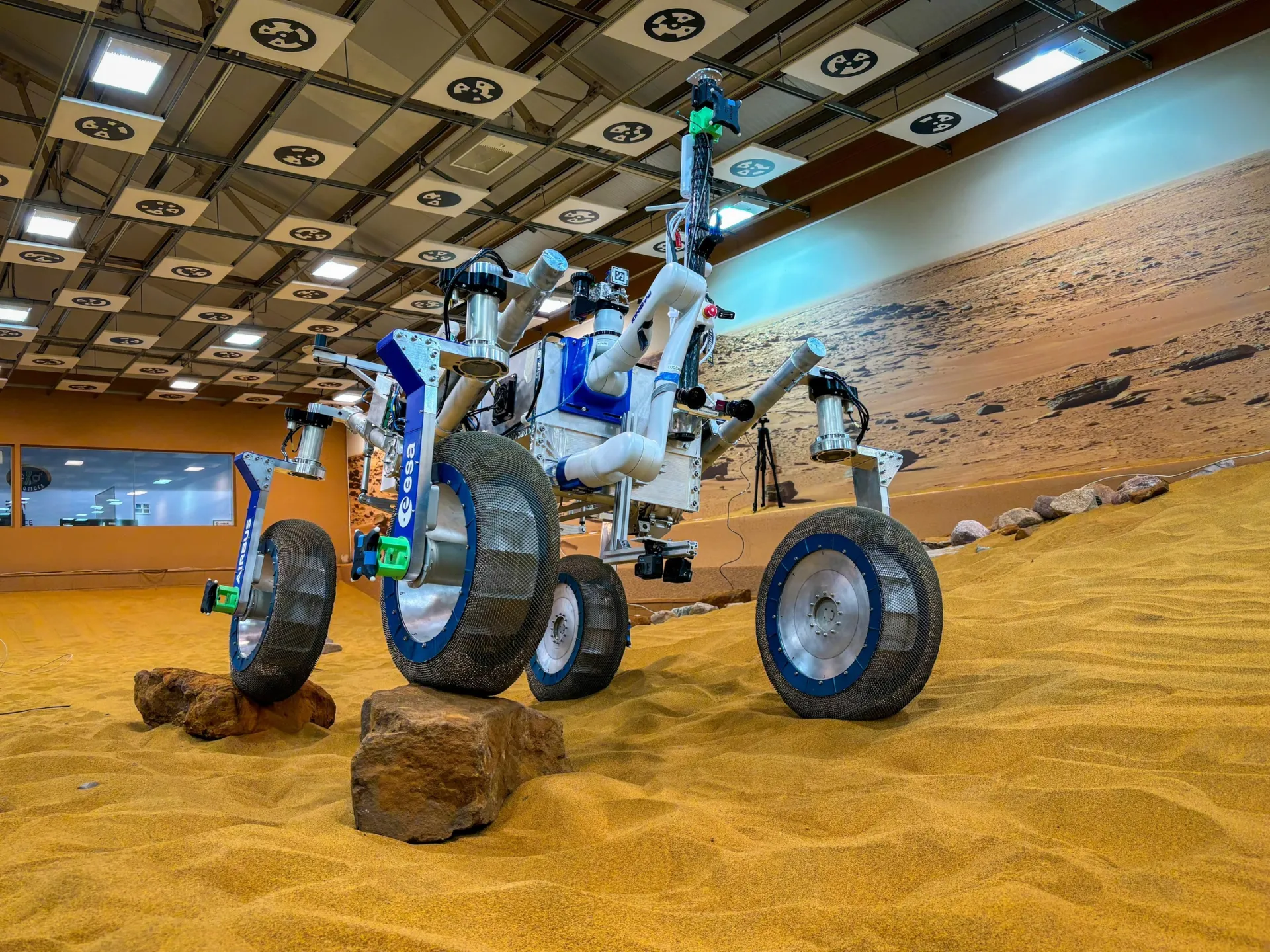
A wheel climbs over uneven rocks. In place of black rubber, woven metal wires yield around the surface and recover. NASA’s shape-memory-alloy spring tire contains no pressurized air. It is being studied for exploration vehicles travelling far from a repair shop.
Hardness alone is insufficient. A wheel must absorb rough terrain and recover its shape. This tire uses the superelastic behaviour of a nickel-titanium alloy. Combining that material with a mesh structure offers a different approach to work usually done by rubber and air.
Tires developed with NASA and Goodyear were tested in autumn 2024 at Airbus’s Mars Yard in Stevenage, England. NASA’s 2025 account describes observing rock traversal, downhill sliding, deformation and damage. The pictured terrain is an Earth test site, not the Martian surface.
With no pressurized air inside, the tire cannot suffer a puncture through loss of inflation. What matters instead is how well the metal mesh recovers after impact and the temperatures at which it performs as intended. Repeated terrain tests help establish those conditions.
As the wheel climbs a rock on the test course, part of its metal mesh compresses and then recovers beyond it. Researchers check whether the tire regains its shape after repeated deformation. Even without air inside, a wheel must yield to the ground and be ready to do so again at the next rock.
Sources and editorial notes
NASA · Mars terrain tire tests
NASA Technology Transfer · Superelastic tire
Image use terms · NASA informational/editorial use
Editorial note: Facts were checked against the linked material. Interpretations are MUADAILY’s editorial perspective. Image: NASA · NASA informational/editorial use · Shape-memory-alloy tire tested on Earth.
Machine-translated from Korean. Read the original.