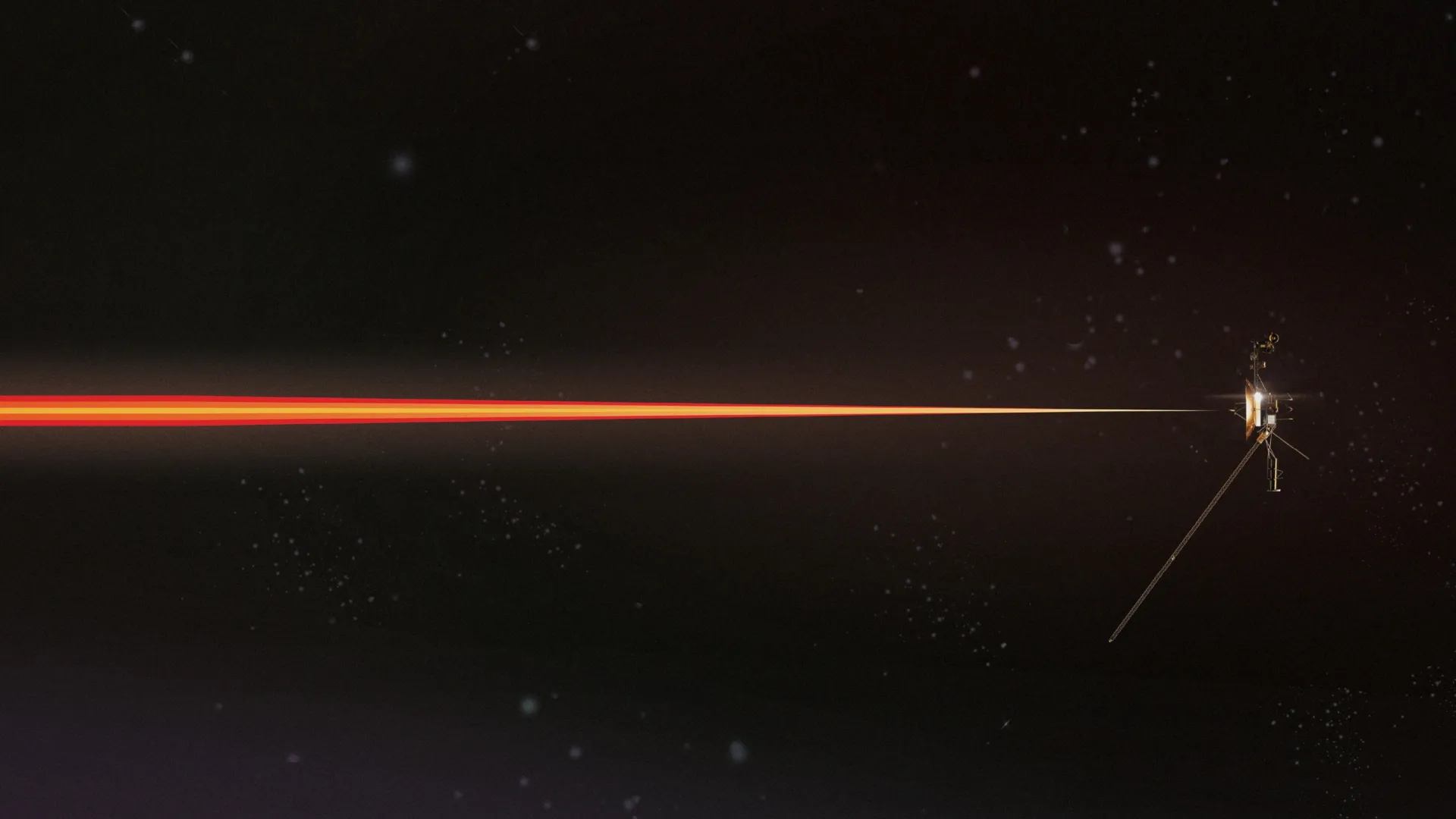
One light-day from Earth, the spacecraft’s carrier signal crossed the distance even while its science data were missing.
Article
A signal from Voyager 1 now takes a day to reach Earth. The spacecraft passed the one-light-day mark on November 18, 2026; NASA announced the milestone the following day. Even radio waves travelling at light speed need 24 hours to cross that distance. [1]
According to NASA’s November 19 announcement, science and engineering data from Voyager 1 had not been received since November 14, although its carrier signal remained detectable. This is the underlying radio wave used to carry information. Earth’s antennas could detect it but could not read the spacecraft’s measurements or status information. [1]
Checking the spacecraft requires data about its condition. Detecting the carrier established that a radio signal was reaching Earth, but did not show that the equipment had recovered. The information needed to locate the problem was still missing. [1]
Distance also enters the repair process. Sending a command and receiving its result requires roughly two days of radio travel alone. Processing the command and analysing the response add further time. Troubleshooting is very different from restarting equipment beside a desk.
Launched in 1977, Voyager 1 entered interstellar space in 2012 after crossing the boundary of the Sun’s wind-filled bubble. Its distance from Earth has now grown to the distance light travels in a day. The signal arriving at Earth today left the spacecraft a day earlier. [1]
Sources and editorial notes
[2] Image licence · NASA/JPL informational use
Editorial note: Facts were checked against the linked sources. Interpretations are MUADAILY’s editorial perspective. Image: NASA/JPL-Caltech · NASA/JPL-Caltech’s artist’s concept of Voyager 1 in flight; this is an illustration, not a photograph taken in space.
Machine-translated from Korean. Read the original.