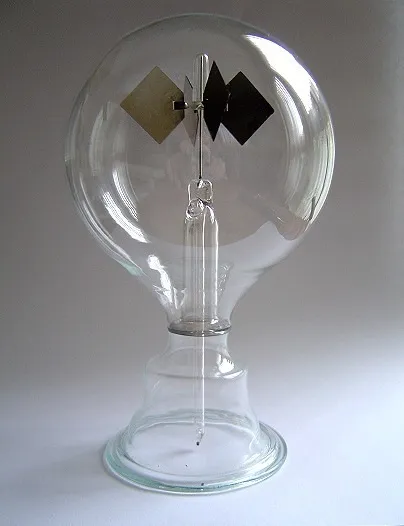
A Crookes radiometer turns under illumination. Unequal heating of dark and light surfaces interacts with the small amount of gas left inside.
Article
A tiny rotor sits inside a glass bulb. Bright light makes it turn without an electrical connection. Each vane has a dark side and a light side. Called a Crookes radiometer, the device turns differences between illuminated surfaces into visible motion.
The dark surface absorbs more light and becomes warmer. Some air has been removed from the bulb, but gas remains inside. Molecules exchange energy differently near the warmer and cooler faces.
Gas moves between the warmer and cooler faces of the vanes. Flow and pressure differences near their edges are particularly important to rotation. Arizona State University explains this in terms of thermal transpiration, the movement of rarefied gas caused by a temperature difference. It is a different effect from the direct pressure of light on the vanes.
Removing all the gas would remove this mode of operation. A Crookes radiometer requires not only dark and light surfaces but also a small amount of gas and a low-friction pivot.
Move the glass bulb into bright light and the dark surfaces inside warm up. Light passing through the sealed glass sets the gas in motion, and the resulting forces turn the small vanes.
Sources and editorial notes
www.arborsci.com · 크룩스 복사계 자료 2
Editorial note: Facts were checked against the linked sources. Interpretations are MUADAILY’s editorial perspective. Image: Timeline · CC BY-SA 3.0 · A Crookes radiometer with dark and light vane surfaces.
Machine-translated from Korean. Read the original.