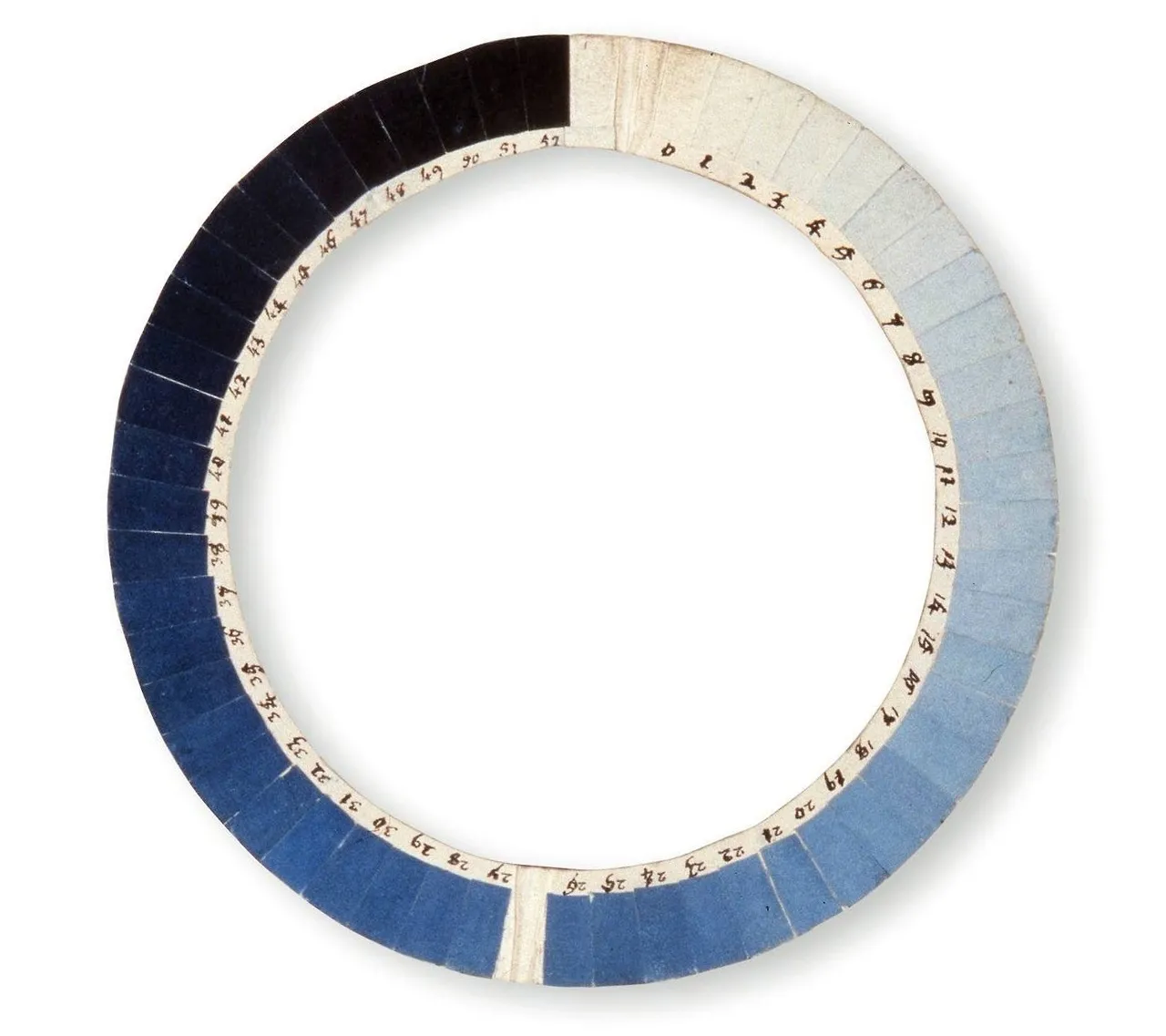
Saussure’s cyanometer compared the sky with graded blues. It offered a way to record and compare colours observed at different altitudes.
Article
It is easy to say the sky is blue. Saying how much bluer it is than yesterday, or how it differs between a mountain’s base and summit, is harder. Eighteenth-century naturalist Horace-Bénédict de Saussure compared the sky with a series of blue shades. The device is called a cyanometer.
It works much like choosing a colour sample. Hold up a scale ranging from lighter to darker blues and select the closest match. Recording its number makes comparison with another location possible. A position on the scale replaces a long verbal description of the colour.
Saussure studied the atmosphere at different heights in the Alps. The Swiss National Museum describes an observation in 1788 with Saussure at the Col du Géant, his son Nicolas Théodore in Chamonix, and his colleague Jean Senebier in Geneva. The three measured the colour of the sky simultaneously at different altitudes.
Visual colour selection is affected by conditions. The direction of observation, the Sun’s position and clouds all influence the apparent blue. A cyanometer did not automatically analyse wavelengths; it helped a person place an observed colour on a common scale.
Before a photograph could be sent instantly, an observer looked at the sky and wrote down a number. Someone receiving that record could open the same scale and find the blue that had been selected.
Sources and editorial notes
blog.nationalmuseum.ch · 하늘 파랑을 재는 시아노미터 자료 1
Image source · Musée d’histoire des sciences, Geneva / Horace-Bénédict de Saussure
Editorial note: Facts were checked against the linked sources. Interpretations are MUADAILY’s editorial perspective. Image: Musée d’histoire des sciences, Geneva / Horace-Bénédict de Saussure · CC BY-SA 4.0 · Saussure’s 1788 cyanometer colour scale, Museum of the History of Science, Geneva.
Machine-translated from Korean. Read the original.