MIT’s flapping robot carried sensors and computing hardware, while still receiving power from outside.
Article
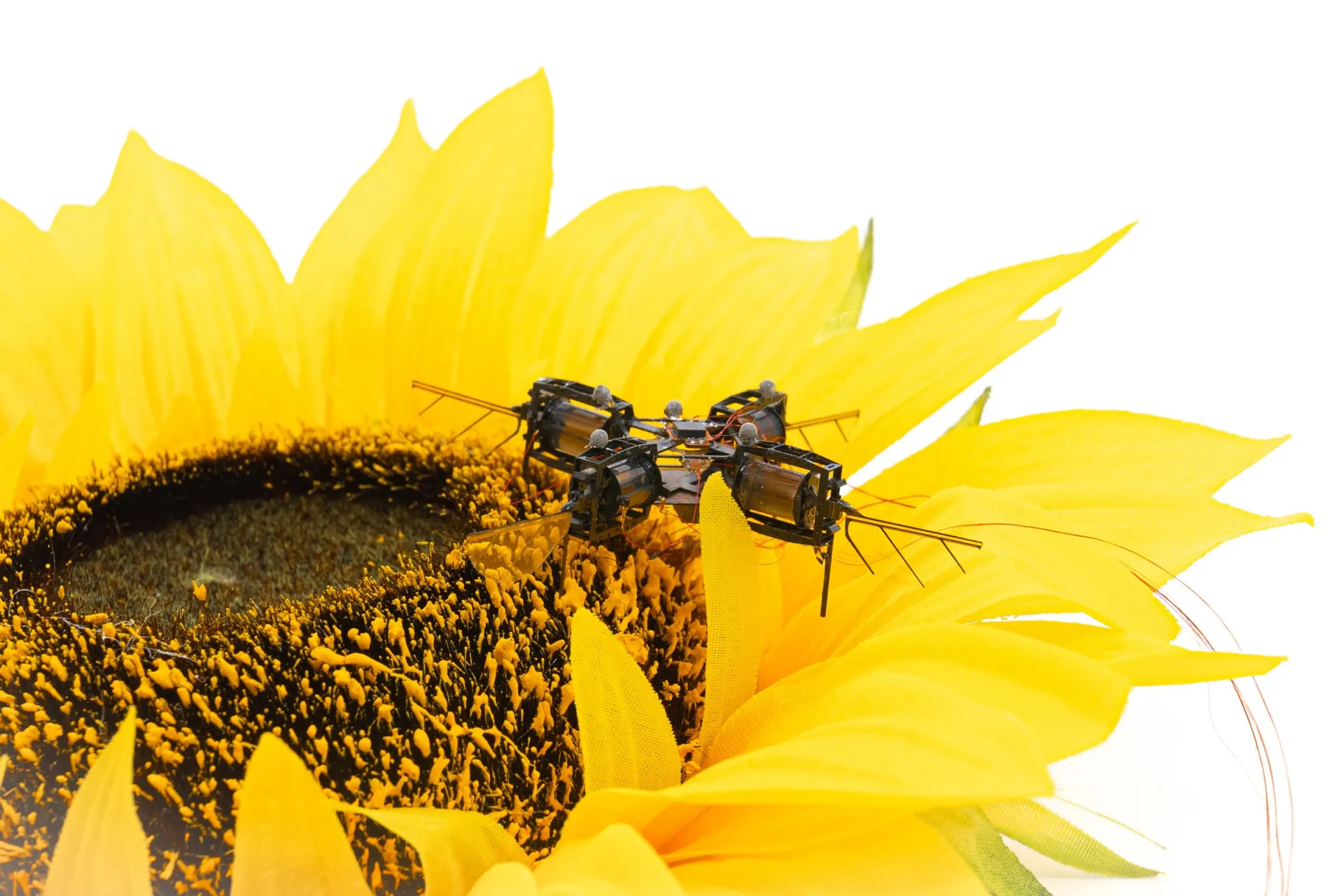
A small flapping robot lands on a sunflower. The robot introduced by MIT on November 18, 2026 flew with sensors and computing hardware onboard. It estimated its position and orientation without relying on the lab’s external motion-capture system. [1]
Previously, equipment surrounding such robots helped track their movement. Leaving that setup requires carrying electronics, but every added component burdens a very small flying machine. [1]
The team’s electronics package weighs 244 milligrams. Carrying it required work on the artificial muscles driving the wings and on packaging the components. Adding computation also meant revisiting lift and weight. [1]
Power for flight still comes through an external tether. The equipment moved onboard handles sensing and computation for position and orientation. The robot that landed on the sunflower also remained connected to that power supply. [1]
The researchers are considering future uses such as pollination and crop monitoring. Power supply remains a problem to solve on the way to those applications. In this experiment, the small aircraft flew while carrying its own sensing and computing equipment.
Sources and editorial notes
[2] Image licence · CC BY-NC-ND 3.0
Editorial note: Facts were checked against the linked sources. Interpretations are MUADAILY’s editorial perspective. Image: Courtesy of the researchers / MIT News · CC BY-NC-ND 3.0 · MIT’s small flapping robot with onboard sensors and computing rests on a sunflower. The experiment uses an external power tether. · Resized proportionally and converted to JPEG.
Machine-translated from Korean. Read the original.