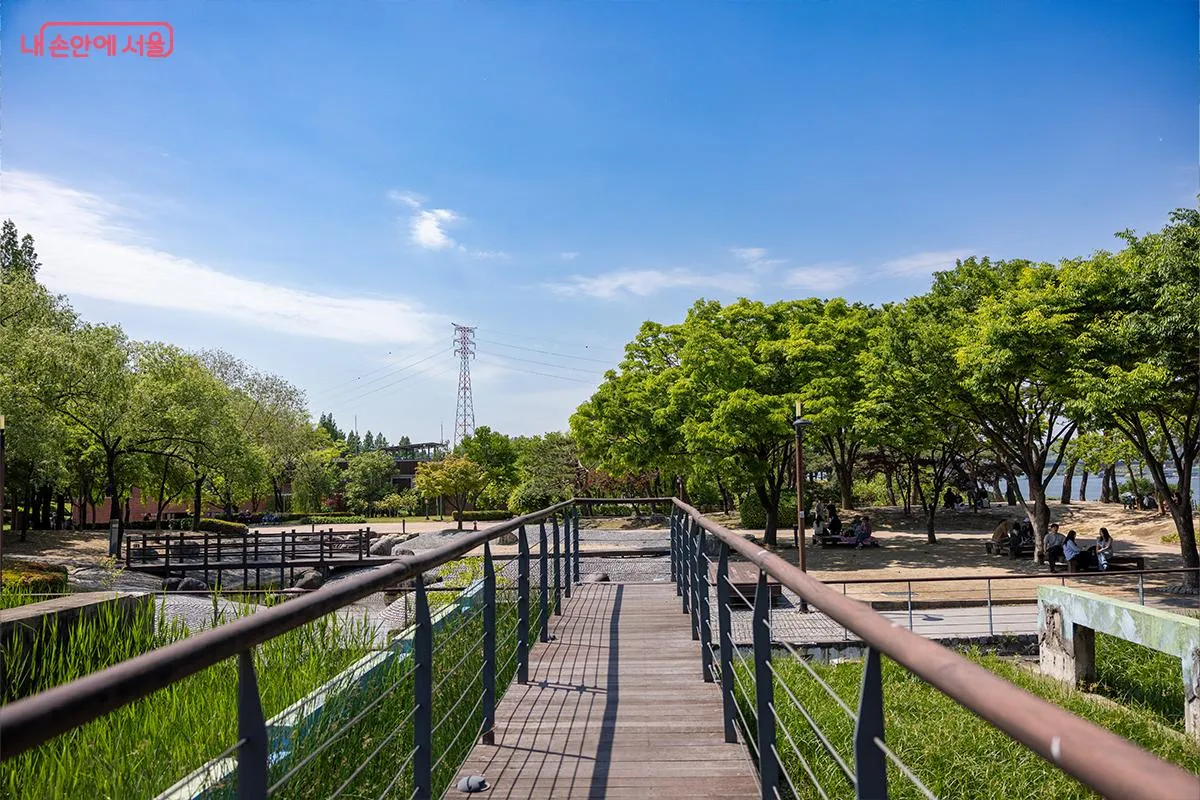
Seonyudo Park retains columns and tanks from an old water-treatment plant, adapting them into gardens and resting places. The route once followed by water still shapes the walk.
Article
A roofless room stands among ivy-covered columns. In Seoul's Seonyudo Park, the garden can briefly look like a building left unfinished or partly demolished. The columns were not newly added as decoration. They remained after the concrete roof slab of a water-treatment structure was removed, opening a former reservoir to sky and plants.
From 1978 to 2000, Seonyudo treated water drawn from the Han River. The park opened in 2002 after the plant closed. A team including landscape architect Jeong Young-seon and architect Cho Seong-ryong did not clear the site and begin with empty land. Spaces once used for settling, filtering, and moving water became the basis for paths and gardens.
In the Garden of Green Pillars, columns from the former treated-water reservoir stand in rows. Light and rain enter where the roof once lay, and plants climb around the supports. Structural elements that held up an interior now set the height and spacing of an outdoor garden. Their arrangement suggests the extent of the former concrete enclosure.
Water and plants still occupy the old tanks. The water-purification garden and aquatic-plant garden let visitors observe plants and water together rather than producing a supply for homes. The sunken Garden of Time retains traces of the settling basin's walls and channels. Looking down from above and then descending the steps changes the view within the park.
Circular structures once used to process treatment residue have found other uses. Sludge-thickening and regulating tanks became an amphitheater and spaces for play and learning. Rectangular basins and round tanks retain different outlines. Places once divided by the treatment process now offer people distinct areas to enter and stay.
Plants and old structures remain visible together, neither entirely concealing the other. Leaves climbing a wall reveal the edge of a former tank, and rows of columns shelter places to sit. Water treatment has ended at Seonyudo, but the shape of its working spaces remains. Walking and resting now occupy places once used to hold water.
Sources and editorial notes
Seoul City in My Hands / Citizen Reporter Jang Shin-ja's 2026-05-15 on-site coverage
Seoul City in My Hands Photos and field records by facility in 2020 by citizen reporter Yang In-eok
Seoul City in My Hands · 2021 Green Pillars · Four Circular Spaces Description
Editorial note: Facts were checked against the sources above; interpretations reflect MUADAILY’s editorial perspective. Photo: Jang Shin-ja / Seoul City Seoul in my hands.
Machine-translated from Korean. Read the original.