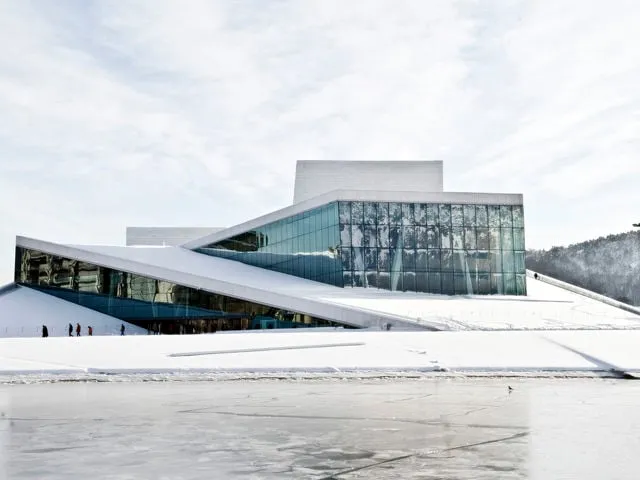
The sloping roof of Oslo Opera House is somewhere people can walk. Snøhetta’s design makes a route through the city part of a performance venue.
Article
An opera house usually brings to mind checking performance times and booking tickets. Oslo’s offers another way to encounter the building. A white roof rises from the waterfront, and people walk across it to look around. Outside the venue, the paths of audience members and city walkers overlap. The roof is more than a surface to admire from a distance.
Designed by Snøhetta, the opera house opened in 2008. Its official introduction highlights the form sloping towards the water and the accessible roof. Pale stone across the roof and plaza connects the building to its waterfront setting. The continuous-looking slope is also a surface people actually walk on: appearance and use meet underfoot.
Moving up the roof becomes a way to see the surrounding city. Instead of finding one position before an impressive façade, a walker sees water and buildings from changing angles. The experience differs from arriving at a high observation deck: it begins low and follows the slope. The building itself provides a place from which to look at it and its surroundings.
The open exterior does not make every interior space public. Auditoriums, stages and production areas have their own access and operating conditions. Inside, curved timber creates a different atmosphere from the pale exterior stone. A public outdoor route and focused performance spaces belong to the same building without offering the same experience.
Using a roof as a walking space also depends on weather and management. Visitors need to follow current access information and instructions on site; snow in a photograph is not permission to walk everywhere in similar conditions. Openness and practical operation belong together. This account draws on official architectural information rather than a personal site visit.
The opera house need not matter only to people attending performances. Before a show begins, or on a day without a ticket, there is still a reason to approach it. Performances unfold inside while everyday journeys pass across the roof. Its relationship with the city extends beyond the entrance and the seats.
Sources and editorial notes
Norwegian National Opera & Ballet · Introduction to the opera house architecture
Editorial note: Facts were checked against the sources above; interpretations reflect MUADAILY’s editorial perspective. Image: Erik Berg / Norwegian National Opera & Ballet.
Machine-translated from Korean. Read the original.