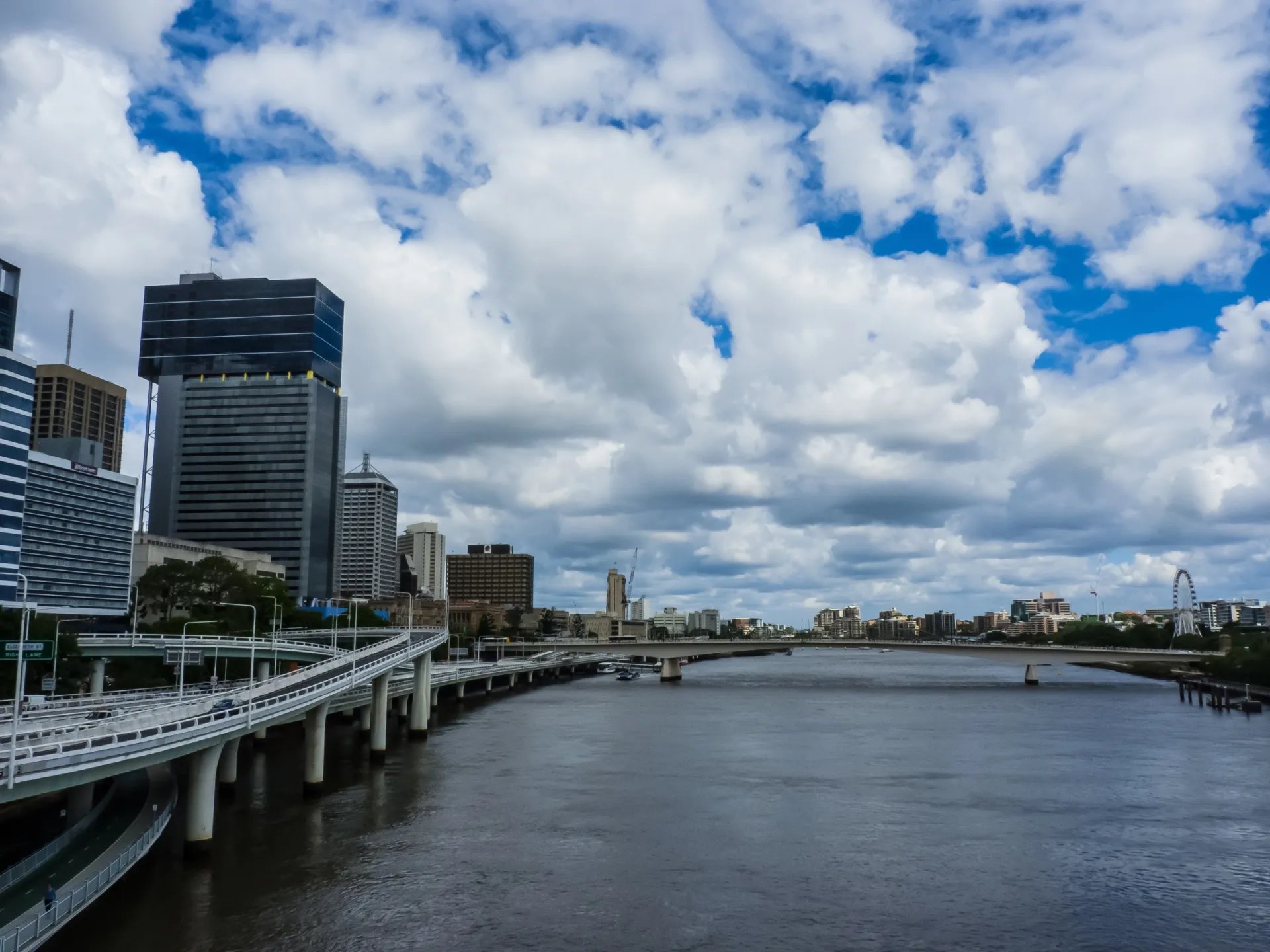
A pedestrian and cycle bridge over the Brisbane River uses inclined masts and tensioned cables to share structural forces.
Article
Kurilpa Bridge over the Brisbane River looks like an arrangement of rods and cables crossing one another. Instead of a neat set of stays descending from two large towers, masts of different heights lean in several directions. Horizontal spars appear to float between them. Below runs the path for pedestrians and cyclists.
Opened in 2009, the bridge links central Brisbane with the cultural precinct across the river. Engineers Arup, architects Cox Rayner and contractor Baulderstone worked together on it. The route had to leave clearance for river traffic and cross a major road before joining the city’s pedestrian network.
Arup describes its use of tensegrity principles: tensioned cables and compressed members interact to support the structure. The visible lines and rods are not simply scattered decoration. Cable tension restrains the members, which resist compression and maintain their positions within the system.
The whole bridge is not made solely of disconnected rods suspended by strings. The deck, its supporting structure, masts and cables work together. Arup’s technical account describes adjusting member forces and controlling geometry during construction. The seemingly loose arrangement required calculated positions and forces.
A canopy provides shade over the walkway. From a pedestrian’s level, cables and spars pass overhead at different angles. The lines overlap differently when seen from the riverbank and from the bridge deck.
Sources and editorial notes
Image source · John Robert McPherson
Editorial note: Facts were checked against the linked material. Interpretations are MUADAILY’s editorial perspective. Image: John Robert McPherson · CC0 · Kurilpa Bridge over the Brisbane River.
Machine-translated from Korean. Read the original.