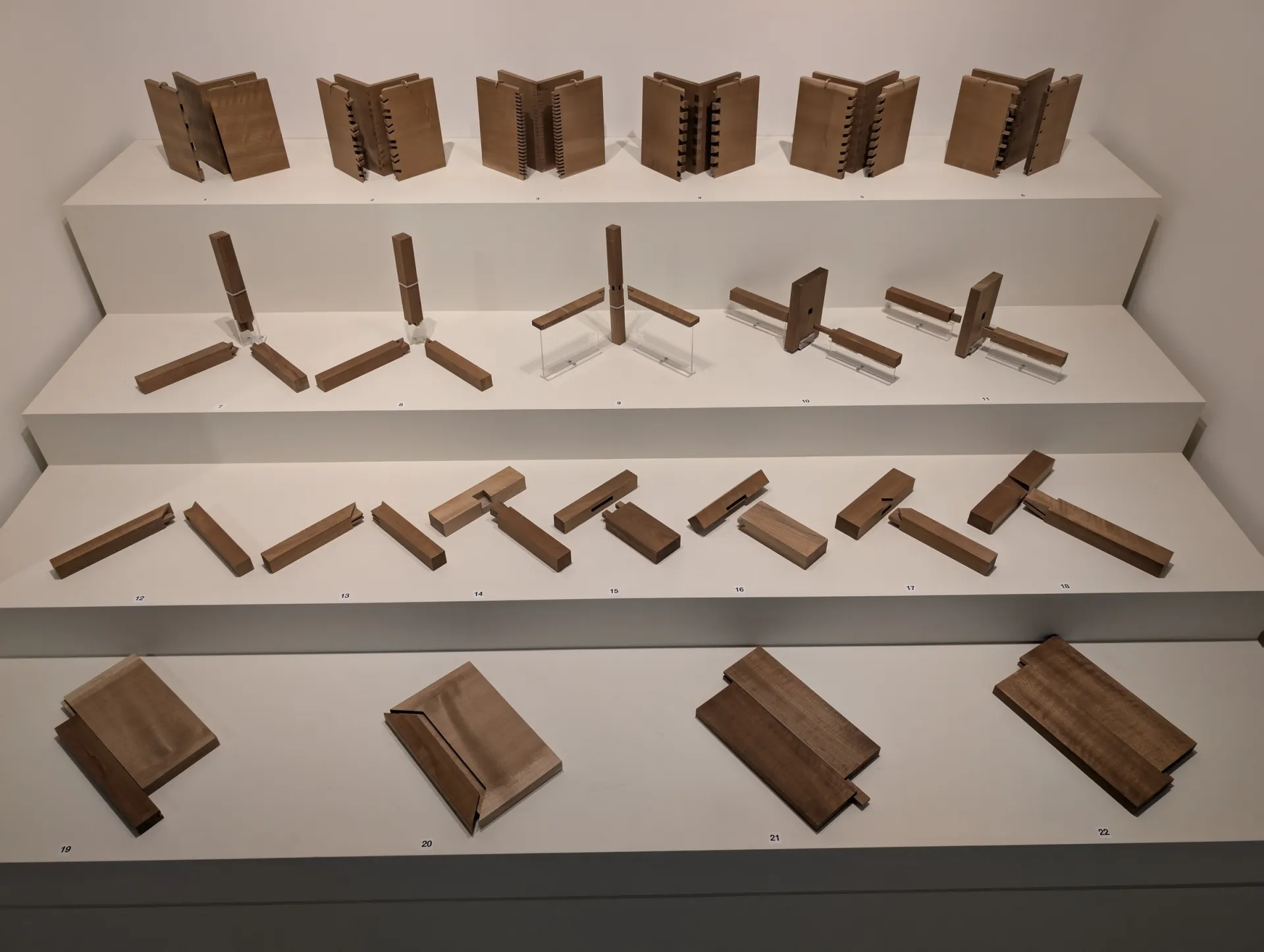
Japanese joinery cuts timber so its parts interlock. Recesses and projecting shoulders remain hidden inside the completed connection.
Article
Two pieces of timber meet without a visible nail head. Separate the joint and one reveals a projection while the other has a recess to receive it. Kigumi refers to Japanese woodworking techniques that shape timber precisely so the components interlock.
Members joined end to end need different connections from those meeting at a right angle. Pieces that look like identical square posts can contain very different cuts. The direction of movement and the forces acting on the timber influence the placement of recesses and shoulders.
Interlocking shapes also determine assembly order. A piece may enter from one direction while resisting movement in another, or a later member may secure one inserted earlier. The finished joint can conceal which piece went in first.
An exhibition developed with the Takenaka Carpentry Tools Museum and Japan House presented such structures through hands-on assembly models. Its 2025 London presentation covered temple and shrine carpentry, teahouse construction and kigumi. A full-scale teahouse and more than eighty tools showed the preparation involved before timber could be joined.
Even a joint assembled without nails has a direction and an order of assembly. Beneath the close-fitting surfaces are the recesses cut away and the projections left in place so the two pieces can interlock.
Sources and editorial notes
www.japanhouselondon.uk · 나무를 맞추는 기구미 자료 1
www.japanhouselondon.uk · 나무를 맞추는 기구미 자료 2
Editorial note: Facts were checked against the linked sources. Interpretations are MUADAILY’s editorial perspective. Image: Andy Li · CC0 · Sashimono joinery models displayed at Japan House London.
Machine-translated from Korean. Read the original.