Hydraulic mechanisms hidden in the railings turn Paddington’s 12-metre Rolling Bridge into a sculpture on one bank.
Article
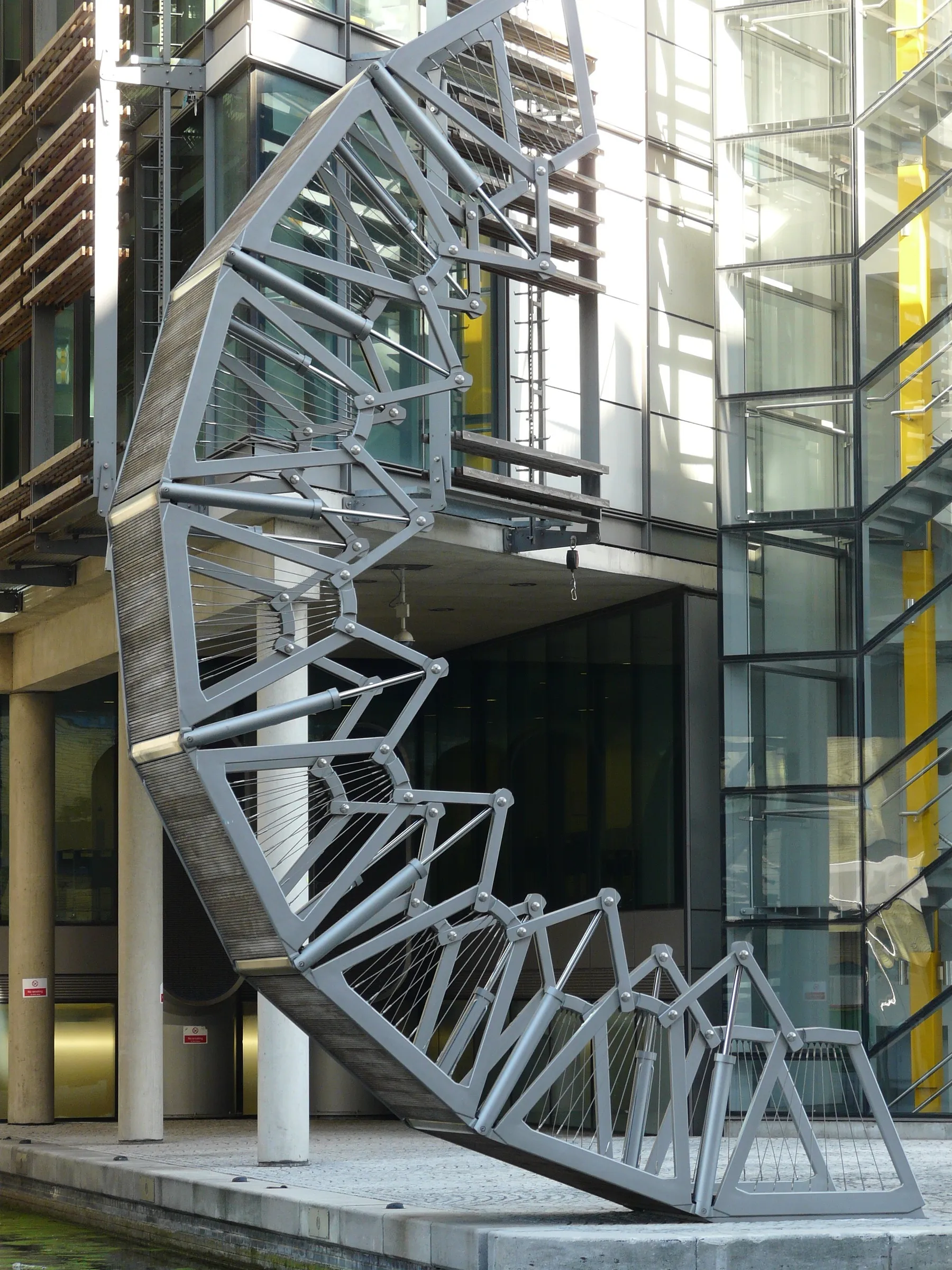
A path across a canal inlet slowly curls upwards. Its deck bends, the railings rise and the two ends meet. At London’s Paddington Basin, the Rolling Bridge folds onto one bank to clear a route for boats.
Designed by Heatherwick Studio and completed in 2004, the 12-metre bridge spans a small inlet off the main canal. Pedestrians needed a crossing that would not obstruct boats. Instead of splitting the bridge and raising its halves, the designers made the structure transform as a whole.
Hydraulic mechanisms supply the movement. Hidden inside what look like railing supports, they bend the bridge’s articulated sections. Once it is fully curled, no fragment remains on the opposite bank. The structure stays attached to one side while changing its shape.
The designers took inspiration from the flexible tails of the animatronic dinosaurs in Jurassic Park. Rigid materials can produce a flowing curve when joints and movement are coordinated. The studio explains that it chose conventional materials to focus attention on the opening sequence rather than an unusual appearance at rest.
Curled up, the bridge resembles a small waterside sculpture. When the hydraulics reverse, the circle unfolds and its sections line up horizontally again. A walkable deck returns across the water.
Sources and editorial notes
heatherwick.com · 패딩턴 롤링 브리지 자료 1
Image use terms · CC BY-SA 2.0
Editorial note: Facts were checked against the linked sources. Interpretations are MUADAILY’s editorial perspective. Image: Loz Pycock · CC BY-SA 2.0 · The Rolling Bridge curling onto one side of its inlet.
Machine-translated from Korean. Read the original.