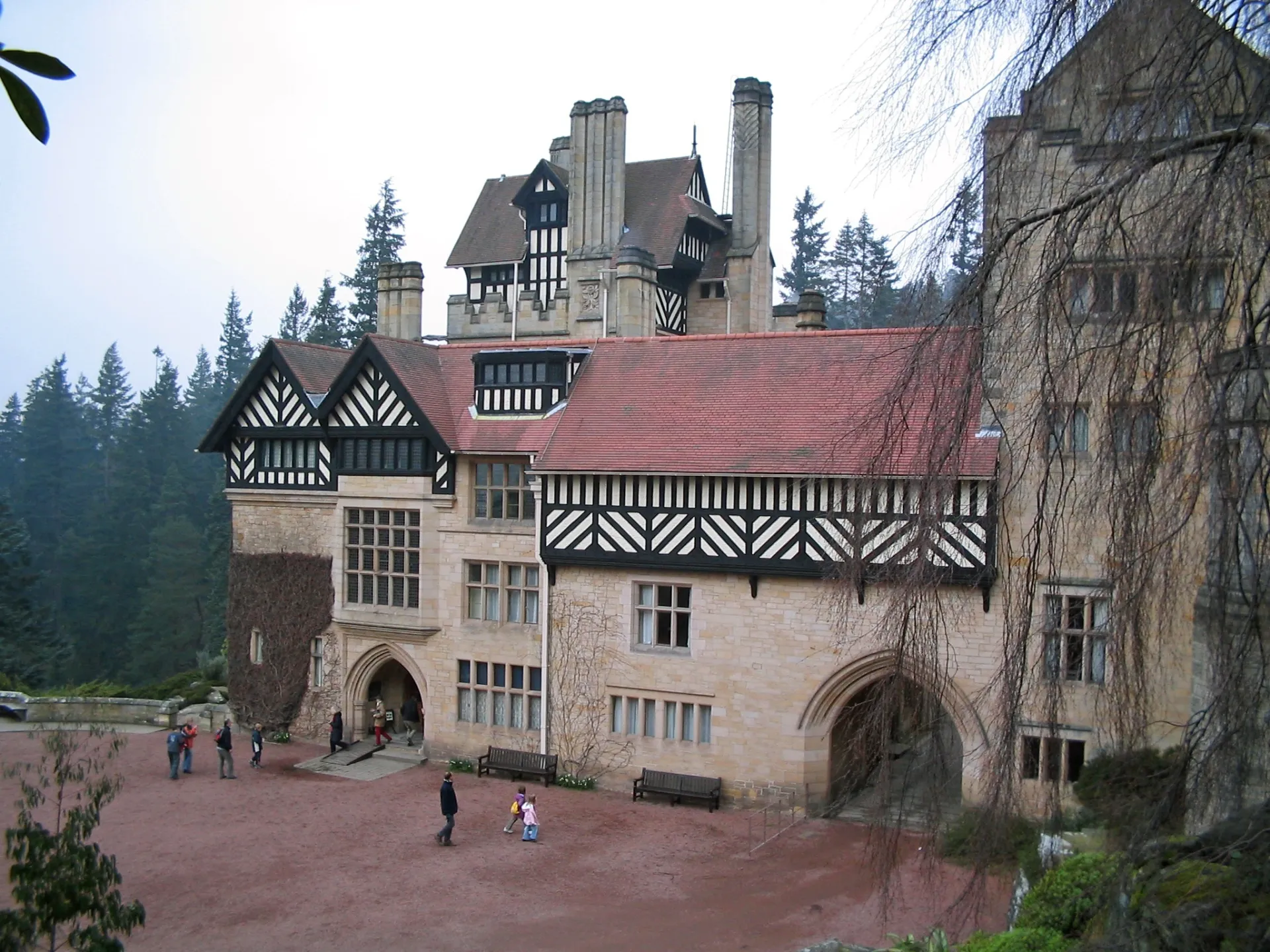
Water collected around this Victorian house powered its lamps and domestic machinery. Five reservoirs and their waterways supplied the equipment.
Article
At Cragside, a large house in the woods of Northumberland, collected water powered the lights. The lamps inside were connected to reservoirs, waterways and generating equipment outside.
Its owner, engineer and inventor William Armstrong, began building and extending the house in the 1860s. He brought water power into domestic work, damming small streams to create five reservoirs that supplied his equipment.
Water also helped with household work. Water pressure turned a roasting spit and operated lifting equipment, while water-driven generators produced electricity for the lamps. Traces of these systems remain at Cragside.
Carbon-arc lamps were installed in the gallery in 1878. In 1880, collaboration with Joseph Swan brought incandescent bulbs to the library. Light produced between carbon rods was followed by light from a filament inside a glass bulb. The National Trust describes Cragside as the first house lit by hydroelectricity.
An Archimedes screw generator was installed in 2014, renewing the use of water power. Following the waterways and generating equipment adds another dimension to the furnished rooms: the outdoor infrastructure needed to switch on their lights.
Sources and editorial notes
www.nationaltrust.org.uk · 크래그사이드 수력 전등 자료 1
www.northeastmuseums.org.uk · 크래그사이드 수력 전등 자료 2
Image source · Glen Bowman from Newcastle, England
Editorial note: Facts were checked against the linked sources. Interpretations are MUADAILY’s editorial perspective. Image: Glen Bowman from Newcastle, England · CC BY 2.0 · Cragside house in Northumberland.
Machine-translated from Korean. Read the original.