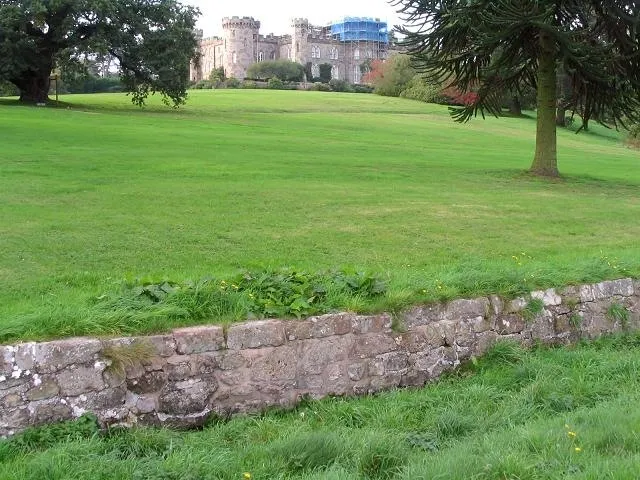
A ha-ha’s boundary comes into view as you approach. Its wall and ditch keep grazing animals out of the garden while leaving the distant landscape visible.
Article
The lawn before a country house seems to continue into distant fields. Walk closer and a sunken ditch and stone wall come into view. A ha-ha creates a boundary by digging down instead of building a fence across the view.
It combines a dry ditch with a retaining wall. On the garden side, the vertical wall reaches the surrounding turf; the opposite side slopes back up. Seen from the house, the wall’s top sits close to lawn level, leaving the distant view open.
One purpose was to keep grazing animals out of the garden. Grass might appear continuous, but a change of level stood in the animals’ path. A person’s gaze could cross the boundary while livestock could not.
The device became common in eighteenth-century landscaping and was described in a French gardening book in 1709. Its name is traditionally linked to the exclamation of surprise on discovering the concealed ditch. The National Trust presents examples at Stowe, Kingston Lacy and other gardens.
From a distance the grass appears connected; at the edge, the depth of the barrier becomes visible.
Sources and editorial notes
www.nationaltrust.org.uk · 하하 정원 담 자료 1
Image use terms · CC BY-SA 2.0
Editorial note: Facts were checked against the linked sources. Interpretations are MUADAILY’s editorial perspective. Image: Peter Craine · CC BY-SA 2.0 · Ha-ha ditch and wall at Cholmondeley Castle, England.
Machine-translated from Korean. Read the original.