Developed by Turing, Welchman and others, the Bombe tested for contradictions. Its surviving candidates still required human checking.
Article
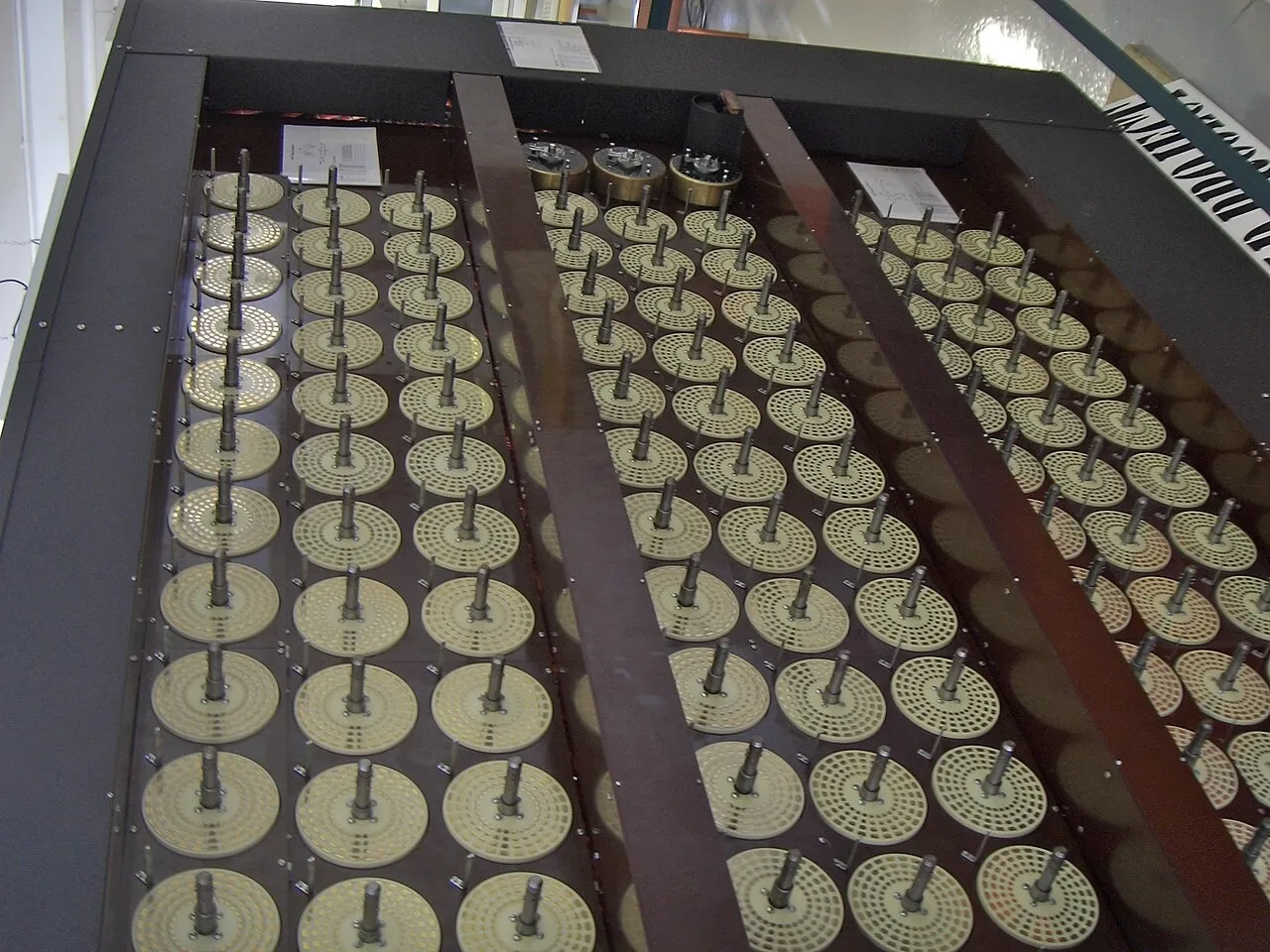
Rows of drums rotate on a large machine. It may resemble a device that accepts ciphertext and prints a message, but the wartime Bombe did something different. It rapidly rejected contradictory settings, narrowing the possibilities for further examination.
Alan Turing, Gordon Welchman and others contributed to the British Bombe, building in part on earlier Polish work on Enigma. Developing a method, turning it into machinery and checking results involved many people. Today’s museum reconstruction demonstrates the mechanical part of that work.
Codebreakers used a crib: a conjecture about words that might appear in a message. They linked relationships between the presumed plaintext and ciphertext and tested possible machine settings. Conflicting conditions allowed a candidate to be rejected.
A stop did not automatically produce a correct sentence. The indicated setting still needed checks to determine whether it could support decryption. Mechanized elimination and interpretation of the result were distinct parts of the work.
The National Museum of Computing’s reconstruction shows rows of drums testing candidate settings. Contradictory settings are passed over; a stop leaves one for people to examine further. Each cycle of turning and stopping reduced the possibilities and led to the codebreakers’ next task.
Sources and editorial notes
The National Museum of Computing · Bombe
The National Museum of Computing · Turing and Welchman
Image source · Photograph by Mike Peel (www.mikepeel.net).
Image use terms · CC BY-SA 4.0
Editorial note: Facts were checked against the linked material. Interpretations are MUADAILY’s editorial perspective. Image: Photograph by Mike Peel (www.mikepeel.net). · CC BY-SA 4.0 · Reconstructed British Bombe at Bletchley Park.
Machine-translated from Korean. Read the original.