Perforated paper and air pressure operate a real piano. Beneath the moving keys, a person supplies power and controls the performance.
Article
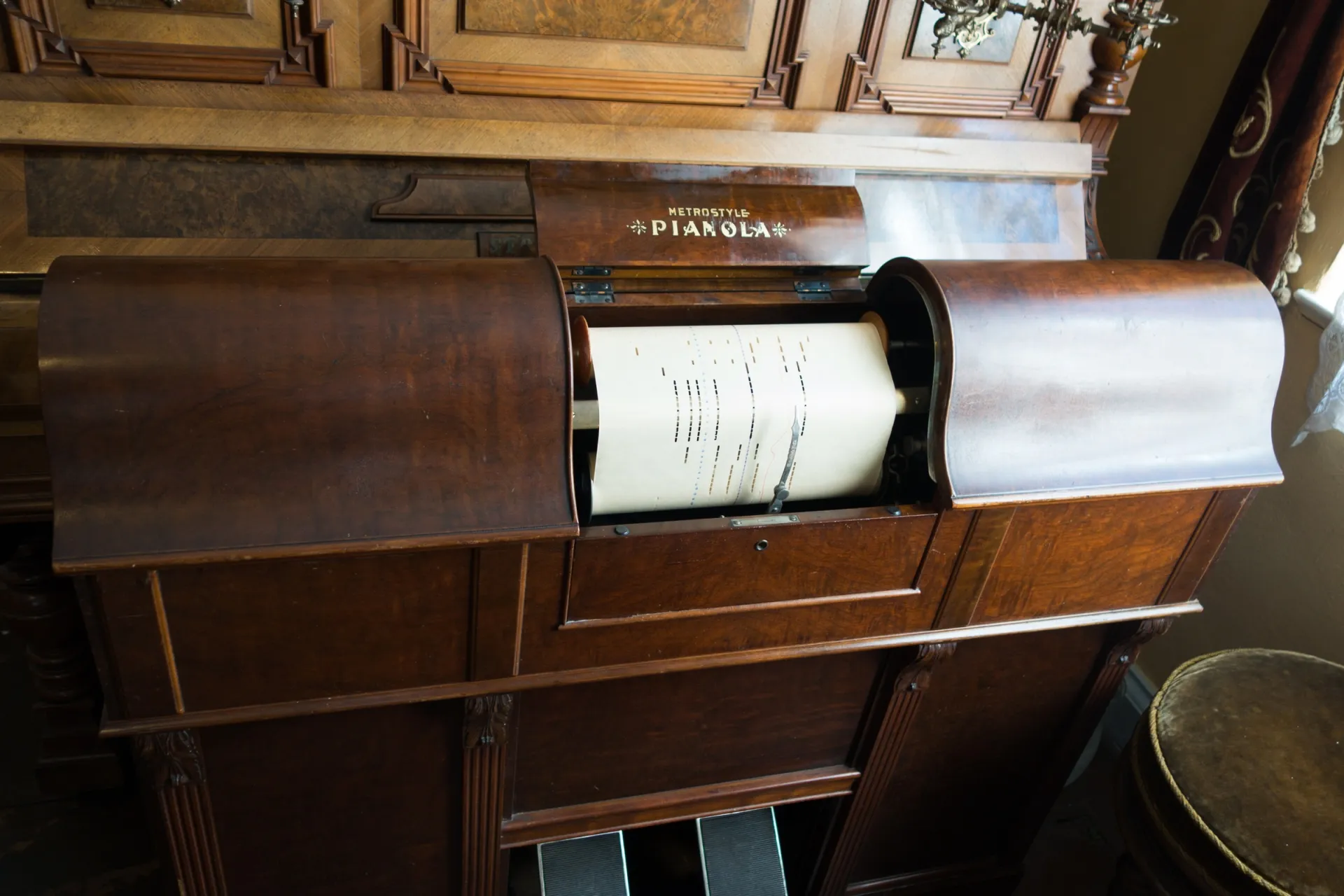
Someone sits at a piano with neither hand on the keys. As their feet pump the pedals, a paper roll turns inside and the keys move in sequence. Player pianos, including the Pianola, read perforations to determine which notes to play and when. They do not reproduce a piano recording through a loudspeaker: they sound the instrument in front of the player.
The paper passes over a metal tracker bar containing a row of small openings. When a perforation in the paper uncovers one of these openings, air enters and activates the mechanism inside. A hammer strikes the corresponding string. The difference between covered and uncovered openings provides the signal to play or release a note.
On a traditional foot-operated instrument, the player supplies the pumping action. Pedalling creates reduced pressure inside, and changes in airflow operate small bellows. The roll carries the sequence of the music, but the player’s feet provide the power.
There is more to do than keep pedalling. The North West Player Piano Association explains that pumping harder produces louder playing, while gentler pumping produces softer playing. On an ordinary pianola, the performer also controls the speed of the roll. Volume and tempo choices can change a performance even when the same roll is used.
Reproducing pianos and specially encoded rolls were also developed to store expression information such as dynamics. Not every piano roll contains the same kinds of performance data. On an ordinary pianola, pedals and speed controls let the performer handle the parts of the performance not assigned to the paper.
Sources and editorial notes
www.pianola.org.uk · 피아놀라 종이롤 자료 2
Editorial note: Facts were checked against the linked material. Interpretations are MUADAILY’s editorial perspective. Image: Thomas Quine · CC BY 2.0 · Perforated paper roll inside a pianola.
Machine-translated from Korean. Read the original.